 Story and photos by Ted Waddell
There’s a little bit of “Woodstock” in everybody.
In honor of the 40th Anniversary of the 1969 Aquarian Exposition, known around globe as Woodstock, local award-winning author Rilla Askew penned “By the Time We Got to Woodstock,” an original world that was unveiled during a world premier at the Liberty Free Theatre, August 20-23, as a staged reading in the First Hearings Series.
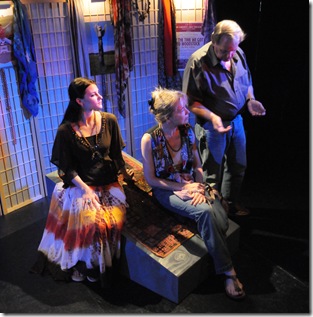
The reading starred Dana Priebe as Faythe, Richard Traviss as Ramon, and in the role of Aradhna, television and film actress Karen Young of “The Sopranos” fame.
The play started out a couple of years ago as a short story titled “Something Turning”, and as it was hammered out into a script for the stage, the central story line remained true to its roots, as it delved into real human stories of grief, loss and hope, emotions that reflect in the eyes and hearts of several generations that find themselves drawn to the Woodstock Memorial, called by some local folks, “the tomb of the unknown hippie,” albeit on the surface for different reasons, callings in the end that are essentially the same and resonant with a shared heartbeat. A convergence of journeys and emotions. All real, all from the soul.
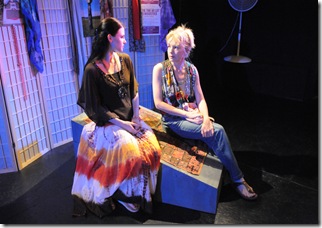 In the final scene of Sunday’s matinee, Young as Aradhna “a middle-aged woman in blue jeans” reaches across the concrete slab to grasp the hand of the young girl, in a symbolic gesture spanning three generations and time, a movement that sparked tears in the eyes of several audience members.
The performances packed the house, as all four shows were sold out.
“Even as I was writing it, I visualized it as a play,” said Askew. “It’s about a woman who goes to the site to offer a remembrance to a friend of hers who’s gone, a friend who loved that site.”
It took Askew 20-some years to finally get to Woodstock, even though as a teenager living in Bartlesville, Oklahoma, she ran away from home, planning on hitching to White Lake with a friend passing through town, hitching from California.
“When I was a girl, I ran away from home because of Woodstock in the
summer of ‘69,” she recalled. “I remember being stuck in this little town, looking up at the moon and thinking ‘I’ve got to get out of here!’ The world was happening on two coasts, New York and California, it wasn’t happening in my little old town of Bartlesville.”
In 1990, Askew and her husband Paul Austin –founder of the Liberty Free Theatre – moved to nearby Kauneonga Lake, and the first folks they met were the Vasmers, a family who played key roles in the original music and art festival 40 years ago.
“Hold on to a dream for twenty years, and you’ll find a different Woodstock,” said Askew, the recent recipient of an Academy Award from the American Academy of Arts and Letters in NYC for the body of her work. “It’s mythic…it’s emblematic of that generation.”
Brought up on jazz, Austin was staging a production of “Mother Courage” up in Vermont back in 1969, so he never made it to the famed festival. His take on the era that saw men set foot on the moon, Woodstock, a war in full and bloody bloom half a world away, and the unchecked emergence of civil rights and gay activism.
 “There was a real sense of abandon to having a really good time, a real bust out from all the constraints of the conventionally understood ways of living, and the spirit of that time is part of our time.”
In a pre-show radio interview about “By the Time We Got to Woodstock”, Austin and Askew were interviewed over the airwaves of WJFF Public Radio, and Austin was asked by the host to describe the difference between a play and a fictional novel.
“The rhythm of behavior, the reflective behavior is different, the thought process of a character comes out in the tonality of the dialogue, [where as] in fiction, you can actually write out the thought process, while in a well-written play, the dialogue is carrying the thought process.”
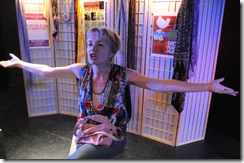
As the play neared its final scene, Aradhna sat on the slab, and flinging her arms wide to the heavens, sang “We are star-dust! We are golden! We are billion year-old carbon! I Hate that goddamn song. No peace! No way to undo. No way to do what we didn’t get done,” and then returns to a ladder, closes it and with the help of Ramon and Faythe, eases it down to the ground, and “By the Time We Got to Woodstock” fades to black.
To view more photos or to purchase prints from Woodstock Emotions and Reflections visit the Chronicle on Zenfolio.
Click any service in this box to share this post with your friends!
Related








 The Catskill Chronicle
Woodstock Emotions and Reflections
August 26, 2009 by The Catskill Chronicle
There’s a little bit of “Woodstock” in everybody.
In honor of the 40th Anniversary of the 1969 Aquarian Exposition, known around globe as Woodstock, local award-winning author Rilla Askew penned “By the Time We Got to Woodstock,” an original world that was unveiled during a world premier at the Liberty Free Theatre, August 20-23, as a staged reading in the First Hearings Series.
The reading starred Dana Priebe as Faythe, Richard Traviss as Ramon, and in the role of Aradhna, television and film actress Karen Young of “The Sopranos” fame.
The play started out a couple of years ago as a short story titled “Something Turning”, and as it was hammered out into a script for the stage, the central story line remained true to its roots, as it delved into real human stories of grief, loss and hope, emotions that reflect in the eyes and hearts of several generations that find themselves drawn to the Woodstock Memorial, called by some local folks, “the tomb of the unknown hippie,” albeit on the surface for different reasons, callings in the end that are essentially the same and resonant with a shared heartbeat. A convergence of journeys and emotions. All real, all from the soul.
The performances packed the house, as all four shows were sold out.
“Even as I was writing it, I visualized it as a play,” said Askew. “It’s about a woman who goes to the site to offer a remembrance to a friend of hers who’s gone, a friend who loved that site.”
It took Askew 20-some years to finally get to Woodstock, even though as a teenager living in Bartlesville, Oklahoma, she ran away from home, planning on hitching to White Lake with a friend passing through town, hitching from California.
“When I was a girl, I ran away from home because of Woodstock in the
summer of ‘69,” she recalled. “I remember being stuck in this little town, looking up at the moon and thinking ‘I’ve got to get out of here!’ The world was happening on two coasts, New York and California, it wasn’t happening in my little old town of Bartlesville.”
In 1990, Askew and her husband Paul Austin –founder of the Liberty Free Theatre – moved to nearby Kauneonga Lake, and the first folks they met were the Vasmers, a family who played key roles in the original music and art festival 40 years ago.
“Hold on to a dream for twenty years, and you’ll find a different Woodstock,” said Askew, the recent recipient of an Academy Award from the American Academy of Arts and Letters in NYC for the body of her work. “It’s mythic…it’s emblematic of that generation.”
Brought up on jazz, Austin was staging a production of “Mother Courage” up in Vermont back in 1969, so he never made it to the famed festival. His take on the era that saw men set foot on the moon, Woodstock, a war in full and bloody bloom half a world away, and the unchecked emergence of civil rights and gay activism.
In a pre-show radio interview about “By the Time We Got to Woodstock”, Austin and Askew were interviewed over the airwaves of WJFF Public Radio, and Austin was asked by the host to describe the difference between a play and a fictional novel.
“The rhythm of behavior, the reflective behavior is different, the thought process of a character comes out in the tonality of the dialogue, [where as] in fiction, you can actually write out the thought process, while in a well-written play, the dialogue is carrying the thought process.”
As the play neared its final scene, Aradhna sat on the slab, and flinging her arms wide to the heavens, sang “We are star-dust! We are golden! We are billion year-old carbon! I Hate that goddamn song. No peace! No way to undo. No way to do what we didn’t get done,” and then returns to a ladder, closes it and with the help of Ramon and Faythe, eases it down to the ground, and “By the Time We Got to Woodstock” fades to black.
To view more photos or to purchase prints from Woodstock Emotions and Reflections visit the Chronicle on Zenfolio.
Click any service in this box to share this post with your friends!
Related
Posted in Comments | Leave a Comment
Comments RSS