Story By Paul Smart – Phoenicia Times – originally published 10/8/09 – reprinted with permission of the publisher – Brian Powers / Photos added by Leni Santoro
ALBANY- 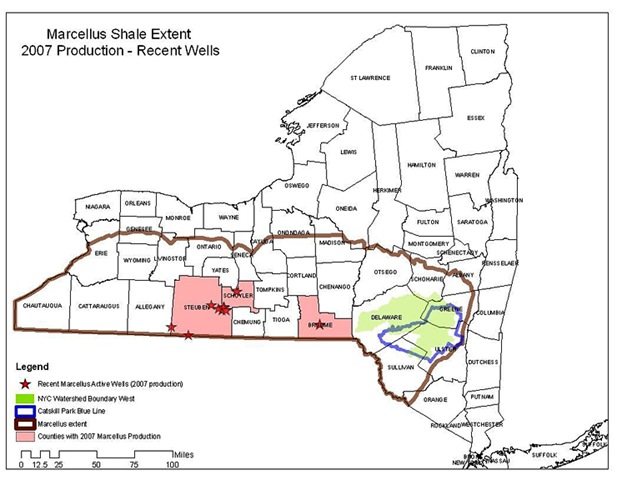 The state Department of Environmental Conservation has finally released its first draft of an environmental impact statement that proposes new laws for natural gas drilling in New York’s Marcellus Shale after 18 months of study and several delays. State officials say the guidelines, which are 809 pages long and extremely detailed, address key concerns including the disclosure of fluids used in the drilling process known as hydraulic fracturing as well as the on-site handling of drilling waste.
The draft materials now face a 60-day public review period. There will be no public hearings where the public can make statements for the record.
Almost immediately, however, the DEIS’ release has generated heated debate, pitting local environmental organizations concerned that the state will not ban drilling inside the New York City watershed, or the Catskill Park, against state legislators from the region who say what’s been written may be the best we’ll get.
 At the same time, the Catskills’ most noted geologist, Dr. Robert Titus of Hartwick College, has said that as far as he can surmise, the Route 28 corridor, including Shandaken and Olive, is outside the effected area, and a more productive shale area under Utica to the north and west may end up rendering most of the concerns about the Marcellus moot, in the long run.
He did add, however, that citizens should report whenever they are approached by gas companies about drilling to this paper, and his office, anonymously if need be, so as to better chart where drilling companies are looking.
As for the main fact that the DEC’s proposed laws don’t seem intent on protecting the Catskill Mountain area that supplies drinking water to 9 million people, Manhattan Borough President Scott Stringer said in a news release following the DEIS release last week that, “The state’s mitigation proposals are half measures. I believe the choice is simple: we either correct this error and ban drilling now, or soon enough the officials entrusted with protecting our environment will be asked to explain why they were asleep at the switch when it mattered most.”
Sullivan County-based Catskill Mountainkeeper, meanwhile, noted that the Draft Supplemental Environmental Impact Study offered some limited protections concerning the New York City watershed and disclosure of chemicals being used, “But overall, this report clears the way for the commencement of large scale gas drilling in New York State in 2010 without adequate protection for the general public in the Catskill region, the New York City watershed, the Catskill Park and in other environmentally sensitive areas.”
 “Unless elected officials, the media and especially the public speak out powerfully and quickly the entire state of New York and our region, in particular, is going to be put at extreme and unnecessary levels of risk,” continued Ramsay Adams, Executive Director of Catskill Mountainkeeper. “In the last year and a half since the commencement of drilling, there have been an extraordinary number of reported accidents connected to gas drilling in nearby Pennsylvania. It is highly questionable whether local authorities will be prepared to handle the wide variety of responsibilities for monitoring and tracking accidents as well as preparing local police, firefighters and healthcare institutions to adequately respond to emergencies… The impending gas exploration and drilling is the single biggest industrial undertaking in the history of New York State.
Members of various fishing and other organizations throughout the area, meanwhile, started e-mailing about images and stories concerning massive fish kills in areas where the new gas drilling technology has been used around the county.
 By early this week, though, some defenders of the DEC were lining up. State Senator John Bonacic said on Monday that he supports the DEC’s “generic” environmental impact study, noting that “natural gas is our own backyard is something that should be extracted” and how drilling would boost local economic vitality.
“In life you can worry about everything, but you have to make intelligent, balanced judgments, and in my mind, we have done that,” he said. “We have strengthened DEC to impose these very strict regulations and at the same time, we are allowing the process to continue to enhance our domestic energy supply to become more independent of foreign oil.”
State Assemblyman Kevin Cahill, who head’s his legislative body’s powerful Energy Committee, sent out a press release the day after the DEIS’ release that said that tapping the Marcellus Shale formation for a short term natural gas supply would provide New York with the opportunity to develop a reliable indigenous fuel supply. “
We have to recognize that we are using natural gas, and even if it is a transitional fuel as we move toward energy independence in New York State, we will need to use natural gas,” he said. “Isn’t it better that we extract it responsibly from New York State and have it here at our doorstep than have it shipped across the country from places like Louisiana where its coming out of swamps with virtually no environmental regulations or coming out of places like West Virginia where their idea of how you get at a mineral is to blow the top off a mountain.”
Provisions in the proposed laws would make New York State’s environmental protections more stringent than those in many other drilling areas, the document’s supporters assure.
New York Gov. David Paterson the new study in July, 2008 after media investigations found that the DEC had told state legislators that hydraulic fracturing was safe, even though the agency had not studied or discussed the sometimes dangerous chemicals that it uses and that later wind up in its waste.
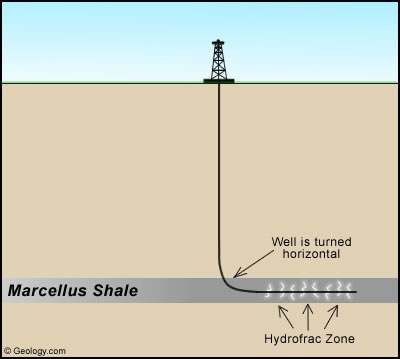 Hydraulic fracturing has made the Marcellus Shale and other difficult-to-reach deposits of gas accessible to drillers. The process shoots millions of gallons of water, sand and chemicals underground at high pressure to break up rock and release gas. According to some estimates being touted by those seeking permits for drilling, the Marcellus holds enough gas to meet the country’s natural gas needs for more than 20 years.
Geologist Bob Titus, however, wonders how far the Marcellus actually goes… and whether it reaches our area.
“The farther east you go, the more likely that the Marcellus has been metamorphosed (‘cooked’) during New England mountain building events. That drives the gas out of the shales,” he wrote in an e-mail this week. “Conventional logic states that very little exploration will occur in Ulster or Greene counties. The chances of good gas plays increase as you approach the Pennsylvanian border. Plays are likely to be pretty good as you pass through Schoharie, Delaware and Otsego counties. And people are very optimistic about the Utica Shale, which may have even more gas than the Marcellus. Most of it is north of the Mohawk River.”
Titus added, however, that the key now is to keep an eye on what gas drilling companies, which have been hitting major stalls due to chemical spills and other problems in nearby Pennsylvania, are up to.
Likewise, Catskill Mountainkeeper is urging people to read what they can of the proposed DEIS and make comments to the state however they can. “
Catskill Mountainkeeper does not believe that gas drilling should commence until it is proven that it can be done safely. The DEC report does not do enough to ensure that goal,” Adams said in a second e-mail following the DEC release last week. “We are urging all elected representatives and residents of New York State to educate themselves as quickly as possible. When the trucks are rolling it will be too late to begin to understand the reality of what we’ve allowed ourselves to get into. We have to act now. This is our last chance to do something to mitigate or stop gas drilling.” A
 Assemblywoman Aileen Gunther of Sullivan County, meanwhile, has announced that the Assembly Standing Committee on Environmental Conservation will hold a single hearing on the Draft Supplemental Generic Environmental Impact Statement governing natural gas drilling on the Marcellus Shale formation in Sullivan County and the Southern Tier of New York on Thursday, October 15, in Albany, starting at 9:00 AM in the Legislative Building.
The SGEIS is available at http://www.dec.ny.gov/energy/47554.html
Public comment period on the draft will be open until November 30.









 The Catskill Chronicle
[…] Drilling OKed For Catskills? « The Catskill Chronicle. Tagged with: Catskills, Greene, NYC, SGEIS, Ulster leave a comment « Change.org […]