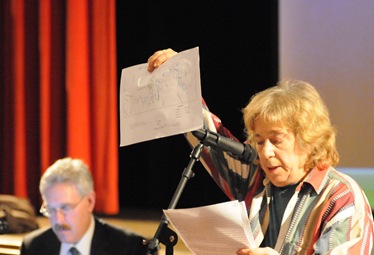
Barbara Arrindell, founder of Damascus Citizens for Sustainability, held up a sketch of property that would be affected by gas drilling.
Story and photos by Ted Waddell
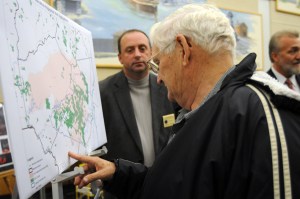
An attendee at the DEC public meeting looks at a chart showing the extent of proposed horizontal gas drilling.
LOCH SHELDRAKE – To some folks the idea of drilling for natural gas in the Upper Delaware River Valley represents salvation from a stagnant local economy. Others think the extraction process, disruption, and damage to the area’s infrastructure, along with potential health and safety issues, will change their way of life forever, and the gas drilling company is the devil incarnate.
On Wednesday, October 28, the NYS Department of Environmental Conservation (DEC) held the first of its four scheduled public meetings to solicit input on their 800-plus page draft Supplemental Generic Environmental Impact State (dSGEIS) on oil, gas and solution mining regulatory program regarding Marcellus Shale.
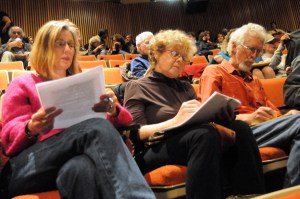
Three concerned citizens prepare their written comments: Helle Hendriksen of Narrowsburg, Susan Sullivan of Narrowsburg, Zeke Boyle of Callicoon.
More than 300 concerned citizens and government filled Sullivan County Community College’s Seelig Theatre to overflowing.
The meeting started out with several town highway superintendents stating that if drilling is approved, in essence they want their respective municipal jurisdictions compensated for damage to town roads. However, many of the highway bosses supported the idea of drilling as a way to bolster the region’s dwindling economic base.
The meetings comes a day after it was announced on October 27 in the New York Times that the Oklahoma City–based Chesapeake Energy Corporation, a major player in the world of natural gas extraction, said it would not drill for natural gas within the upstate New York City watershed, (an area of 5,000 acres that Chesapeake acquired when it bought Columbia Natural Resource a few years ago) The natural gas industry, as a whole, was exempted from the federal Safe Drinking Water Act (SDWA), under energy legislation passed in 2005.
Chesapeake is the sole leaseholder in the NYC watershed area, and is the largest leaseholder in the Marcellus Shale, a subterranean layer of shale rock that extends from New York through Tennessee, and is believed to hold huge natural gas reserves.
Several members of the public expressed reservations about the timing of the statement, calling one woman to comment for the record, “It looks like a sales pitch…everyone would feel easier if the regulations were in place before drilling starts, [but] we’re not ready for this.”
As the meeting progressed, Scott Rotruck, Chesapeake’s vice president of corporate development and state government relations, spoke on the record.
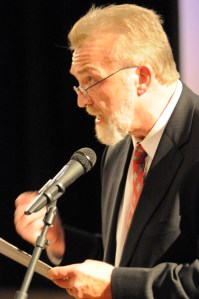
Scott Rotruck, Chesapeake Energy’s vice president of corporate development and state government relations said in part “…most of the public controversy seems to relate to this issue, which in fact is not a realistic or legitimate cause for concern…”
“…Once again, most of the public controversy seems to relate to this issue, which in fact is not a realistic or legitimate cause for concern. Focus on this issue only serves to detract from the unprecedented opportunity that Marcellus Shale presents to New York State to bolster a sagging economy and produce this clean, indigenous resource.
…Chesapeake is convinced that it can safely drill and stimulate wells utilizing hydraulic fracturing anywhere, including those areas that are part of the New York City water supply, as a business decision.
Chesapeake has been and will continue to focus its leasing and drilling efforts in New York State in other areas across the Southern Tier and does not intend to drill horizontal Marcellus wells on its small amount of acreage that is part of the New York City watershed. We believe there are much more prospective areas for Marcellus Shale development and we will be spending our investment dollars in those areas, well outside the New York City watershed.
We have nearly 50 permit applications pending awaiting the finalization of the SGEIS to process and none are near the New York City watershed…As is reflected in the draft SGEIS, through proper planning, control and oversight, drilling and hydraulic fracturing can occur in New York State without threat to the environment…”

Zeke Boyle of Callicoon, said the issue of gas drilling represented “nothing less than the future of our most valuable resource is at stake.”
Rotuck’s latter statement elicited a series of negative comments from some of the more vocal gas drilling opponents, including shouts of “Liar!” These unsolicited comments caused meeting moderator Stu Gruskin, NYS DEC Executive Deputy Commissioner, to quickly call for order and respect for all speaking.

Kathy Bowers of Callicoon, held up a copy of DEC’s 800-plus page dSGEIS report and called for a longer period of public comment. She said the document “reads like an 800 pound gorilla.”
Continuing, the gas drilling company’s spokesman said, “…Chesapeake agrees with the DEC that drilling can occur safely statewide, including areas within the watershed…Chesapeake does not plan to pursue development of the Marcellus Shale utilizing horizontal drilling or hydraulic fracturing on the small number of leases it holds in the New York City watershed area.
“We also note that it would be improper to ban drilling in any particular area of the state, as such a ban is inconsistent with the declared legislative policy to promote recovery of this resource and amounts to a regulatory talking of the mineral interests affected by such a ban.”
Rotuck called upon the DEC to finalize the SGEIS process and “give industry the opportunity to demonstrate its ability to produce this clean, indigenous resource with environmental consequences.”
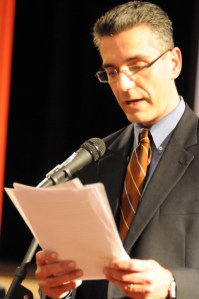
Luiz C. Aragon,. Sullivan County Commissioner of Planning & Environmental Management said the DEC regulations pertaining to potential development in floodplains “do not go far enough…with respect to practices of handling, storage, and transport of frac fluids and flowback materials, the welfare and safety of our residents and workers is paramount.
Luis C. Aragon, Sullivan County Commissioner for Planning & Environmental Management, said that despite the DEC efforts to date, the county “legislature and many of its citizens remained concerned about the findings and recommendations on several issued evaluated in the draft supplement.”

Glenn Goldstein spoke out in opposition to the noise and truck traffic associated with non-stop drilling operations.
Noting that NYS “clearly acknowledges that the development of gas drilling might have an unprecedented and profound effect” on communities statewide, Aragon cited six areas of major concern to the county: impacts on floodplains and flooding, the disclosure of frac fluid contents and the storage and handling of frac fluids, road-use impacts, pipeline and transmission impacts, groundwater and surface water impacts, and notification to municipalities.
In closing, Aragon called for the DEC to extend the period for public comment, and hold additional meetings as warranted, and urged DEC “to ban all drilling in flood plain zones.”
At present, NYS DEC has stated that it will not accept public comments regarding Marcellus shale after November 30, 2009.

James Greier, Town of Fremont supervisor, said farmers have always been “the best stewards of the land.”
James Greier, supervisor of the Town of Fremont, called for 100% cooperation between the DEC and gas drilling companies, adding that “farmers have been the best stewards of our lands [and] leasing of mineral rights will allow them to stay in business.”
Maria Grimaldi is a member of Catskill Mountainkeepers (Protecting the Future of the Catskills) and an organic farmer in the hills of Shandelee. “Gas drilling is not compatible with our environment,” she said, adding that in her opinion there is a “conflict of interest between state government and the gas industry.”

Maria Grimaldi of Shandelee spoke out against gas drilling in the area.
“It’s like closing the barn door after the horse is gone…it must be regulated…an entire ecosystem in Pennsylvania was destroyed. Can we afford to have this happen here? No!” said Grimaldi.
Barbara Arrindell, founder of Damascus Citizens for Sustainability, said the gas company had a “callous disregard for public health,” to which fellow member Joanne Wasserman later added “NYS DEC has been unable to protect this environment [with the dSGEIS]…the bar is so incredibly low.”
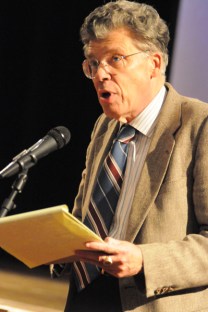 Noel VanSwol, president of the Sullivan County Property Owners Association, said he “totally supports the DEC draft regulations [as a] testament to the staff of DEC.”
VanSwol, who gained local notoriety several years ago as a vocal opponent of the National Park Service presence on the Upper Delaware Scenic and Recreational River and later on his views on the Sullivan West Central School District merger, said that “everyone should realize NYS is virtually bankrupt” and in essence gas drilling revenues might be a way of the state’s financial mess.
“Let us take advantage of this,” he added before describing a large majority of the audience as “a small group of environmental radicals.”
To view more photos or to purchase prints from Are We Running on Empty? visit the Chronicle on Zenfolio.










 The Catskill Chronicle
Great Pictures and reporting. It helps those of us who could not make it.
…Mr. Van Swol calls the opposition “dilletante” and a “small group of environmental radicals”. He does this in spite of the fact that the overwhelming majority of New Yorkers do not benefit from this proposed activity. Someone should tell him that 9 million people live in NYC, whereas, only 76,000 live in Sullivan, and barely 47,000 live in Delaware County, and I firmly believe that the large majority of those residents do not welcome drilling as he does.
Mr. Van Swol speaks only the language of money…I never saw a man so self impressed, based on so little.