Story and photos by Ted Waddell
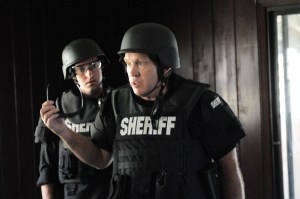
Deputy Blake Starner is the son of Sandi & George Starner and the nephew of SCSO Deputy Don Starner. During a training scenario, tactical team commander Det. Ed Simon critiques the training exercise.
After the decision was made to create a local SWAT (Special Weapons And Tactics) team, the sheriff’s office applied for and was awarded several federal/state grants to provide specialized training, state-of-the-art weaponry, and body armor including heavy duty protective gear and ballistic helmets.
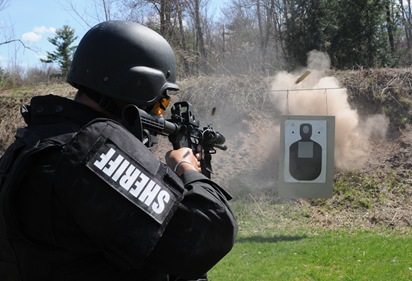
Specialized weapons include UMP Heckler and Koch 40-caliber submachine guns (chambered for 40-caliber rounds to match side-arms), a mixed bag of semi and full-auto AR15’s, along with non-lethal devices.
Once the grants were in hand, the Sullivan County Legislature signed off on the project to form a SCSO emergency response team, a team that was created and equipped without local tax dollars.
In the works is an old surplus Brinks Armored truck (bought for $10) that is being reconfigured to SCSO response team use by the county’s DPW. As new grant money becomes available, thermal imaging and night vision will be added to the team’s bag of tricks.
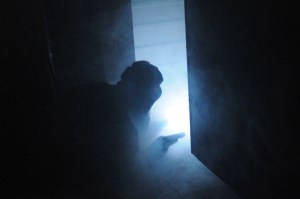
In a recent training exercise the team donned gas masks and crawled through a maze in heavy smoke at the Sullivan County 911 Training Center.
“It’s all about the tools for the job,” said Schiff.
Members of the Sullivan County Sheriff’s Office elite response team: Detective Ed Simon (tactical commander), Lieutenant Paul Pratti (team leader), Detective Jason Gorr (assistant team leader), Sgt. Ed Clouse (assistant team leader), Sergeant Chris Lopez, Cpl. Time Search, and dupities Peter Ramos, Blake
Starner, Kyle Muthig (sniper), Charles Blackburn, Dale Niemann, Lamar Jackson, Martin Gorr and Scott Jordi (paramedic).
The 15-man team has a combined total of 192 years with the SCSO (an average of 12.8 years), and the pack is led by Simon and Pratti, who between the two have a total of 57 years of dedicated service on the front line of local law enforcement.
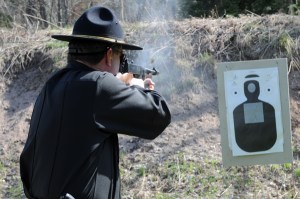
Sheriff Mike Schiff fires a vintage Thompson submachine gun from the days of Elliot Ness and Al Capone; the SCSO has owned the Navy surplus weapon for decades.
History once again proves there’s almost nothing new under the sun: an old patrol manual back from the days of former Sullivan County Sheriff Joe Wasser mentions a SWAT team and snipers, and the SCSO has owned a 1920’s U.S. Navy Thompson 45-caliber submachine gun for decades.
The first SWAT team in the United States was established by the Los Angles Police Department (LAPD) in 1968, and since then similar elite tactical units have been formed in many American and international jurisdictions, performing hostage rescues and counter-terrorism operations, serving high-risk arrest warrants and search warrants, subduing barricaded suspects, and engaging heavily armed criminals.
Since it’s inception, the SCSO rapid response team received initial tactical training from LAPD SWAT, has since trained with similar units in Ulster and Orange Counties under mutual aid, completed a basic 40-hour course, and is required to attend 40-hours continuous training annually, and every month, an 8-hour in-service – all to standards outlined by the National Tactical Officers Association (NTOA).
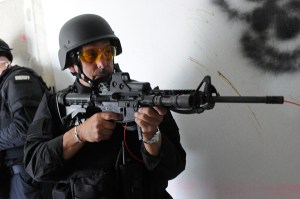
Lieutenant Paul Pratti is the tactical team leader.
Lieutenant Pratti serves as the lead team leader of the SCSO’s rapid response team.
“The level of professionalism has increased dramatically in the last three years, the training has been fabulous, phenomenal compared to the last 25 years,” he said.
His take on the new emergency response team?
“A good bunch of guys working together.”
Detective Simon wears a lot of hats with the SCSO response team, and in addition to his training officer’s black boonie hat and the ballistic helmet he wears leading intense field training exercises as tactical commander, serves as range master during live-fire practicals. “Our rules of engagement are different than in the military…a deputy can use deadly physical force if he or another is threatened with the use of deadly force.
Of particular note is the fact that Deputy Jordi, the newest member of the team, takes to the field as the first paramedic police officer in NYS.
“This isn’t something you put together ad hoc and go ‘yahoo!’, it’s an actual discipline in law enforcement,” said Chaboty.
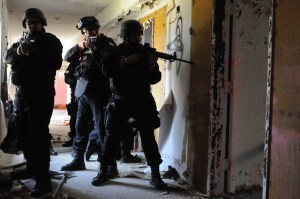
Practicing serving a high-risk arrest warrant on a bad guy.
Reflecting back on those near-tragic events of February 2006, Schiff said, “I decided that if we have an active shooter in a building or a public school, we can’t wait outside, and I don’t want it on my conscious to send people in untrained, unprotected, and without the proper offensive gear to get the job done.”
“In a situation where someone is shooting your loved ones, we are expected to go in with the best training, weaponry and protective gear so they’ll be able to go home at the end of the day.”
“Nobody expects it to happen in their backyards, but when it does we’re required to respond,” added Schiff of events following Columbine and the world after 9-11-2001.
To view more photos or to purchase prints from Sheriff’s Office Unveils New Tactical Response Team visit the Chronicle on Zenfolio.
Click any service in this box to share this post with your friends!
Related










 The Catskill Chronicle
Sheriff’s Office Unveils New Tactical Response Team – Part Two of a Two Part Story
November 4, 2009 by The Catskill Chronicle
Story and photos by Ted Waddell
Deputy Blake Starner is the son of Sandi & George Starner and the nephew of SCSO Deputy Don Starner. During a training scenario, tactical team commander Det. Ed Simon critiques the training exercise.
After the decision was made to create a local SWAT (Special Weapons And Tactics) team, the sheriff’s office applied for and was awarded several federal/state grants to provide specialized training, state-of-the-art weaponry, and body armor including heavy duty protective gear and ballistic helmets.
Specialized weapons include UMP Heckler and Koch 40-caliber submachine guns (chambered for 40-caliber rounds to match side-arms), a mixed bag of semi and full-auto AR15’s, along with non-lethal devices.
Once the grants were in hand, the Sullivan County Legislature signed off on the project to form a SCSO emergency response team, a team that was created and equipped without local tax dollars.
In the works is an old surplus Brinks Armored truck (bought for $10) that is being reconfigured to SCSO response team use by the county’s DPW. As new grant money becomes available, thermal imaging and night vision will be added to the team’s bag of tricks.
In a recent training exercise the team donned gas masks and crawled through a maze in heavy smoke at the Sullivan County 911 Training Center.
“It’s all about the tools for the job,” said Schiff.
Members of the Sullivan County Sheriff’s Office elite response team: Detective Ed Simon (tactical commander), Lieutenant Paul Pratti (team leader), Detective Jason Gorr (assistant team leader), Sgt. Ed Clouse (assistant team leader), Sergeant Chris Lopez, Cpl. Time Search, and dupities Peter Ramos, Blake
Starner, Kyle Muthig (sniper), Charles Blackburn, Dale Niemann, Lamar Jackson, Martin Gorr and Scott Jordi (paramedic).
The 15-man team has a combined total of 192 years with the SCSO (an average of 12.8 years), and the pack is led by Simon and Pratti, who between the two have a total of 57 years of dedicated service on the front line of local law enforcement.
Sheriff Mike Schiff fires a vintage Thompson submachine gun from the days of Elliot Ness and Al Capone; the SCSO has owned the Navy surplus weapon for decades.
History once again proves there’s almost nothing new under the sun: an old patrol manual back from the days of former Sullivan County Sheriff Joe Wasser mentions a SWAT team and snipers, and the SCSO has owned a 1920’s U.S. Navy Thompson 45-caliber submachine gun for decades.
The first SWAT team in the United States was established by the Los Angles Police Department (LAPD) in 1968, and since then similar elite tactical units have been formed in many American and international jurisdictions, performing hostage rescues and counter-terrorism operations, serving high-risk arrest warrants and search warrants, subduing barricaded suspects, and engaging heavily armed criminals.
Since it’s inception, the SCSO rapid response team received initial tactical training from LAPD SWAT, has since trained with similar units in Ulster and Orange Counties under mutual aid, completed a basic 40-hour course, and is required to attend 40-hours continuous training annually, and every month, an 8-hour in-service – all to standards outlined by the National Tactical Officers Association (NTOA).
Lieutenant Paul Pratti is the tactical team leader.
Lieutenant Pratti serves as the lead team leader of the SCSO’s rapid response team.
“The level of professionalism has increased dramatically in the last three years, the training has been fabulous, phenomenal compared to the last 25 years,” he said.
His take on the new emergency response team?
“A good bunch of guys working together.”
Detective Simon wears a lot of hats with the SCSO response team, and in addition to his training officer’s black boonie hat and the ballistic helmet he wears leading intense field training exercises as tactical commander, serves as range master during live-fire practicals. “Our rules of engagement are different than in the military…a deputy can use deadly physical force if he or another is threatened with the use of deadly force.
Of particular note is the fact that Deputy Jordi, the newest member of the team, takes to the field as the first paramedic police officer in NYS.
“This isn’t something you put together ad hoc and go ‘yahoo!’, it’s an actual discipline in law enforcement,” said Chaboty.
Practicing serving a high-risk arrest warrant on a bad guy.
Reflecting back on those near-tragic events of February 2006, Schiff said, “I decided that if we have an active shooter in a building or a public school, we can’t wait outside, and I don’t want it on my conscious to send people in untrained, unprotected, and without the proper offensive gear to get the job done.”
“In a situation where someone is shooting your loved ones, we are expected to go in with the best training, weaponry and protective gear so they’ll be able to go home at the end of the day.”
“Nobody expects it to happen in their backyards, but when it does we’re required to respond,” added Schiff of events following Columbine and the world after 9-11-2001.
To view more photos or to purchase prints from Sheriff’s Office Unveils New Tactical Response Team visit the Chronicle on Zenfolio.
Click any service in this box to share this post with your friends!
Related
Posted in Comments | Leave a Comment
Comments RSS