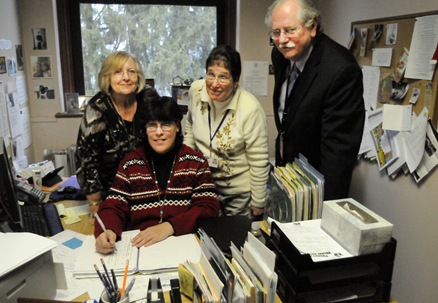
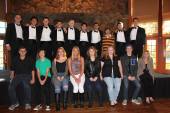
Seated: Jamie Latimer, SCB A.S.K. student support specialist
Standing: Patricia Crumley, SCB A.S.K. student support specialist; Kathy
Meckle, SCB, coordinator educational support services; Lawrence B.
Schafman, director of special programs and public relations, Fallsburg
Central School District.
Story and photos by Ted Waddell
SULLIVAN COUNTY – A.S.K. and ye shall receive.
The Sullivan County Academic Support for Kids (A.S.K.) program is designed for families living in temporary housing, i.e., homeless in the land of plenty.
The county’s A.S.K. program is administered by Sullivan County BOCES (SCB) under the direction of Kathy Meckle, coordinator of educational support services, while the field case work is done by student support specialists Jamie Latimer and Patricia Crumley.
The Sullivan County A.S.K. staff provides assistance to parents, legal guardians, and as required to youth not living with their parents or guardians (known as unaccompanied youth) with such issues as enrolling kids in school, transporting parents to school for meetings, assisting in obtaining proper immunizations for children, providing advocacy and mentoring for parents and students, referring families to appropriate programs and agencies, providing school supplies, and assisting in arranging transportation to the school of origin.
For a look at the definition of homeless as defined by the Federal McKinney-Vento Act, and as it applies to school-age children from pre-school to 21-years of age living in temporary housing, refer to “Homeless in the Land of Plenty: Part IV,” published exclusively online by The Catskill Chronicle.
Over the past couple of years, the number of homeless kids in the tri-county area of Sullivan, Orange and Ulster has shot up almost 30% due to a tanking local economy, and as the situation gets worse (and the counting by school districts improves) the numbers are expected to increase.
In the 2007-08 school year, the state listed almost 1,600 students as homeless in the tri-county area, but folks in social services and A.S.K. are in agreement that the real numbers are significantly greater.
Each school district is mandated by the state under McKinney-Vento to appoint a liaison who is charged with keeping tabs on the number of homeless students in their respective districts, reporting the numbers accurately, and making sure parents/guardians/students are aware of all the varied services in place to help homeless kids get an education.
“We work with the Sullivan County school districts to make sure they are counting all the homeless students they have,” said Meckle, now in her 18th  year working for SCB. “Some schools are very willing to do it, for others it’s not really on the top of their list.”
The SCB A.S.K. program is in its second year of a three-year program funded at $100,000 annually.
“The needs of families are just so much more,” added Meckle. “The whole cycle of not having adequate housing…you try to get a job, you lose the job, the car breaks down and you lose the apartment…it just seems like a merry-go-round.”
In 2008-09, she said the county’s A.S.K. program helped 173 homeless kids in grades Pre-K to 12 and one GED student in the county’s eight public school districts.
Lawrence B. Schafman is director of special programs and public relations for the Fallsburg Central School District, and he is a man with a mission to help homeless kids get a decent education, particularly in these tough times.
“There’s a stigma about being homeless,” he said. ”There’s a lot of downgrading, looking down on homeless people, a lot of blaming people for their plight, and I think the person who is homeless takes that in and starts owning that label.”
Schafman got involved with the problem when he came to Fallsburg in 2003 and began working with the migrant education program – today, approximately 20% of the district’s population is Hispanic – and with a noticeably transient population “a lot of families were falling through the cracks, they didn’t know they could obtain federal assistance.”
“Now that the economy has gone south, there are a lot more homeless people out there…and in a way there’s less stigma because you see more middle class people who had really good jobs and nice homes losing their wherewithal…in the richest country in the world,” he added.
Working in the Combat Zone
 While a lot of folks cast blame on others for being homeless, who in their right mind can fault a kid for being forced by circumstances – whatever the reason – for living in a roach-infested room, a broken down car or even a tree house out in the middle of the sticks. Not a lot of fun to sleep on a bedbug ridden mattress covered with piles of dirty clothes and food wrappers, especially if you’re sharing it with siblings while trying to do your homework. Good luck, kid. Wish you all the best in the world…that’s the attitude of a lot of folks who have a roof over their heads, three squares a day and some clean sheets.
However, at the SCB A.S.K. program, a couple of case workers are trying to make things right, sometimes in spite of ‘the system’
Jamie Latimer has worked as a student support specialist for six years, and works with homeless students in four of the county’s eight school districts: Fallsburg, Liberty, Roscoe and Livingston Manor.
“Some of the kids have head lice, and there’s no money for medicine, so they stay home and miss school,” she said. “If they [the parents] don’t have money to do the laundry, they don’t send their kids to school.”
Just like a slice of bread, there are two sides to any story, and as a case in point while a lot of people decry the often deplorable conditions of some department of family services-funded temporary housing, in other instances it’s the tenants who trash the place and leave it a mess.
“We have some very destructive families, and when they leave [the rooms] need a complete overhaul, and that’s expensive…I’ve been in some rooms before they were redone, and it’s pretty scary,” said Latimer.
If you’re homeless and forced to live in temporary housing, don’t expect a palace, but you shouldn’t have to live in dump crawling with roaches. First impressions are lasting ones, and Latimer and Crumley have enough ‘first-hand looks’ to last a lifetime.
“The thing that stands out for me is everything they own is packed into the room,” said Latimer of the typical one-room temporary housing provided by the county’s Division of Health & Family Services (DHFS). “When you walk into the Lakeside and open the door to the hallway, the smell is awful…sometimes you see the clothes hanging over the sink because they don’t have money for the [coin-operated) washers and dryers.”
“Kids are bouncing on the bed because they are bored, and the playground is a parking lot,” she added.
According to Latimer, a lot of parents aren’t thinking about their kids’ homework because they are worried about putting food on the table and how to get enough gas for the car (if they have one) to get to a doctor’s appointment.
It’s proven by any number of academic studies that homeless kids traditionally post lower grades in school, due in large part to living in temporary housing.
“It’s constant,” said Latimer of the vicious cycle of poverty and homelessness, “[In some cases] They’re listening to mom and dad or mom and her boyfriend fight all night, they’re trying to sleep with two or three other kids in the bed, and a lot of time they’re getting bounced around from one pace to another…people get it together, and then it all falls apart again.”
Latimer said one thing that really stands out when she interviews students about their homeless situation is that [in most cases] they want the teachers to know what’s going on in their stress-filled lives. “If a kid’s having a bad day or didn’t get their homework done, there may be a very good reason, so instead of saying ‘You have detention!” or ‘You’re in trouble!, find out why.”
Crumley is a veteran in the local social services field, and for the last three years has worked with homeless students in four school districts (Monticello, Tri-Valley, Eldred and Sullivan West).
 She described most of the temporary housing provided to homeless families or single moms with kids through the county’s social services as “below adequate for anybody.”
“I don’t find fault with family services for any of this,” she added. “It’s what’s available out there, and it’s what they are allowed to use [but] it’s not living for normal people.”
First impressions at the Heritage Inn of Monticello …
“They use these motel rooms in back of the Heritage, and there are usually eight to ten rooms assigned [to homeless families with students] in back of the building,’ said Crumley.
“You knock on the door and go in and there’s two beds less than double size, sometimes they have a tiny table, sometimes they don’t. One or two chairs, and there’s always a TV that is probably 20 years old, something you can use to keep your mind off your troubles, and the bathrooms are about the smallest you can ever use.”
Crumley said some tenants try to make the best of what she called “just deplorable conditions to begin with” by cleaning the floors every night, but it’s a hard row to hoe if you’re homeless and living in one room with a bunch of kids.
Asked if taxpayers and the ‘system’ are getting a good deal for their money, she replied, “Absolutely not!”
In Sullivan County, the Department of Health and Family Services (DHFS) provides temporary housing for homeless students served by A.S.K. at eight locations in three towns: Monticello (Heritage Inn, Raceway Motel, Travel Inn, Delano Motel and Super 8), Liberty (Liberty Motel and Budget Inn) and Fallsburg (Lakeside Motel, formerly Hillsdale Dorms).
Is Past Really Prolog?
Meckle recalled going into a room at the Willowemoc Hotel (currently closed) a few years ago to offer assistance to a mother living in one cramped room with five kids and her elderly father.
“There was a playpen in the middle of the room, and the kids were beating on one another, there was nothing else for them to do but jump on the beds…it was a memorable experience,” she said. “A couple of these children were in school. Could these children think about doing homework when they came home?”
When she first started out in social services, Meckle encountered an 18-year old BOCES student who built a tree house in the Western part of the county because he had nowhere else to live.
“These are my circumstances, these are my options,” she said of his will to surmount some difficulties.
“A lot of these kids have a great spirit to survive, triumph and still maintain a sense of their dreams even in desperate circumstances.” Meckle added that Steve White, program administer of the Sullivan County Federation for the Homeless has long held that a shelter for the county’s homeless women and children is an idea that should be put on the front burner.
“It’s critical to give children a place they can call their own, [that they] know they can have three meals a day, a place to put their pictures on the wall, a place for them to do their homework, a place to give them a sense of stability,” she said. “It’s just looking at the tip of the iceberg,” she said of gazing at
homelessness in the land of plenty.
For additional information about Sullivan County A.S.K., call 845-794-4405 (Jamie Latimer @ ext. 303 or Patricia Crumley @ ext. 304), or visit them at the St. John Street Education Center, 22 St. John Street, Monticello, New York.
The mailing address: A.S.K. Program, Sullivan County BOCES, Educational Support Services, 6 Wierk Avenue, Liberty, New York 12754.
Click any service in this box to share this post with your friends!
Related








 The Catskill Chronicle
Homeless in the Land of Plenty: Part V
January 8, 2010 by The Catskill Chronicle
Seated: Jamie Latimer, SCB A.S.K. student support specialist
Standing: Patricia Crumley, SCB A.S.K. student support specialist; Kathy
Meckle, SCB, coordinator educational support services; Lawrence B.
Schafman, director of special programs and public relations, Fallsburg
Central School District.
Story and photos by Ted Waddell
SULLIVAN COUNTY – A.S.K. and ye shall receive.
The Sullivan County Academic Support for Kids (A.S.K.) program is designed for families living in temporary housing, i.e., homeless in the land of plenty.
The county’s A.S.K. program is administered by Sullivan County BOCES (SCB) under the direction of Kathy Meckle, coordinator of educational support services, while the field case work is done by student support specialists Jamie Latimer and Patricia Crumley.
The Sullivan County A.S.K. staff provides assistance to parents, legal guardians, and as required to youth not living with their parents or guardians (known as unaccompanied youth) with such issues as enrolling kids in school, transporting parents to school for meetings, assisting in obtaining proper immunizations for children, providing advocacy and mentoring for parents and students, referring families to appropriate programs and agencies, providing school supplies, and assisting in arranging transportation to the school of origin.
For a look at the definition of homeless as defined by the Federal McKinney-Vento Act, and as it applies to school-age children from pre-school to 21-years of age living in temporary housing, refer to “Homeless in the Land of Plenty: Part IV,” published exclusively online by The Catskill Chronicle.
Over the past couple of years, the number of homeless kids in the tri-county area of Sullivan, Orange and Ulster has shot up almost 30% due to a tanking local economy, and as the situation gets worse (and the counting by school districts improves) the numbers are expected to increase.
In the 2007-08 school year, the state listed almost 1,600 students as homeless in the tri-county area, but folks in social services and A.S.K. are in agreement that the real numbers are significantly greater.
Each school district is mandated by the state under McKinney-Vento to appoint a liaison who is charged with keeping tabs on the number of homeless students in their respective districts, reporting the numbers accurately, and making sure parents/guardians/students are aware of all the varied services in place to help homeless kids get an education.
“We work with the Sullivan County school districts to make sure they are counting all the homeless students they have,” said Meckle, now in her 18th year working for SCB. “Some schools are very willing to do it, for others it’s not really on the top of their list.”
The SCB A.S.K. program is in its second year of a three-year program funded at $100,000 annually.
“The needs of families are just so much more,” added Meckle. “The whole cycle of not having adequate housing…you try to get a job, you lose the job, the car breaks down and you lose the apartment…it just seems like a merry-go-round.”
In 2008-09, she said the county’s A.S.K. program helped 173 homeless kids in grades Pre-K to 12 and one GED student in the county’s eight public school districts.
Lawrence B. Schafman is director of special programs and public relations for the Fallsburg Central School District, and he is a man with a mission to help homeless kids get a decent education, particularly in these tough times.
“There’s a stigma about being homeless,” he said. ”There’s a lot of downgrading, looking down on homeless people, a lot of blaming people for their plight, and I think the person who is homeless takes that in and starts owning that label.”
Schafman got involved with the problem when he came to Fallsburg in 2003 and began working with the migrant education program – today, approximately 20% of the district’s population is Hispanic – and with a noticeably transient population “a lot of families were falling through the cracks, they didn’t know they could obtain federal assistance.”
“Now that the economy has gone south, there are a lot more homeless people out there…and in a way there’s less stigma because you see more middle class people who had really good jobs and nice homes losing their wherewithal…in the richest country in the world,” he added.
Working in the Combat Zone
However, at the SCB A.S.K. program, a couple of case workers are trying to make things right, sometimes in spite of ‘the system’
Jamie Latimer has worked as a student support specialist for six years, and works with homeless students in four of the county’s eight school districts: Fallsburg, Liberty, Roscoe and Livingston Manor.
“Some of the kids have head lice, and there’s no money for medicine, so they stay home and miss school,” she said. “If they [the parents] don’t have money to do the laundry, they don’t send their kids to school.”
Just like a slice of bread, there are two sides to any story, and as a case in point while a lot of people decry the often deplorable conditions of some department of family services-funded temporary housing, in other instances it’s the tenants who trash the place and leave it a mess.
“We have some very destructive families, and when they leave [the rooms] need a complete overhaul, and that’s expensive…I’ve been in some rooms before they were redone, and it’s pretty scary,” said Latimer.
If you’re homeless and forced to live in temporary housing, don’t expect a palace, but you shouldn’t have to live in dump crawling with roaches. First impressions are lasting ones, and Latimer and Crumley have enough ‘first-hand looks’ to last a lifetime.
“The thing that stands out for me is everything they own is packed into the room,” said Latimer of the typical one-room temporary housing provided by the county’s Division of Health & Family Services (DHFS). “When you walk into the Lakeside and open the door to the hallway, the smell is awful…sometimes you see the clothes hanging over the sink because they don’t have money for the [coin-operated) washers and dryers.”
“Kids are bouncing on the bed because they are bored, and the playground is a parking lot,” she added.
According to Latimer, a lot of parents aren’t thinking about their kids’ homework because they are worried about putting food on the table and how to get enough gas for the car (if they have one) to get to a doctor’s appointment.
It’s proven by any number of academic studies that homeless kids traditionally post lower grades in school, due in large part to living in temporary housing.
“It’s constant,” said Latimer of the vicious cycle of poverty and homelessness, “[In some cases] They’re listening to mom and dad or mom and her boyfriend fight all night, they’re trying to sleep with two or three other kids in the bed, and a lot of time they’re getting bounced around from one pace to another…people get it together, and then it all falls apart again.”
Latimer said one thing that really stands out when she interviews students about their homeless situation is that [in most cases] they want the teachers to know what’s going on in their stress-filled lives. “If a kid’s having a bad day or didn’t get their homework done, there may be a very good reason, so instead of saying ‘You have detention!” or ‘You’re in trouble!, find out why.”
Crumley is a veteran in the local social services field, and for the last three years has worked with homeless students in four school districts (Monticello, Tri-Valley, Eldred and Sullivan West).
“I don’t find fault with family services for any of this,” she added. “It’s what’s available out there, and it’s what they are allowed to use [but] it’s not living for normal people.”
First impressions at the Heritage Inn of Monticello …
“They use these motel rooms in back of the Heritage, and there are usually eight to ten rooms assigned [to homeless families with students] in back of the building,’ said Crumley.
“You knock on the door and go in and there’s two beds less than double size, sometimes they have a tiny table, sometimes they don’t. One or two chairs, and there’s always a TV that is probably 20 years old, something you can use to keep your mind off your troubles, and the bathrooms are about the smallest you can ever use.”
Crumley said some tenants try to make the best of what she called “just deplorable conditions to begin with” by cleaning the floors every night, but it’s a hard row to hoe if you’re homeless and living in one room with a bunch of kids.
Asked if taxpayers and the ‘system’ are getting a good deal for their money, she replied, “Absolutely not!”
In Sullivan County, the Department of Health and Family Services (DHFS) provides temporary housing for homeless students served by A.S.K. at eight locations in three towns: Monticello (Heritage Inn, Raceway Motel, Travel Inn, Delano Motel and Super 8), Liberty (Liberty Motel and Budget Inn) and Fallsburg (Lakeside Motel, formerly Hillsdale Dorms).
Is Past Really Prolog?
Meckle recalled going into a room at the Willowemoc Hotel (currently closed) a few years ago to offer assistance to a mother living in one cramped room with five kids and her elderly father.
“There was a playpen in the middle of the room, and the kids were beating on one another, there was nothing else for them to do but jump on the beds…it was a memorable experience,” she said. “A couple of these children were in school. Could these children think about doing homework when they came home?”
When she first started out in social services, Meckle encountered an 18-year old BOCES student who built a tree house in the Western part of the county because he had nowhere else to live.
“These are my circumstances, these are my options,” she said of his will to surmount some difficulties.
“A lot of these kids have a great spirit to survive, triumph and still maintain a sense of their dreams even in desperate circumstances.” Meckle added that Steve White, program administer of the Sullivan County Federation for the Homeless has long held that a shelter for the county’s homeless women and children is an idea that should be put on the front burner.
“It’s critical to give children a place they can call their own, [that they] know they can have three meals a day, a place to put their pictures on the wall, a place for them to do their homework, a place to give them a sense of stability,” she said. “It’s just looking at the tip of the iceberg,” she said of gazing at
homelessness in the land of plenty.
For additional information about Sullivan County A.S.K., call 845-794-4405 (Jamie Latimer @ ext. 303 or Patricia Crumley @ ext. 304), or visit them at the St. John Street Education Center, 22 St. John Street, Monticello, New York.
The mailing address: A.S.K. Program, Sullivan County BOCES, Educational Support Services, 6 Wierk Avenue, Liberty, New York 12754.
Click any service in this box to share this post with your friends!
Related
Posted in Comments | Leave a Comment
Comments RSS