
Sky and Kiley Asher-Stalbaum of Goshen attend the Homestead School in Glen Spey and were among those in attendance at the meeting on February 20, 2010.
Story and photos by Ted Waddell
CALLICOON – A lot of folks think the pristine beauty of Upper Delaware River Valley is under attack by corporate interests, and instead of widespread development, believe it should be preserved for future generations, while some companies are convinced the area’s natural resources are the solution to the nation’s energy crisis and represent potential ripe pickings for corporate profits.
A few years ago, New York Regional Interconnection (NYRI), a Canadian-based energy gorilla, wanted to erect giant towers throughout the region including portions of the federally protected Upper Delaware River Scenic & Recreational River to transmit high-voltage electricity to the metro area.
On March 31, 2009 the Federal Energy Regulatory Commission (FERC) turned down NYRI’s request to review the recently approved rules on the NYS Independent System Operator (NYSSO) for transmission tariffs, in a move that NYRI said “created an unacceptable financial risk” for their investors, and on April 3 issued a press release stating it had suspended participation in the NYS Public Service Commission (PSC) Article VII process for the 1200MW HVDC project.
About 18 months ago, several natural gas drilling companies began to show up in the region, both to tout the benefits to the national/local economy and get landowners to sign leases to allow gas drilling on their property.
On Saturday, February 20, the Delaware Youth Center was packed with a standing room only crowd as they turned out to hear the mayor of a small town in rural northern Texas talk about his first hand experiences with gas drilling.
Also on the program was Nancy Janyszeski, Pa. chair of the Lower Delaware Wild and Scenic River, an environmental advocacy organization, and chairman of the board of supervisors in Nockamixon Township, Pa.
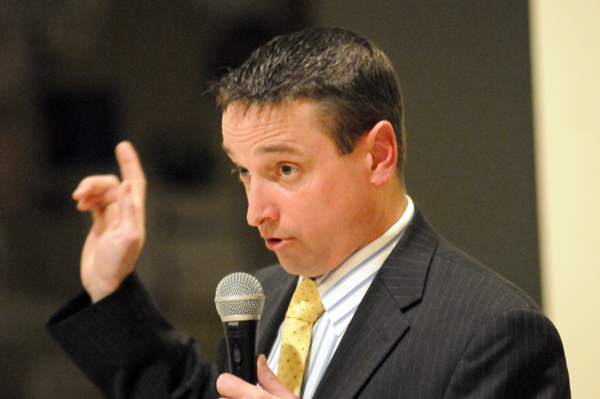
Mayor Calvin Tillman of Dish, Texas.
Calvin Tillman, mayor of Dish, Texas said that while he wasn’t opposed top gas drilling, local residents should be aware of problems associated with the complicated extraction process, and said that in his view landowners should get their legal ducks in line before it’s too late. “If you do it wrong, ain’t nobody gonna want to live here,” he said. “This is a delicate process that has to be regulated…” Proving that in addition to being a straight shooter from Texas, as well as a master of understatement, Tillman said the issue to gas drilling in the valley “seems to be a top topic up here.”
He likened natural gas drilling to drugs or a game show, “It’s a lot like heroin because you get addicted to it…I’ve got a deal for you.” Tillman called for local regulations “you’re local officials need to get back that control” and the imposition of a severance tax that would pay for damages to the infrastructure caused by heavy truck traffic, adding, “there should be some places that are off-limits.”
“You don’t have to put a well in a schoolyard or pipelines in somebody’s front yard.”
According to Tillman, when residents of his 180-folks town complained about noxious odors, the drilling operators hired a couple of guys to drive around town in a Toyota Rav 4 for a few hours during a time “when there was still some trust there.”
After being told the results showed “no natural gas leaks were found detectable to the human nose, Tillman said he decided to spend 15-percent of his town’s annual budget to conduct their own study conducted by Wolf Eagle Environmental.

Nancy Janyszeski, Pa. chair of the Lower Delaware Wild & Scenic River
“They came back with 16 others toxins that were above the effect stream level…and also confirmed the presence of multiple recognized and suspected human carcinogens (such as benzene)….now that you know, you can’t not know.”
The Dish health assessment tallied the answers to a questionnaire filled out by 31 citizens and former residents, and according to the report, 61-percent of the health effects reported “are known health effects of the chemicals detected…(and include) difficulty in breathing, brain disorders, chronic eye irritation, dizziness, frequent nausea, increased fatigue, muscle aches, severe headaches, sinus problems, throat irritations, and allergies.”
Tillman called his little town the ”Grand Central Station of the Barnett Shale”, and said mineral leases range from $75 to $30,000 per acre, and 12% to 3)5 royalties, and then cautioned the audience to be cautious of “moles” in their midst, folks who get a small percentage of mineral leases.
On the subject of hydraulic fracturing – a technique used to increase (or restore) the rate at which fluids, such as oil, natural gas or water, can be produced from a reservoir (including shale rock or coal beds) with reported environmental concerns such as contamination of aquifers with fracturing chemicals or waste fluids – Tillmam said, while noting that in Dish, Texas most drillers use horizontal drilling methods, hydrofracking is exempt from the Clean Water Act (and amendments).
“I was a complete mystery for a while what was in the fracking fluid…[now] we know there are over 250 chemicals used [and] over 90-percent of them have adverse health effects…each well site will have a different mix, and they (the gas drilling companies) don’t have to tell you what’s in your mix.”
Tillman said that of the 32 states in the country where there is oil and natural gads drilling, 30 of them have imposed a severance tax on the companies to pay for damages: NY and PA are the exceptions.
“Based upon my experience in Texas, I was shocked to find that the local governments did not develop ordinances….it needs to be brought back to the local level…together we bargain, divided we beg.”
Tillman never called for banning gas drilling, but rather said the area should establish baseline air and water tests, impose severance taxes, and advocate for greener drilling techniques.
“There’s folks who want to paint me as some environmental wacko,” he said. “Don’t assume nothing will happen, prepare ahead of time. “You have an opportunity to do this better than we did.”
“New York has an opportunity to do this a little better than we did,” added Tillman, advising people to visit Dimock Township in Susquehanna County, PA to get a firsthand idea of how gas drilling can impact a community “whether you’re for against drilling, are on the fence, or just have questions…go, it will become clear what the risks are.”
Janyszeski said, “We need to be educated and on top of exactly what gas drilling means to the Upper Delaware River.”
“I think everyone understands there will be drilling, we just have to make sure it’s done responsibly,” she added.
Fred Peckham is a quarryman from Hancock, NY.
“I’m in favor of responsible drilling, and I think New York State should jump on the boat like any other state in making sure the environment is protected.” he said. “Nobody in Hancock basically has jobs…the logging industry is down, the stone industry is down, basically that’s all you have…most people are self-employed, so there’s no unemployment benefits.”
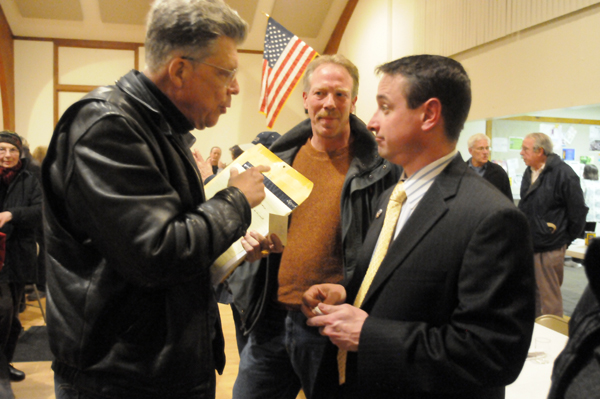
Noel van Swol,(l) president of the Sullivan-Delaware Property Owners Association and Fred Peckham, (ctr) a quarryman from Hancock speak with Calvin Tillman, (r) mayor of Dish, Texas.
Noel van Swol, of Long Eddy, president of the Sullivan-Delaware Property Owners Association “representing 70,000 acres in the Marcellus Shale”, called the February 20 information forum “a propaganda meeting” and said that according to articles appearing on the internet, Tillman “is rumored to be running for the Texas Railroad Commission”, an allegation Tillman later denied.
“The railroad commission regulates the oil and gas industry, and everyone is convinced that I’m going to run for that office, but I’m not,” said Tillman, an aviation consultant who serves as the unpaid mayor of Dish, Texas.
Von Swol said the newly added NYS DEC draft regulations “will take care of all the problems that have been raised” with the first 800-some page document.
“If you can’t regulate this industry with these kinds of regulations, then every bureaucrat in Albany that has anything to do with the environment or with oil and gas drilling should be fire and replaced.”
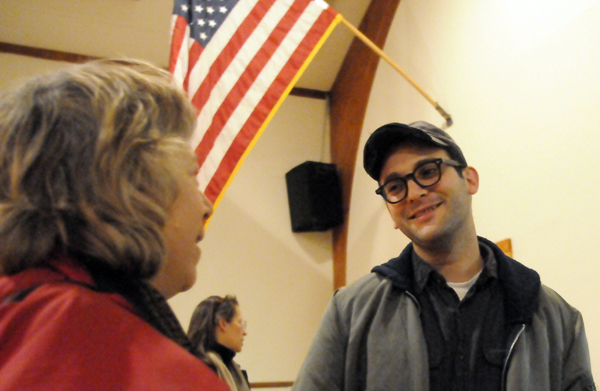
Barbara Arrindel of Damascus Citizens for Sustainability and Josh Fox, winner of the special documentary jury prize for his film “Gasland.”
Josh Fox, of Milanville, PA, winner the special jury prize for documentary films at Sundance for his film “Gasland” attended the meeting, and the day before the gas drilling meeting won the special jury prize at the Big Sky Documentary Film Festival.
“I am convinced having been in 34 states with gas drilling sites all over America, that if it starts in this area I will not be able to live in my home. I know what happens to the air, what happens to the water…I won’t be able to live in my house.”
“The one thing I would like to say in response to this meeting is that drilling is not inevitable…we will do everything in our power to stop it, and we will win.”
“The rabbit hole keeps getter deeper and deeper…and the dangers are too great. People must realize it will mean the destruction of the Catskills as they know it,” added Fox.
To view more photos or to purchase prints from Hundreds Turn Out for Gas Drilling Meeting visit the Chronicle on Zenfolio.










 The Catskill Chronicle
what is a “quarryman?”
According to the Merriam Webster online dictionary: a worker in a stone quarry