Story and photos by Carol Montana
SOUTH FALLSBURG, NY – When Steve Vegliante first took office as the new Supervisor of the Town of Fallsburg back in January, one of the first things he did was sit down with his department heads to talk about growth in the town. Because he did this, he was one of the first supervisors in the state to find out about a change in the policy determining grants and low-interest loans from the U.S. Department of Agriculture’s Rural Development Agency. ”Unfortunately,” said Vegliante, “I found they changed the rules on rural communities, all of a sudden we’re excluded from grants …”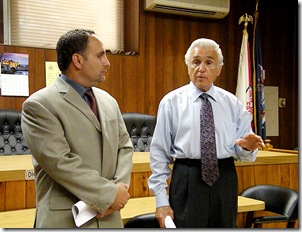
When U.S. Congressman Maurice Hinchey came to town on Friday, July 16, he thanked Vegliante for bringing the matter to his attention. Hinchey was in town to talk about his efforts to reverse the policy change.
“The set of circumstances to help small towns and provide grants and low interest loans is essential for maintenance of very small towns,” said Hinchey, “Unfortunately the USDA Rural Development agency stopped low interest loans for communities that go up over 10,000 people. That’s a number that should be changed. They have looked at this in the wrong way.”
Hinchey further remarked that the “misinterpretation causes very serious consequences. … It is critically important to work this out. They are misinterpreting the word rural in a way that will exclude significant numbers of communities.”
In a letter to Secretary of Agriculture Tom Vilsack, Hinchey, along with other members of the New York State Congressional Delegation including Kirsten Gillibrand, Scott Murphy and John Hall, urged the department to “reconsider its new interpretation of the definition of rural and rural area in New York State with regard to the USDA’s Rural Development Water and Waste Disposal program. We believe that many communities in New York are being unfairly excluded from this program at a time when they desperately need federal assistance.
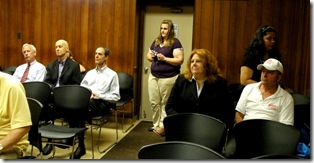 “As you know,” the letter continues, “current law limits USDA Rural Development grants to towns with a population under 10,000. … In New York, some towns include incorporated water or wastewater districts which only provide water services to a specific service area within the town. Many towns also include incorporated villages that provide an array of municipal services only within the village limits, often including drinking water and wastewater services. Through the end of last year, many of these water or wastewater districts, villages and the surrounding towns with populations below 10,000 were appropriately treated as separate entities and were eligible for Rural Development’s Water and Waste Disposal grants and loans.
“Unfortunately, last year USDA Rural Development reinterpreted its definition of towns. Following that decision, in January, 2010, the agency determined it would not issue grants and loans to a number of towns in New York that were previously eligible to receive them. The agency decided, on its own accord, to combine the population of a town with the population of an incorporated village and/or incorporated water or wastewater district for purposes of determining eligibility instead of counting them separately as it did before. As a result of this change, many towns and water or wastewater districts which were once eligible for grants have lost their eligibility. …”
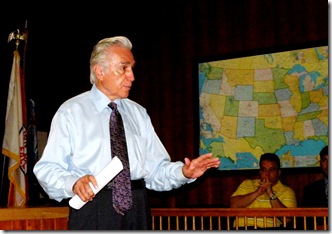 Hinchey and the other representatives took the agency to task for issuing the new policy in an internal memo, “which was not subject to public review or comments. In addition, this new policy was never shared with affected members of Congress. …”
Vegliante characterized the move as a “way of steering money out of NY.” He further pointed out that if the town is able to “upgrade our water and sewer plants, (that) will have an economic impact on jobs and purchases.” When asked what the alternative was, he responded, “I’m not sure we have a strong alternative, we can’t move that much of a burden onto our taxpayers.”
Hinchey agreed that the rules change is harmful to economic growth and will stop projects, new jobs, new business and area progress. He called the situation “harmful to economic growth. … I am working directly with the Department of Agriculture and in the Congress to address this issue, and I am hopeful that it will be resolved favorably. Local governments in Sullivan County and throughout New York rely on these Rural Development water and wastewater grants and loans to take the burden off local taxpayers, and it is absolutely essential that we reverse the USDA’s misguided rules change."
In other news, Congressman Hinchey also addressed the unemployment extension for people whose benefits had expired. Saying that the unemployment rate is currently at 9.3 percent, he reported that the House had passed the extension, and expressed hope that the Senate would vote on the measure this week.
To read more about Congressman Hinchey views on this issue, visit Hinchey Leads Push for USDA to Reverse Policy Change.
To see more photos or to purchase prints from Hinchey Visits the Town of Fallsburg visit The Catskill Chronicle on Zenfolio.
Click any service in this box to share this post with your friends!
Related









 The Catskill Chronicle
Congressman Hinchey Visits the Town of Fallsburg
July 19, 2010 by The Catskill Chronicle
Story and photos by Carol Montana
SOUTH FALLSBURG, NY – When Steve Vegliante first took office as the new Supervisor of the Town of Fallsburg back in January, one of the first things he did was sit down with his department heads to talk about growth in the town. Because he did this, he was one of the first supervisors in the state to find out about a change in the policy determining grants and low-interest loans from the U.S. Department of Agriculture’s Rural Development Agency. ”Unfortunately,” said Vegliante, “I found they changed the rules on rural communities, all of a sudden we’re excluded from grants …”
When U.S. Congressman Maurice Hinchey came to town on Friday, July 16, he thanked Vegliante for bringing the matter to his attention. Hinchey was in town to talk about his efforts to reverse the policy change.
“The set of circumstances to help small towns and provide grants and low interest loans is essential for maintenance of very small towns,” said Hinchey, “Unfortunately the USDA Rural Development agency stopped low interest loans for communities that go up over 10,000 people. That’s a number that should be changed. They have looked at this in the wrong way.”
Hinchey further remarked that the “misinterpretation causes very serious consequences. … It is critically important to work this out. They are misinterpreting the word rural in a way that will exclude significant numbers of communities.”
In a letter to Secretary of Agriculture Tom Vilsack, Hinchey, along with other members of the New York State Congressional Delegation including Kirsten Gillibrand, Scott Murphy and John Hall, urged the department to “reconsider its new interpretation of the definition of rural and rural area in New York State with regard to the USDA’s Rural Development Water and Waste Disposal program. We believe that many communities in New York are being unfairly excluded from this program at a time when they desperately need federal assistance.
“Unfortunately, last year USDA Rural Development reinterpreted its definition of towns. Following that decision, in January, 2010, the agency determined it would not issue grants and loans to a number of towns in New York that were previously eligible to receive them. The agency decided, on its own accord, to combine the population of a town with the population of an incorporated village and/or incorporated water or wastewater district for purposes of determining eligibility instead of counting them separately as it did before. As a result of this change, many towns and water or wastewater districts which were once eligible for grants have lost their eligibility. …”
Vegliante characterized the move as a “way of steering money out of NY.” He further pointed out that if the town is able to “upgrade our water and sewer plants, (that) will have an economic impact on jobs and purchases.” When asked what the alternative was, he responded, “I’m not sure we have a strong alternative, we can’t move that much of a burden onto our taxpayers.”
Hinchey agreed that the rules change is harmful to economic growth and will stop projects, new jobs, new business and area progress. He called the situation “harmful to economic growth. … I am working directly with the Department of Agriculture and in the Congress to address this issue, and I am hopeful that it will be resolved favorably. Local governments in Sullivan County and throughout New York rely on these Rural Development water and wastewater grants and loans to take the burden off local taxpayers, and it is absolutely essential that we reverse the USDA’s misguided rules change."
In other news, Congressman Hinchey also addressed the unemployment extension for people whose benefits had expired. Saying that the unemployment rate is currently at 9.3 percent, he reported that the House had passed the extension, and expressed hope that the Senate would vote on the measure this week.
To read more about Congressman Hinchey views on this issue, visit Hinchey Leads Push for USDA to Reverse Policy Change.
To see more photos or to purchase prints from Hinchey Visits the Town of Fallsburg visit The Catskill Chronicle on Zenfolio.
Click any service in this box to share this post with your friends!
Related
Posted in Comments | Leave a Comment
Comments RSS