The Master Falconer and the Bookstore
October 26, 2010 by The Catskill Chronicle
Compiled by Jeremy Gorelick
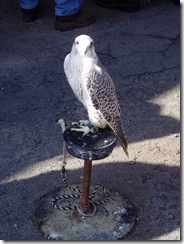 WHITE SULPHUR SPRINGS, NY – Brian Bunce, Master Falconer, visited Monique’s Book Boutique in White Sulphur Springs on Saturday, October 23, to talk about the sport of falconry. Guest contributing writer, Jeremy Gorelick, had the chance to ask him some questions about this challenging sport for The Catskill Chronicle (TCC):
TCC: Brian, your birds are beautiful and so well behaved. Do you often bring them to events like this?
BB: Actually, no. These birds are not rescue birds nor are they pets. They are bred specifically for hunting and are not domesticated animals. They are used in the sport of falconry, which is defined by the DEC [Department of Environmental Conservation which also oversees hunting permits for other game animals] as a sport of hunting using trained raptors.
TCC: I had no idea that falconry was managed by the DEC. Do they have any specific restrictions?
BB: Yes, they do. In fact, it requires years of patience and practice to be called a falconer. The process is pretty specific. First, in order to be a falconer, you need to follow all of the guidelines that the DEC sets forth, including building a mew, (an old British word for a bird enclosure) that is a minimum of 8-feet wide, 8-feet long and 8-feet high with an eight-foot-by-eight-foot outdoor area, and buying a whole host of different paraphernalia that costs, on average, $1,500. 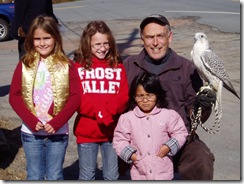 You also need to convince a local falconer to be your sponsor as you act as an apprentice, and capture either a juvenile red-tailed hawk or kestrel for training. After two years of apprenticeship, you are eligible to take a test in front of two people (one being your sponsor and the other a General Falconer) in order to receive your accreditation as a General Falconer. After that, you have the option of working as a General Falconer for five years and taking an additional exam to be certified as a Master Falconer, in front of three Falconers, which enables you to have additional rights as a Falconer.
TCC: It seems like a pretty involved process. What made you interested in falconry?
BB: I always had a love for birds, and for hunting, and this is an impressive combination of the two. I spend a minimum of two hours a day with my birds, and I enjoy every minute of it.
TCC: A dumb question – if your birds are hunting birds, what do you do for food for them in the winter?
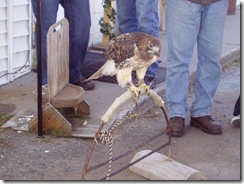 BB: That’s not a dumb question at all. My birds hunt wild turkey and, since they don’t eat the whole turkey in one go, I will often take the remainder and freeze it so that they can enjoy their prey during the whole winter.
TCC: Are there many Falconers in Sullivan County?
BB: The whole list is available through the DEC, but I have to say that one of the most interesting events that we have each year is our annual statewide meeting in Cobleskill. This year, it will take place on November 5, 6 and 7, and I am very much looking forward to it.
TCC: Brian, what advice do you have for someone interested in the sport of falconry?
BB: Monique (of Monique’s Book Boutique) has access to some of the best books on falconry. Other than asking me directly, that’s probably the best place to start.
For more information on the sport of falconry, and many other topics, contact Monique at Monique’s Book Boutique at 845-292-BOOK. Or visit the Monique’s Book Boutique page on Facebook.
Click any service in this box to share this post with your friends!
Related







 The Catskill Chronicle
The Master Falconer and the Bookstore
October 26, 2010 by The Catskill Chronicle
Compiled by Jeremy Gorelick
TCC: Brian, your birds are beautiful and so well behaved. Do you often bring them to events like this?
BB: Actually, no. These birds are not rescue birds nor are they pets. They are bred specifically for hunting and are not domesticated animals. They are used in the sport of falconry, which is defined by the DEC [Department of Environmental Conservation which also oversees hunting permits for other game animals] as a sport of hunting using trained raptors.
TCC: I had no idea that falconry was managed by the DEC. Do they have any specific restrictions?
BB: Yes, they do. In fact, it requires years of patience and practice to be called a falconer. The process is pretty specific. First, in order to be a falconer, you need to follow all of the guidelines that the DEC sets forth, including building a mew, (an old British word for a bird enclosure) that is a minimum of 8-feet wide, 8-feet long and 8-feet high with an eight-foot-by-eight-foot outdoor area, and buying a whole host of different paraphernalia that costs, on average, $1,500. You also need to convince a local falconer to be your sponsor as you act as an apprentice, and capture either a juvenile red-tailed hawk or kestrel for training. After two years of apprenticeship, you are eligible to take a test in front of two people (one being your sponsor and the other a General Falconer) in order to receive your accreditation as a General Falconer. After that, you have the option of working as a General Falconer for five years and taking an additional exam to be certified as a Master Falconer, in front of three Falconers, which enables you to have additional rights as a Falconer.
TCC: It seems like a pretty involved process. What made you interested in falconry?
BB: I always had a love for birds, and for hunting, and this is an impressive combination of the two. I spend a minimum of two hours a day with my birds, and I enjoy every minute of it.
TCC: A dumb question – if your birds are hunting birds, what do you do for food for them in the winter?
TCC: Are there many Falconers in Sullivan County?
BB: The whole list is available through the DEC, but I have to say that one of the most interesting events that we have each year is our annual statewide meeting in Cobleskill. This year, it will take place on November 5, 6 and 7, and I am very much looking forward to it.
TCC: Brian, what advice do you have for someone interested in the sport of falconry?
BB: Monique (of Monique’s Book Boutique) has access to some of the best books on falconry. Other than asking me directly, that’s probably the best place to start.
For more information on the sport of falconry, and many other topics, contact Monique at Monique’s Book Boutique at 845-292-BOOK. Or visit the Monique’s Book Boutique page on Facebook.
Click any service in this box to share this post with your friends!
Related
Posted in Comments | Leave a Comment
Comments RSS