GRAHAMSVILLE, NY (May 6, 2012) – Just about two weeks ago, the U.S. Environmental Protection Agency honored 26 individuals, organizations and businesses from across New York State with Environmental Quality Awards for their achievements in protecting public health and the environment.
EPA Regional Administrator Judith A. Enck was joined by Mayor Dana Redd of Camden, New Jersey to present the 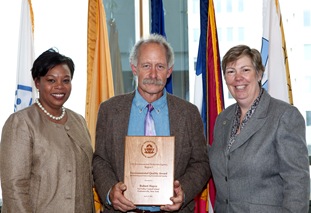 awards to this year’s recipients at a ceremony at EPA’s offices in Manhattan.
Included in the group was Robert Hayes, agriculture teacher at Tri Valley Central School, who was nominated for the award for the contributions he and his students have made to stream stewardship in partnership with Sullivan County Soil & Water Conservation District and New York City DEP.
In the photo at left are Dana Redd (left) Mayor of Camden, NJ, Robert Hayes – Tri Valley Central School and Judith Enck – USEPA Region 2 Administrator.
The EPA presents Environmental Quality Awards annually during Earth Week to individuals, businesses, government agencies, environmental and community-based organizations and members of the media in EPA Region 2, which covers New Jersey, New York, Puerto Rico, the U.S. Virgin Islands and eight federally-recognized Indian Nations. The awards recognize significant contributions to improving the environment and public health in the previous calendar year.
Mr. Hayes has engaged his conservation class students in a unique collaboration with stream management staff from Sullivan County and New York City DEP. In addition to learning about stream management concepts, the students established and operated a native plant materials center which provided willows and potted plants for stream stabilization projects designed and built to protect New York City’s unfiltered water supply. As they focus on the important day-to-day tasks associated with growing plants native to the Catskills, the students are part of the wider collaborative stewardship approach that has been demonstrated in the New York City watershed in which New York City and watershed residents work together to protect water quality and promote healthy ecosystems.
The learning activities are keyed to NY State curriculum goals for coursework in the National Resources cluster. Students acquire basic technical, manipulative, job-related, and societal skills in preparation for entry into employment and/or higher education in areas such as conservation, forestry, and fishery occupations.
One of the biggest contributions made by the students has been building a plant materials center to maintain potted native plants destined for stream restoration planting projects at local sites identified by the Catskill Streams Buffer Initiative. Prior to this project, the plants were in a remote location where, though near to a watering pond, access for deliveries and watering were challenging due to steep terrain.
As Tri-Valley already had a nursery developed with greenhouses and an abundance of surrounding lawn, the school proved to be an ide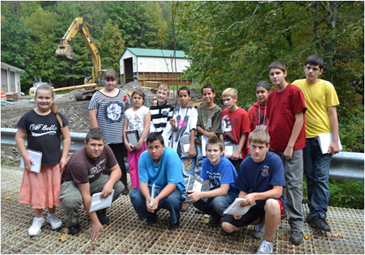 al site for everyone (and everything) involved – the plants, the field staff and the students. Mr. Hayes worked closely with Americorps intern, Brenden Wagner, and high-school intern, Steven Vogler, to build this plant facility. The students were actively engaged repotting plants into larger containers as they were moved from the mountain location to the new school storage. Irrigation was installed along with a deer exclusion fence, and the native plant facility steadily expanded and improved.
Students provide daily support to Rondout Neversink Stream Program by Mr. Hayes and class aides Mr. Fritz and Ms. Hussey. The biggest undertaking last fall was the creation of a willow-soaking pit to prepare 9,000 live cuttings for planting in a timber crib wall at the Ulster County Highway Garage in Sundown along an important tributary of the Rondout Creek. After excavating a large ditch, the students moved over 5 tons of sand to line the pit above and below a waterproof bladder, installed to create a temporary pond. They learned how to operate many hand tools, in addition to water pumps. The most important contribution they made was their daily, physical labor. The students enthusiastically moved the willow cuttings out of refrigeration into the pit for soaking. As the weeks went by, the cuttings sprouted all along their lengths and the student crew regularly helped the field staff load them in batches for transport to the restoration site 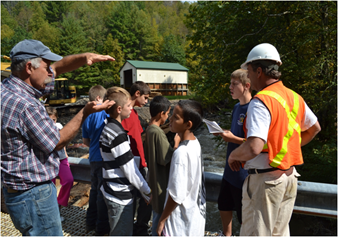 in Sundown. The students became an integral part of the project construction team and successfully completed their plant material supply function.
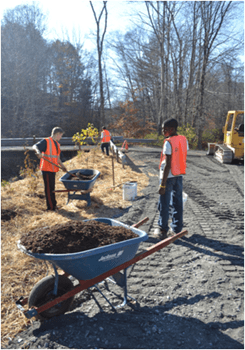
Visits to the restoration site were scheduled, where the students began to see the end result of all their hard work. They viewed the engineer’s plans, heard about the roles of the foreman and equipment operators, learned about safety onsite and studied many detailed aspects of the construction process up close, including all the materials specified in the design. When the timber crib wall was complete, the students returned to prepare a final planting of over one hundred trees, shrubs and ferns, which included digging holes, adding soil amendments, seeding and mulching.
Students reported on their accomplishments to a public audience at the December meeting of the Tri-Valley Central School Board. During their presentations, they were able to convincingly articulate the process, goals, learning and group and personal successes of the partnership experience. In addition, the field staff was invited to give a final report on the multiple benefits of this partnership: providing education and vocation for the students; caring for the nursery stock; aiding in the completion of contract deliverables for the field staff; and modeling a commitment to stream stewardship for the community.
 Plans are underway now to expand this partnership over the next two years. Cornell Cooperative Extension of Sullivan County recently purchased an EMriver model stream demonstration table for use by 4H middle/high school students with a grant received from the Catskill Watershed Corporation. A curriculum is being developed by Tri-Valley, Cooperative Extension and the New York City Department of Environmental Protection to demonstrate stream stability concepts for community audiences in presentations by Soil & Water Conservation Districts during this period of post-flood outreach activity.
In addition, the following activities are planned or in progress: greenhouse propagation of native seeds (by elementary school students); development of native willow beds for use in future stream bank restoration projects; partnering with Frost Valley YMCA to plant flood-damaged streamside areas; hands-on training with riparian design experts to learn bioengineering techniques; and eradication of invasive species in the watershed. This conservation team will continue to contribute to stream protection activities in their community and inspire the wider watershed stream program to replicate successes in other New York City watershed basins.
“Change that will create a healthier and more sustainable future begins with people like those the EPA is honoring today,” said Regional Administrator Judith A. Enck at the ceremony in Manhattan on Friday April 27. “They give of themselves and set a high bar in their actions to protect public health and the environment.” For information about the Environmental Quality Awards in EPA Region 2, visit http://www.epa.gov/region02/eqa/.
Click any service in this box to share this post with your friends!
Related







 The Catskill Chronicle
US Environmental Protection Agency Honors Tri-Valley Teacher
May 6, 2012 by The Catskill Chronicle
GRAHAMSVILLE, NY (May 6, 2012) – Just about two weeks ago, the U.S. Environmental Protection Agency honored 26 individuals, organizations and businesses from across New York State with Environmental Quality Awards for their achievements in protecting public health and the environment.
EPA Regional Administrator Judith A. Enck was joined by Mayor Dana Redd of Camden, New Jersey to present the awards to this year’s recipients at a ceremony at EPA’s offices in Manhattan.
Included in the group was Robert Hayes, agriculture teacher at Tri Valley Central School, who was nominated for the award for the contributions he and his students have made to stream stewardship in partnership with Sullivan County Soil & Water Conservation District and New York City DEP.
In the photo at left are Dana Redd (left) Mayor of Camden, NJ, Robert Hayes – Tri Valley Central School and Judith Enck – USEPA Region 2 Administrator.
The EPA presents Environmental Quality Awards annually during Earth Week to individuals, businesses, government agencies, environmental and community-based organizations and members of the media in EPA Region 2, which covers New Jersey, New York, Puerto Rico, the U.S. Virgin Islands and eight federally-recognized Indian Nations. The awards recognize significant contributions to improving the environment and public health in the previous calendar year.
Mr. Hayes has engaged his conservation class students in a unique collaboration with stream management staff from Sullivan County and New York City DEP. In addition to learning about stream management concepts, the students established and operated a native plant materials center which provided willows and potted plants for stream stabilization projects designed and built to protect New York City’s unfiltered water supply. As they focus on the important day-to-day tasks associated with growing plants native to the Catskills, the students are part of the wider collaborative stewardship approach that has been demonstrated in the New York City watershed in which New York City and watershed residents work together to protect water quality and promote healthy ecosystems.
The learning activities are keyed to NY State curriculum goals for coursework in the National Resources cluster. Students acquire basic technical, manipulative, job-related, and societal skills in preparation for entry into employment and/or higher education in areas such as conservation, forestry, and fishery occupations.
One of the biggest contributions made by the students has been building a plant materials center to maintain potted native plants destined for stream restoration planting projects at local sites identified by the Catskill Streams Buffer Initiative. Prior to this project, the plants were in a remote location where, though near to a watering pond, access for deliveries and watering were challenging due to steep terrain.
As Tri-Valley already had a nursery developed with greenhouses and an abundance of surrounding lawn, the school proved to be an ide al site for everyone (and everything) involved – the plants, the field staff and the students. Mr. Hayes worked closely with Americorps intern, Brenden Wagner, and high-school intern, Steven Vogler, to build this plant facility. The students were actively engaged repotting plants into larger containers as they were moved from the mountain location to the new school storage. Irrigation was installed along with a deer exclusion fence, and the native plant facility steadily expanded and improved.
Students provide daily support to Rondout Neversink Stream Program by Mr. Hayes and class aides Mr. Fritz and Ms. Hussey. The biggest undertaking last fall was the creation of a willow-soaking pit to prepare 9,000 live cuttings for planting in a timber crib wall at the Ulster County Highway Garage in Sundown along an important tributary of the Rondout Creek. After excavating a large ditch, the students moved over 5 tons of sand to line the pit above and below a waterproof bladder, installed to create a temporary pond. They learned how to operate many hand tools, in addition to water pumps. The most important contribution they made was their daily, physical labor. The students enthusiastically moved the willow cuttings out of refrigeration into the pit for soaking. As the weeks went by, the cuttings sprouted all along their lengths and the student crew regularly helped the field staff load them in batches for transport to the restoration site in Sundown. The students became an integral part of the project construction team and successfully completed their plant material supply function.
Visits to the restoration site were scheduled, where the students began to see the end result of all their hard work. They viewed the engineer’s plans, heard about the roles of the foreman and equipment operators, learned about safety onsite and studied many detailed aspects of the construction process up close, including all the materials specified in the design. When the timber crib wall was complete, the students returned to prepare a final planting of over one hundred trees, shrubs and ferns, which included digging holes, adding soil amendments, seeding and mulching.
Students reported on their accomplishments to a public audience at the December meeting of the Tri-Valley Central School Board. During their presentations, they were able to convincingly articulate the process, goals, learning and group and personal successes of the partnership experience. In addition, the field staff was invited to give a final report on the multiple benefits of this partnership: providing education and vocation for the students; caring for the nursery stock; aiding in the completion of contract deliverables for the field staff; and modeling a commitment to stream stewardship for the community.
In addition, the following activities are planned or in progress: greenhouse propagation of native seeds (by elementary school students); development of native willow beds for use in future stream bank restoration projects; partnering with Frost Valley YMCA to plant flood-damaged streamside areas; hands-on training with riparian design experts to learn bioengineering techniques; and eradication of invasive species in the watershed. This conservation team will continue to contribute to stream protection activities in their community and inspire the wider watershed stream program to replicate successes in other New York City watershed basins.
“Change that will create a healthier and more sustainable future begins with people like those the EPA is honoring today,” said Regional Administrator Judith A. Enck at the ceremony in Manhattan on Friday April 27. “They give of themselves and set a high bar in their actions to protect public health and the environment.” For information about the Environmental Quality Awards in EPA Region 2, visit http://www.epa.gov/region02/eqa/.
Click any service in this box to share this post with your friends!
Related
Posted in Comments | Leave a Comment
Comments RSS