Tracking the Asian Tiger Mosquito
May 31, 2013 by The Catskill Chronicle
SULLIVAN COUNTY, NY (May 31, 2013) – Cornell Cooperative Extension is tracking the Asian Tiger Mosquito.
The Tiger Mosquito or Forest Day Mosquito, Aedes albopictus (Stegomyia albopicta), from the mosquito (Culicidae) family, is characterized by its black and white striped legs, and small black and white striped body.
It is native to the tropical and subtropical areas of Southeast Asia; however, in the past couple of 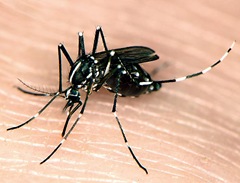 decades this species has invaded many countries throughout the world through the transport of goods and increasing international travel.
This mosquito has become a significant pest in many communities because it closely associates with humans (rather than living in wetlands), and typically flies and feeds in the daytime in addition to at dusk and dawn.
The insect is called a tiger mosquito because its striped appearance is similar to a tiger. Aedes albopictus is an epidemiologically important vector for the transmission of many viral pathogens, including the West Nile virus, Yellow fever virus, St. Louis encephalitis, dengue fever, and Chikungunya fever, as well as several filarial nematodes such as Dirofilaria immitis.
If you discover this mosquito biting you or someone you know, take a picture with your phone, download the app and/or visit the site listed below and let Cornell know. http://www.inaturalist.org/projects/asian-tiger-mosquito-range-in-new-york-state-and-beyond
It’s easy to identify – a large black-and-white mosquito biting you during the day.
Click any service in this box to share this post with your friends!
Related










 The Catskill Chronicle
Tracking the Asian Tiger Mosquito
May 31, 2013 by The Catskill Chronicle
SULLIVAN COUNTY, NY (May 31, 2013) – Cornell Cooperative Extension is tracking the Asian Tiger Mosquito.
The Tiger Mosquito or Forest Day Mosquito, Aedes albopictus (Stegomyia albopicta), from the mosquito (Culicidae) family, is characterized by its black and white striped legs, and small black and white striped body.
It is native to the tropical and subtropical areas of Southeast Asia; however, in the past couple of decades this species has invaded many countries throughout the world through the transport of goods and increasing international travel.
This mosquito has become a significant pest in many communities because it closely associates with humans (rather than living in wetlands), and typically flies and feeds in the daytime in addition to at dusk and dawn.
The insect is called a tiger mosquito because its striped appearance is similar to a tiger. Aedes albopictus is an epidemiologically important vector for the transmission of many viral pathogens, including the West Nile virus, Yellow fever virus, St. Louis encephalitis, dengue fever, and Chikungunya fever, as well as several filarial nematodes such as Dirofilaria immitis.
If you discover this mosquito biting you or someone you know, take a picture with your phone, download the app and/or visit the site listed below and let Cornell know. http://www.inaturalist.org/projects/asian-tiger-mosquito-range-in-new-york-state-and-beyond
It’s easy to identify – a large black-and-white mosquito biting you during the day.
Click any service in this box to share this post with your friends!
Related
Posted in Comments | Leave a Comment
Comments RSS