MONTICELLO, NY (August 6, 2012) – Monticello Village Historian Tom Rue prepared the following for the celebration of Monticello’s Broadway Centennial. He was gracious enough to share it with The Catskill Chronicle.
By Tom Rue, Village Historian
The Village of Monticello, New York
Sunday, August 5, 2012
Broadway is a small part of a highway that was the economic engine during Sullivan County’s earliest years, stretching from Newburgh on the Hudson River all the way to the Upper Delaware at Cochecton. Called "Main Street" in its first century, it is a one-mile stretch of the Newburgh Cochecton Turnpike.
In earlier years, livestock were a common sight. Horse-races and parades of decorated coaches were 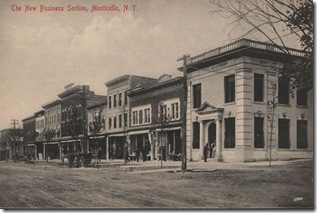 annual summer events. A very early resolution of the Board of Trustees prohibited pigs and oxen from running loose on Main Street. In later years, the Monticello Board of Trade boasted of Monticello’s broad streets lined with stately shade trees, including maples from which home-owners were known to tap syrup, even on here the village’s busy thoroughfare. Residents and business owners decided the street deserved a more cosmopolitan name than “Main Street,” which sounded like a sleepy little town.
At the February 22, 1908 meeting of the Board of Trustees, John J. Burns was appointed President of the Village. The first order of business, after he was sworn into office, was the following:
"Moved and carried that Main Street, Monticello, N.Y., be changed to Broadway, that Depot Street be changed to St. John Street; that the street east of the Village Park be renamed Jones Street; that the street running from Main to High Street, formerly called Orchard Street, be changed to Landfield Avenue."
On August 9, 1909, a massive fire swept through this neighborhood which started at the Murray Electric Co. located at the corner of what we know as North Street and Landfield Avenue – wiping out both sides of Broadway from the west side of Pleasant Street to the east side of Liberty Street, from the west side of St. John Street to the east side of Prince Street.
Four days later, on August 13, 1909, the Board of Trustees adopted laws prohibiting construction of wood frame buildings in that area, and “the construction within the corporate limits of the Village of Monticello any electric or steam power house for the purpose of furnishing electric light or power outside of the building, is hereby forbidden” unless the walls of the plant were at least 18 inches thick and built of solid concrete, with a roof of steel. Needless to say, no power plants have been built within Village limits since then.
Reconstruction began immediately, starting with the buildings, and then moving on to Broadway itself. The Board of Trustees ordered that Broadway be widened by 10 feet, “by purchase or condemnation.”
In a letter by Maj. John O’Neil, owner of the Colonial Hill, dated April 1, 1911, addressed to Village President John Burns, Major O’Neil gave the Village “permission to take out stone for repairing the streets. And will say that such repairs are sadly needed.”
Just as the Village was born again after its baptism by fire, ending with the 1912 paving of Broadway, it is now undergoing a rebirth at this centennial anniversary of that event. The Board of Trustees, State, and Federal officials worked hard, together, to see this project finished according to plans laid out over past years.
Let this rebuilt road represent our connection to each other, our shared heritage and future as a community.
Click any service in this box to share this post with your friends!
Read Full Post »
 They are looking for businesses to participate with booths, demonstrations and sponsorship opportunities.

 Dr. Harris, noted pediatric dentist and philanthropist, created an endowment fund for prevention of childhood dental disease. Annually, the ADAF (













 County Chamber of Commerce. An article written by Cindy Waxer for CNNMoney states: “Welcome to the world of social media where 140 characters can cause irreparable damage to your
  company’s reputation – and bottom line – in seconds flat. Blogs, Facebook, Twitter, LinkedIn – each one is a digital grapevine, letting consumers air their grievances to millions with the single click of a mouse.”
  The Governor’s legislation would also give authority to the Department of State to ban telemarketing companies that violate New York’s telemarketing laws from doing business in New York State.
 effect in 90 days.
 ROCK HILL, NY (August 10, 2012) – If you missed the August 1 meeting in Goshen, a second opportunity has been scheduled for August 22 in Rock Hill, Sullivan County.
 6:00 to 8:00 p.m.



 This year, seven women in seven categories are being recognized for their contributions to the Sullivan County community, and will be celebrated during a ceremony and cocktail reception to be held at The Club at Villa Roma.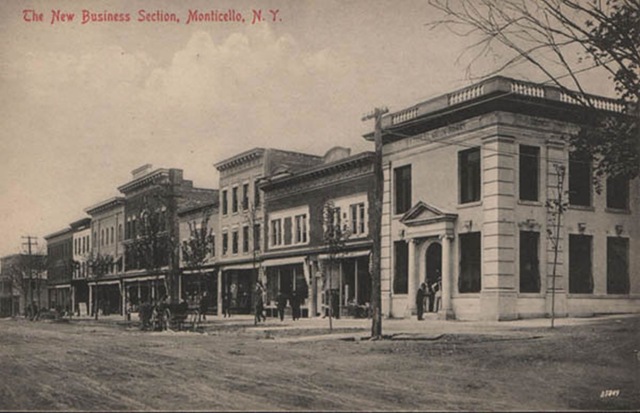

 achieved the goals that Alexis and the committee set forth, which were to create awareness about the needs of the Clubs, cultivate existing relationships within the community, and ultimately raise funds for the kids that the Boys & Girls Clubs serve."
 SULLIVAN COUNTY, NY (August 1, 2012) – The Catskill Chronicle is a three-year old community online newspaper that reports on events in Sullivan County, NY.
 While we’re on hiatus, take a glance at some of our archived stories that you may have missed, or that you may want to enjoy a second time:
  the Recovery Center and the Fallsburg Police Department are collaborating once again as part of the National Night Out Against Crime (NNO) at Brian Ingber Park in South Fallsburg from 5:30 to 8:30 p.m. on Tuesday, August 7, 2012.
 The third annual fundraising initiative, led by ShopRite Supermarkets, its customers, store associates and vendors, will raise funds to benefit The Schenectady Military Affairs Council, The Tower of Hope, The Orange County Veterans Food Pantry and The Committee for the Families of Iraq & Afghanistan War Vets – all of whom support the many needs of veterans and their families throughout New York State. This year, ShopRite has increased its goal to $275,000 – an increase of $50,000 from last year’s $225,000 raised. The campaign will run from now through September 8, 2012.









 The Catskill Chronicle

1st Annual Big Eddy Film Fest Announces Film Selections – Five Have Sullivan County Connection
Posted in Comments on August 24, 2012| Leave a Comment »
NARROWSBURG, NY – The Big Eddy Film Festival has announced the official selections for its first annual event taking place in Narrowsburg, NY from September 14 to 16, 2012.
The Festival opens with the Tribeca Films release “For Ellen,” directed by So Yong Kim and starring Paul Dano and John Heder.
“As this is our first year, we handpicked our selections from the best of what’s out there,” says lead programmer Tina Spangler, who previously served as a producer with Sundance Channel and a programmer at NewFest in New York City. “The curatorial philosophy is to show high quality films that advance the art of storytelling. With that simple guiding principle, I worked with a team of programmers to identify an exciting lineup of films, some of which screened earlier this year at festivals such as Sundance or Tribeca, and others that are brand new.”
The film selection includes three feature films, three documentaries, and 11 short films. A total of 18 directors will be presenting works at the Festival. Among these, half are women. Five of the film selections have a local connection to Sullivan County and/or the Upper Delaware River Region. There’s also a screening of short films made by local youth.
“We are really excited to be bringing back a credible film festival to the area,” says Elaine Giguere, executive director of the presenting organization, the Delaware Valley Arts Alliance. “We truly believe that this event will not only provide an economic boost to the local economy, but also provide a unique three-day cultural experience for residents and tourists of the Upper Delaware River region.”
“I’m so happy to have a new film festival starting up in Sullivan County,” says Academy Award-nominated actress Debra Winger. “Life only gets better when there are great venues like the Tusten Theatre to show films that entertain, educate and shine light on the things that connect us to each other and take us to worlds we’ve yet to discover.”
For more information, including the list of film selections, visit www.bigeddyfilm.com or call 845-252-7576.
Click any service in this box to share this post with your friends!
Read Full Post »