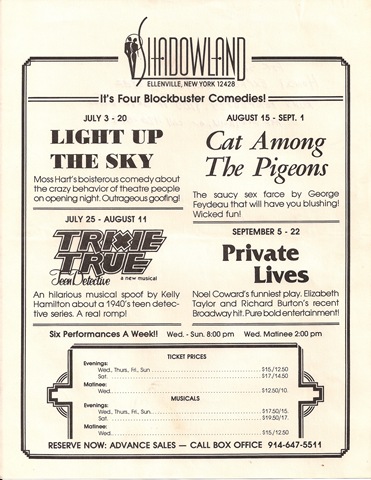
 ELLENVILLE, NY, June 14, 2010 – More than 25 years after defying long odds, harsh wintry conditions, scant supplies of food and little money to invest, members of the Cooperative Artists, the group that established professional theater at a then-closed 1920s Art Deco movie house in the old Borscht Belt region of the Lower Catskill Mountains are returning for a July 4th weekend reunion celebration at Shadowland Theatre, the Actors’ Equity theater in downtown Ellenville, NY, 90 miles northwest of Broadway.
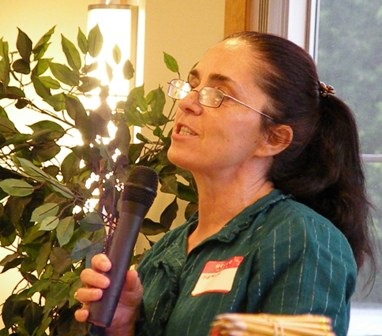
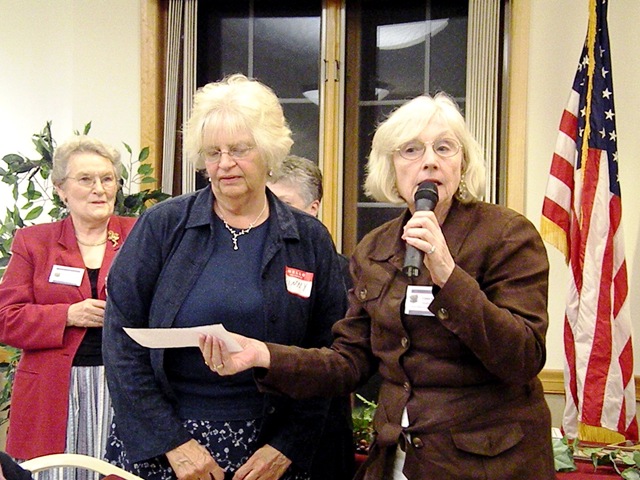
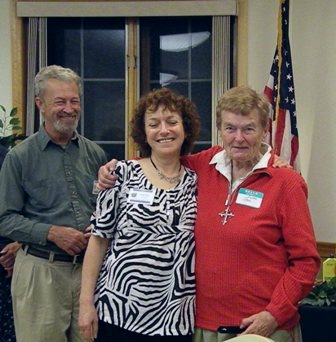
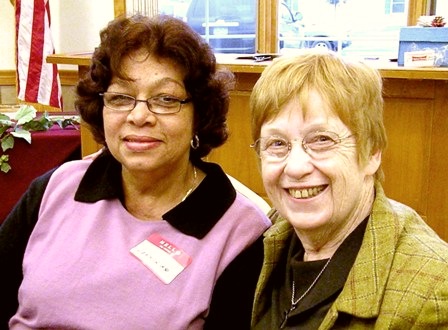
Open to the public, the reunion and reception will be held July 3 at 4 pm at Shadowland. Up to 15 of the original 33 Cooperative Artists members plan to attend, sharing memories, photos and recorded interviews from members unable to attend. At 8 pm, they will attend the evening performance of “Guest Artist,” written by stage and film star Jeff Daniels and directed by James Glossman. “Guest Artist” stars John Astin, who played Gomez Addams in the ABC-TV network series, “The Addams Family.” Astin, now director of theater studies at John Hopkins University, is returning to the Shadowland stage after an 11-year absence.
According to Brendan Burke, artistic director at Shadowland, some of the former Cooperative Artists members may be staying at the theater’s new housing, now nearing completion. Shadowland acquired the downtown house in December 2009 through a $50,000 donation from Provident Bank. It is being renovated at a cost of $100,000 to accommodate actors and crew, housed previously in local homes and rented apartments.
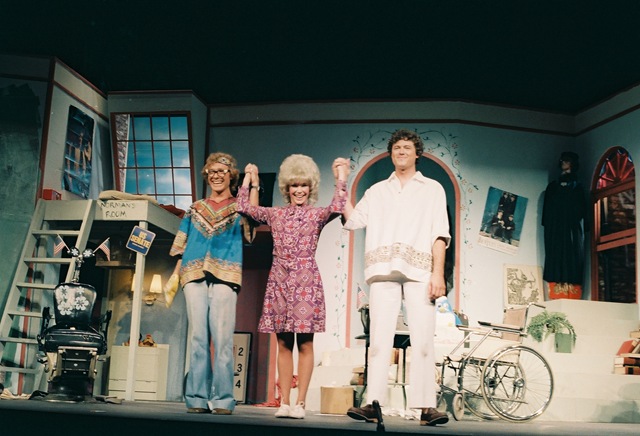 Andy Walter, a former president of Cooperative Artists and now a local resident, said professional theatre at Shadowland started with a vision fostered by Ron Marquette, the founding artistic director and currently coordinator of community relations and special events at SUNY Ulster, a local college. “Ron called in the dead of winter around Christmas, 1984 and asked me to head upstate and give an assessment of this theatre in Ellenville, to open it up and produce live shows with the acting company, Cooperative Artists, comprised of acting students trained at the American Academy of Dramatic Arts.”
Driving up in a January 1985 snowstorm, said Walter, they found the theater in a terrible state of disrepair, closed for more than a year after having been used as a movie theater for over 50 years. “Soon after, 33 people from Cooperative Artists drove up from the city and the decision was made to buy the theater, each chipping in $1,000 to get started.”
On April 15, 1985, Marquette, Walter and two other actors started at the front door, worked their way in, cleaning out the building, sleeping on the stage at night in the freezing cold theater that lacked heat and running water. In the following weeks, joined by other actors from the group who would drive up for a day or week to help when they could, the goal was to prepare the theater for a grand opening gala event during the July 4th holiday weekend. A press release was issued to the local community, not knowing anybody or what to expect, inviting them to come and see Kit McClure and Her All-Girl Swing Band plus the Cooperative Artists, who performed patriotic skits, songs and dance numbers.
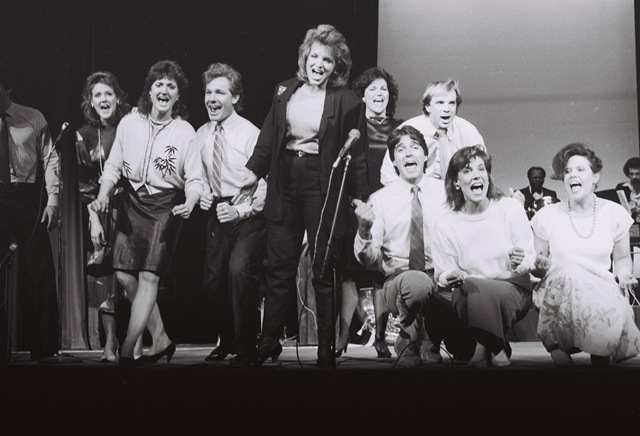 According to Walter, “We were amazed that the house sold out, which at the time was over 400 seats. The excitement was palpable. Within two minutes, many in the audience were standing, cheering, clapping.”
The group didn’t know what to expect, he said. “To be greeted by such a turnout was just the push we needed to prepare us for what lay ahead. The theater needed so much work and we were so broke. But local people would bring us plates of sandwiches and the pizza guy would bring us leftover slices at the end of the day. It kept us alive. Sometimes we would all chip in a dollar each and buy a large bag of potatoes…spuds. For several days at a time, we ate them for breakfast, lunch and dinner. It was desperation, but, boy, it was fun.”
As they picked up steam heading into their opening season, construction work continued inside the theater. “There was always someone playing the piano in the lobby accompanied by singing from whoever was in the room. We built sets on in a barn on Park Street, set them on huge, wheeled dollies and rolled them down the street in the middle of the night to the theater, so as not to disrupt traffic.
“A lot of people from the Town of Wawarsing and the Village of Ellenville supported the group,” added Burke. “Businesses extended credit, often for no other reason than they enjoyed that first evening with Kit McClure’s band. The fact that this group rambled into town and started from scratch was met with great support that continues today locally and throughout the Lower Hudson Valley region.”
“It had a feel to it,” added Walter, “similar to the Judy Garland, Mickey Rooney, ‘let’s put on a show’ concept.” From there, he said, “Creative people – actors, singers, dancers, writers, teachers, set builders, musicians – got involved in some way or another. But it was the original 33 and Ron Marquette’s vision for the whole thing that brought us together for such a wonderful, unique, exciting time in our lives.
A quarter of a century later, the original actors have moved on with their lives, some still in show business, some having returned to their home countries. “But to get together again, years later,” says Walter, “and celebrate such a unique, life-changing adventure is a time for us to stop and smell the roses over this wonderful thing we started. Today, Shadowland, this little theater that could, stands as a testament to the original vision and dedication and talent of the Cooperative Artists members.”
Tickets for the Saturday, July 3, 8:00 pm performance of “Guest Artist” are available at the Shadowland box office at 157 Canal Street, Ellenville, by calling 845-647-5600 or visiting www.shadowlandtheatre.org.
Andy Walter
Andy Walter studied acting at the American Academy of Dramatic Arts in Manhattan. He has written, produced and directed children’s plays in New York City and the Catskills. After helping found Shadowland Theater in the late 1980s, he moved to Ellenville, working at theater on a full-time basis for four years and served as president of the Cooperative Artists. He married, started a family locally and eventually leaving the theater, opened a carpentry business in the Hudson Valley area, 16 on center. He rejoined the Shadowland effort in 2007 as a member of the board of directors. In addition to operating his business, he teaches acting classes at Shadowland, producing children’s theater productions each winter. He has also functioned as general contractor for the rebuilding of a house in Ellenville, donated by Provident Bank that will serve as housing for Shadowland’s professional actors and staff.
About Shadowland Theatre
Shadowland Theatre is the leading professional nonprofit Actors’ Equity company in the Lower Hudson Valley/Catskill Mountain region. Located only 90 miles from New York City in Ellenville, NY, Shadowland was named “Best of the Valley” by Hudson Valley magazine in 2004, 2005 and 2007; “2006 Cultural Business of the Year” by Ulster Development Corporation and Ulster County Chamber of Commerce; “Best Theatre 2006” by the Times Herald Record; and “Best Drama of the Year” by The Daily Record in NJ for The Good German. Founded in 1984, Shadowland performs in a restored 1920’s Art Deco vaudeville/movie house converted to a 148-seat theatre. For more information, visit http://www.shadowlandtheatre.org.
















The Museum at Bethel Woods Invites Fans Nationwide to Be Part of Preserving History
Posted in Comments on June 29, 2010| Leave a Comment »
The Museum started collecting Sixties and Woodstock festival artifacts while it was being built. Since opening in 2008, The Museum has continued to acquire artifacts. The most interesting and significant acquisitions often come from donors who have a love of the decade and who enjoy knowing that their treasured object will be preserved and enjoyed by others in exhibits at Bethel Woods. Objects associated with the historic 1969 Woodstock Music and Art Fair are essential to the growth and educational potential of The Museum and are actively sought by its team. Past donations have created the beginning of an outstanding collection that continues to appeal to all generations from varied backgrounds throughout the world. Artifacts provide insight to the past and enhance and strengthen the ability to share history with future generations.
Special exhibit highlights include:
· Woodstock festival photographs shot by then 18-year old Doug Lenier – Lenier’s photographs offer a fresh look at the Woodstock festival, the crowds and the artists. Determined to photograph the 1969 Woodstock festival in Bethel, NY, Lenier grabbed his girlfriend and Nikon to capture the event. Lenier is a professional photographer and currently works in the music industry in California. Upon reading about The Museum at Bethel Woods, he reviewed his old festival photos and contacted The Museum. One photo confirms the existence of the often-mentioned, but never previously seen, Ferris wheel which was located atop the hill near where The Museum is currently located.
· Woodstock festival photograph shot by Richard Gordon – Gordon provides a new perspective on navigating the muddy field.
· Journal of artists and performances donated by John Marvelle – Kevin Marvelle enjoyed the entire festival, from Richie Havens through Jimi Hendrix, and maintained a handwritten journal that documents each act. This journal, donated to The Museum by his brother, is the ultimate corroboration for recent revisions to the history of “who played when.”
· Hog Farm “red rag” – The Hog Farm, the New Mexico commune hired by Woodstock promoters to set up the campground and assist with “public safety,” sent 12 people via bus to Bethel, NY to work the festival. Other communards joined them, and there were as many as 100 Hog Farmers working to develop campgrounds, prepare kitchens to feed the crowds and maintain order prior to the start of the concert. To create an identity for the Hog Farmers and their volunteers, Paul Foster, Hog Farmer and Merry Prankster, made a drawing of a hog with wings. Alton Kelley, one of the decade’s most highly-regarded poster artists, printed the image on red fabric, torn into strips, to be distributed to all Hog Farmers and volunteers. The red rags became both an all-access pass to any area of the site and symbol of the spirit of the festival.
· Yasgur Farm Artifacts – By the late 1960s, Max Yasgur’s dairy was the largest milk producer in Sullivan County. When Woodstock festival promoters tried to find a last-minute location for the festival, Yasgur agreed to lease one of his fields in Bethel, NY and the rest is history. Artifacts from the Yasgur’s dairy farm include a milk crate, creamery hat, bottle cap, and “swag” syrup pitcher that was distributed to his customers.
“It’s thrilling to see the permanent collection continue to grow and flourish,” said Lawrence. “Without the generosity of wonderful fans nationwide, who have donated touchstone pieces of recent history, much of the material witness to our past would be lost forever. We encourage all Woodstock and 1960s fans to go to our website and learn how they too can be a part of The Museum and history.”
If you own an object that is related to the historic 1969 Woodstock Music and Art Fair or the decade of the 1960s and would be interested in sharing it with the world, not only at the present time, but for generations to come, then The Museum would like to hear from you.
Please visit http://www.bethelwoodscenter.org/museum/about/contributeartifact.aspx for information on the process of submitting artifacts.
Museum director Wade Lawrence explained, “Please don’t send your artifacts to The Museum unless we have seen the item and have asked you to send it to us. We must first see a photo of the item being offered and hear a bit about its history in order to evaluate whether it is appropriate for the permanent collection. We couldn’t possibly accept everything that is offered to us. Some items we already have in sufficient quantity, others are readily available and could be easily borrowed if we needed them for an exhibition, and some items simply don’t fit our collecting mission. Additionally, there are costs to The Museum for each item we add to the permanent collection, including costs to catalog and research the item, to conserve it, and to properly display or store it. These policies are in place to help us build a collection of only the best examples and ones worthy of serious study for years to come.”
Admission to this special exhibition is included in the regular Museum admission. For more information on the special exhibit, The Museum, and Bethel Woods Center for the Arts, please visit www.BethelWoodsCenter.org.
About The Museum at Bethel Woods and Bethel Woods Center for the Arts:
The Museum is a not-for-profit 501(c)(3) educational corporation, which is dedicated to the study and exhibition of the social, political and cultural events of the 1960s, including the Woodstock Festival, and the legacies of those times. The Museum is located on lands owned by the Bethel Woods Center for the Arts which is dedicated to improving the quality of life in Sullivan County and the surrounding region by promoting economic development and interest in the region through arts, education and culture. For more information on The Museum at Bethel Woods, or Bethel Woods Center for the Arts, please visit http://www.BethelWoodsCenter.org. Follow The Museum at Bethel Woods on Facebook and Twitter.
Click any service in this box to share this post with your friends!
Read Full Post »