By Helena Clare Pittman
with Illustrations by Leni Santoro
If my cat, Violet, was going out, say to the store to buy some groceries, cat food, I’d guess, or maybe fresh litter, she’d wear a hat. I can’t imagine she’d go out without one.
 She might go shopping to a hardware store, perhaps for a new bowl for her water. Violet loves water, especially when it’s fresh. She likes to poke her paw into her bowl and stir it around before she drinks. Maybe it reminds her of the days she lived in the woods before she turned up on my porch, when our friendship began.
I imagine Violet’s hat would be red, maybe velvet. A cloche, I think, with a little veil, the kind ladies used to wear for dress when I was a child. Red velvet would suit Violet if she pranced daintily down the street and waited politely at the counter at Frankle’s Hardware Store to be waited on.
Therese is Violet’s daughter, though Violet seems to have forgotten this connection. Sometimes something comes up between Violet and Therese. Something I don’t quite understand since, in spite of my best efforts to
teach them, neither cat speaks English. Violet understands some English, however. She knows the word water. I can tell by the way her ears prick up when I say “Water, Violet, wa-ter!” And offer her a fresh bowl filled straight from the tap. It seems the equivalent of offering some people sushi.
 Therese understands “Kitties down!” though she forgets after a minute or two. But when something does come up between Violet and Therese, usually pretty suddenly, they chase each other around the house, hissing and growling.
If Therese were to go out, and I think she would under the right circumstances, instead of looking suspiciously at the light flooding through the front door when it’s open, having been born in the house, in fact, in my bed. But if my hunch is right she’d wear a straw hat with ribbon ties and maybe a flower, a crumpled blue satin rose for instance. The brim, wide, I imagine, might have a few seashells sewn to it. That would be Therese’s style.
If she did go out it would be to follow Tuck, her brother, who seems disinterested in that world of bright daylight beyond the front door. Doesn’t give it a second glance. Turns his back, in fact, as if it weren’t there at all. Maybe he doesn’t see it, I sometimes muse. A blind spot. A kind of kitty denial. What he hasn’t experienced doesn’t exist. Tuck and I have that in common.
But if Tuck were to take notice of the world beyond the door and step cautiously outside, I think he’d wear a cowboy hat. Not like Gene Autrey’s, that would be too reasonable for Tuck who weighs so much I have to support my back against a table when I pick him up to scratch his neck and whisper in his ear, to persuade him not to be so upset, to stop struggling to get back to the floor where I’m sure his huge, roley bulk feels much safer.
 Tuck, big as he is, is skittish. He doesn’t, for instance, take easily to men, hides when one shows up at the door delivering something or to make a repair. Tuck takes off when he hears a truck rumbling in the driveway, sometimes even a car–hears it before I do, me wondering why his ears are sitting against his head at that funny angle before he disappears to somewhere I can never figure, and can’t guess as I can never find him when I look. It’s always puzzling, him being so big and all. I can’t attribute any of this to trauma since he arrived a stowaway in Violet’s stomach and was born onto the same blanket, just after Therese. That lightning streak on his nose made him mine as soon as I saw him. Though he doesn’t like thunder, or high winds either. He’s looked for solace even from his mother then. She just swats him. Three months of mothering was, it seems, enough for Violet.
No, this cowboy hat would be the ten gallon kind, like Hopalong Cassidy’s. Hoppy was my idea of a good man when I was nine. It would be a white hat, like his. Tuck might even take to wearing it inside. Knowing Tuck’s eccentricities once he discovered that ten gallon he’d wear it all the time, wouldn’t need the excuse of going out.
I once had a cat named Babby. She would have worn a small pillbox hat. There was something in her character that seemed prim.
Hokusai, named for the great Japanese painter of the wave, who was, in all honesty, not a cat–he wasn’t a person either, but a sentient being, three quarters Siamese, one quarter street cat. My son was his mother and Hoke 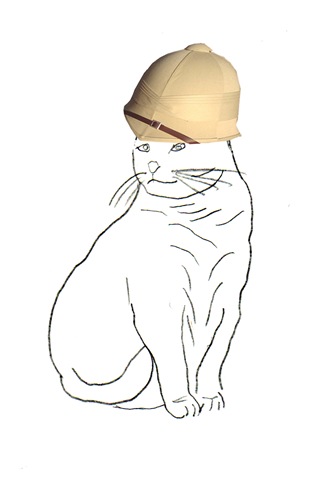 nursed on his earlobes when he was a kitten, causing my son to have red, bulbous Christmas-decoration-like lobes for most of the year of sixth grade. Even as a kitten he made eye contact with people. Major eye contact. “Who-are-you?” sort of eye contact. The owner of his mother, Chi Chi, who couldn’t sell a litter that wasn’t pure bred called us. “We think we have a cat for you,” she said.
My son and I are artists. Our eyes have the same What’s-your-purpose-on-earth look. Hoke was my significant other. My SOC. I imagine Hoke would wear a Safari helmut, and maybe now does, exploring the realms of bright light beyond the portals of this world through which he passed two springs ago, leaving me without a dancing partner during my late night shindigs in my studio.
These days when my work is done I turn to Tuck. But he is not up for it. That’s when I miss Hokusai most consciously, though his absence is a kind of general feeling tone now. About ten or eleven at night, after my work is done and the likelihood of anyone but a bear turning up in the trees beside the studio windows is slim I am still hesitant to listen to Sonny Rollins or Charlie Parker, or Bob Brosnan. Dancing alone is okay, but just to a point. It’s then I miss his purring against my heart. I think Hoke just enjoyed the bouncing. He purred most intensely when we danced. Hoke knew English, I’m pretty convinced. Though he held back from speaking it he indicated that he understood. He knew when I asked him to dance what I wanted. He’d lay down and purr as I moved toward him, clapping, bouncing, Want to dance, Hoke? He’d extend his front paws and look at me with his blue eyes, part wanting to escape, I think, part not being able to resist.
 Henry was a blind cat. He would have worn a fedora. I rescued him before he lost his sight, but after he never stopped going out, insisted on it, sitting in front of the door crying until, racked with guilt at either option, I’d open it. In this practice he was intractible,even when the irate mocking bird whose territory was the trees of my street dive bombed him. Henry would have tilted his fedora at a rakish angle. That feather would not have soothed that mockingbird’s temper, which was fierce. He’d have done better with a crash helmut, but Henry had too much style for that. Besides he never acknowledged his opponents, bird or cat. He only related to me.
 My cat Crombie would have worn a kerchief, I think. Maybe silk or even silver lame. She had a flair. Then there was Natasha, half Siamese half Persian. She would have worn something exotic, something from the bin at the Lord and Taylor Outlet, eccentric for even the shoppers that frequent that place. Green chiffon, perhaps, with a Dr. Seuss like center point, tilting a bit with a rhinestone pin. She could have carried that, cool and remote as she was, wouldn’t have cared who looked at her askance, wouldn’t have blinked her blue, brown-flecked eyes.
There are cats I visit in the homes of friends where I stay when I teach on Long Island. I consider these my niece and nephew cats. There’s Sixtoes, a cat with front paws so big the toes number more like seven, but he was named before anyone could get near enough to count them. An abandoned house cat, saved by my friend, in the wild he had the face of a man, his will to survive one with every sinew and muscle of his mountain lion body, pulling at his face, making his expression unsettling. Those were the days 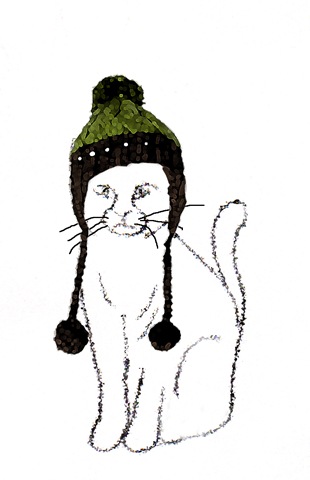 when he roamed the backyards siring litters of gray and white kittens like himself. I think if he were to choose a hat it would be knitted, Peruvian, the kind with a chin strap which Six would leave dangling to look cool.
These days he’s disguised as a pussy cat, well fed and plump, every need taken care of, a permanent resident at my friend’s place, where he was guided by some cat angel. I used to stand over Henry’s outdoor dish with a broom, staring into Six’s man’s face, he staring into mine, which no doubt expressed my own intensity–“I am not taking you on too,” I’d tell him. But my friend, Linda is of that species of human being that can not leave a living thing to starve. We struggle about her raccoon feeding problem.
 Stinky, another nephew, looks, in spite of his name, like a prince.
“He’s a cat on a mission,” says Linda, and I have to agree. Long haired and noble his royalty has a mysterious air. Maybe from the Northern Mongolian border, or the steppes of Central Asia, he’d wear an embroidered cap.
Sammy, a wildcat, still being tamed by my devoted friend streaks past me, terrified. He’d wear a Dick Tracy felt brim, wide black grosgrain ribbon, pulled low over his eyes.
This was my sister’s and my game. She had twenty two of these fortunate creatures, anti-social, three-legged, one-eyed, cats she couldn’t find homes for, cats that sat on the tops of doors, cats rescued or deposited on her doorstep. She was one of those people whose calling was their, and every other animal’s, well being. We’d choose the hats that expressed their personas and lose our breath laughing. She left this life too, thirteen years ago May, and her cats went here and there to friends, except Isis, who’s buried out back in my woods, which was then my sister’s woods. Isis would have worn something black that  dipped down in a V over her nose.
The others of her cats seem a blur, with the passage of these years, and though this story is dedicated to my sister I can’t conjure our laughter or quite bear the task of remembering her cats, name by name, hat by hat.
There was one, though, the only one my sister brought up here to the country in order to get away from the houseful in Queens and to concentrate on her legal briefs that served to improve the lot of these furry people who have no voices – and the humans who cared for them as much as she did.
The cat she brought up here, where I now live, was Scout. He was so special it’s hard to describe the mix of independence and devotion he had for my sister. It was obvious to me that he was head over heels in love with her. I think Scout would be wearing a Safari hat, like Hoke. They likely could be hanging out in that bright world together. They had a certain gravitas in common.
When my sister Jolene was dying she saw Isis, and others of the cats that she held in her arms as they made the crossing. She’d devoted her life to alleviating animal suffering, had some big cases, cases that effect people who  travel with pets. Or elderly people who live in rent-controlled apartments with their dogs, cats, maybe parrots. Cases she and her colleagues fought and won so that pets won’t die in the unregulated temperatures of cargo holds anymore, and elderly residents can’t be evicted after years of living with a pet just because the landlord or lady wants to get rid of them to turn the building into a co-op.
I don’t wear hats myself, don’t have the bone structure to carry them, though in these cold Catskill Mountains I’m gradually letting that vanity go.
I imagine when my time comes to cross over, hatted or hatless, my family will be waiting, and with them will be Henry, Isis, Crombie, Natasha, Babby, Ching, Thomas, Louisa, Glover, Bobo, Harry, Miko, Nikki, Biddy, Lester, Lacy, Scout and Hokusai, in his Safari hat, which I feel sure he will gladly remove to once again accept my invitation to dance.
To view the illustrations and/or to purchase prints from Cats, Hats and Eulogies visit the Chronicle on Zenfolio.








 The Catskill Chronicle
So very glad I found this truly great site