
Story by Ted Waddell
UNITED STATES – Welcome to the numbers game.
Step right up folks, and guess how many people are “homeless.”
It all depends of how you crunch the figures, the formulas for counting the “homeless” vary, but they are often outdated and sometimes confusingly complex depending upon the statistical focus.
In other words, nobody really knows for sure, but in a recent approximation outlined by the National Coalition for the Homeless in July, 2009, they quoted USA Today as estimating there are 1.6 million “unduplicated persons using transitional housing or emergency shelters” in America, living in the land of plenty.
The United States Department of Housing and Urban Development (HUD) requires federally funded organizations to use a computer tracking system for the homeless and records the statistics using the Homeless Management Information System (HMIS).
As a case in point, David P. Kreuter, chief administrative officer of the Recovery Center in Monticello, represents his agency as a member of the Sullivan County Task Force within the Continuum of Care, which conducts an annual point-in-time (PIT) count of the county’s homeless population for HUD.
On 1-28-09, the number of people who said they were homeless in Sullivan County was 245 sheltered individuals and families, along with an addition three people living in unsheltered locations.
Some organizations such as the Electronic Privacy Information Center (EPIC), take issue with counting the homeless, based upon “emerging privacy and civil rights issues” in this electronic age of personal data collection.
Most “snapshots of what the homeless population looks like,” don’t include the ‘invisible people’ living in abandoned buildings, broken down bungalows, caves, subway tunnels, cardboard boxes, under bridges or out by their lonesome in the woods.
Except for counts conducted in large metropolitan centers, the numbers don’t reflect the legions of forgotten homeless sleeping in doorways, trying to find a little bit of warmth on heating grates or huddled against the wind in doorways around the world.
According to an article titled “Human Rights” More Than 100 Million Homeless” by Gustavo Capdevila of the Institute for Policy Studies (IPS) based in Geneva, Switzerland, in 2005 there were an estimated 100 homeless people worldwide.
A Few Words About Homelessness from the USDHUD
In HUD’s Third Homeless Assessment Report to Congress (July 2008), the agency reported that on a single night in January 2007, a single point analysis indicated there were 671,888 sheltered and unsheltered homeless people in the U.S.
The HUD report (based on 2007 data) noted there were 123,833 people with repeated episodes of homelessness, or who have been homeless for extensive time periods; 82% of the homeless are not considered to be chronically homeless, while the remaining 18% are in chronic situations (6% sheltered, 12% unsheltered).
According to HUD’s estimate of sheltered homeless people, approximately 1,589,000 people used an emergency shelter and/or transitional housing during the 12 month period (October 2006-September 2007), a statistic that indicated one in every 200 people in the land of plenty was in a homeless facility at some point in time during that period: 1,115,054 (70.2%) individuals; 473,541 (29.8%) families, and the number of people with children in sheltered housing was about 130,968 (based in part on “HUD Reports Drop in the Number of Chronically Homeless Persons: More Resources and Better Reporting Contribute to Annual Declines”.
How Many Grains of Sand on a Beach? How Many Drops of Water in the Ocean?
Measuring the extent of the homeless population is like trying to count how many grains of sand there are on a beach, or how many drops of water there are in the ocean.
There are two basic methods used by researchers to count the ‘homeless’: point-in-time counts record all the people who are homeless on given day or during a given week while period prevalence counts document the number of people who are homeless.
Much of the previously reported data is based on findings from the National Survey of Homeless Assistance Providers and Clients (NSHAPC) which extrapolated their estimates from a study of nationwide service providers at two different times during 1996, and more recent findings by the Urban Institute and the National Law Center on Homelessness and Poverty (NLCHP).
The NSHAPC study was conducted under the direction of the Interagency Council on the Homeless (ICH), a working group of the White House Domestic Policy Council, and the Census Bureau collected the data for the 12 federal sponsoring agencies.
It was conducted to provide updated (now outdated) information about providers of assistance services to the homeless and the characteristics of the homeless who use these services for the “federal agencies responsible for administering homeless assistance programs and other interested parties”, but was not designed or conducted to produce a count or estimate of the number of homeless.
In 1987, the Urban Institute did the first national survey that interviewed homeless people, and the data from that study was collected before the passage of the Stewart B. McKinney Homeless Assistance Act (referred to as the McKinney-Vento Act) of the same year.
The National Coalition for the Homeless (NCH) in a report titled “How Many People Experience Homelessness” dated July 2009, stated “…there is no easy answer to this question and, in fact the question in itself is misleading.”
“In most cases, homelessness is a temporary situation – not a permanent condition. A more appropriate measure of the magnitude of homelessness is the number of people who experience homelessness over time, not the number of ‘homeless people’.”
According to the NCH, based upon the USA Today estimate of 1.6 million “unduplicated persons using transitional housing or emergency shelters,” approximately one-third are members of households with children, a 9% increase since 2007.
In early 2007, the National Alliance to End Homelessness (NAEH) reported a PIT estimate of 744,313 people experiencing homelessness in January 2005.
Another estimate of the number of homeless was a 2007 study conducted by the NLCHP over a given period of time, which stated that about 3.5 million people, 1.35 of them kids, are likely to experience homelessness in a given year.
“The high turnover in the homeless population documents by recent studies suggests that many more people experience homelessness than previously thought and that most of these people do not remain homeless,” said the NCH.
Getting Down to Brass Tacks
A study done in 1991 looked at homeless ‘rates’ (the number of shelter beds in a city divided by the city’s population) in 182 U.S. cities with populations in excess of 100,000 and according to the study found that homeless rates tripled between 1981 and 1989 for the cities as a group.
In 1997, the NCH reviewed research data complied over the decade (1987-97) in 11 communities and 4 states, and concluded that shelter capacity had more than doubled in 9 of the communities and 3 states, while in the other communities/states sampled, the shelter capacities had increased three-fold.
In the 2008 U.S. Conference of Mayor’s Report, researchers noted an increase of homelessness in 19 of 25 reporting cities over the previous year, and 16 cities reported an increase in the number of homeless families.
In a recent Conference of Mayors report, 12 of the 23 cities surveyed reported they had to turn people in need of shelter away due to a lack of available capacity.
Rural areas such as Sullivan County are hard-pressed to come up with actual figures on the number of homeless, due in large part to demographics and the varied definitions of ‘homelessness’.
But informed sources indicate the real numbers of homeless are probably 3-4 times the figures reported to federal/state/local agencies, not by design but the difficulty in getting a verifiable count.
“By its very nature, homelessness is impossible to measure with 100% accuracy,” said the National Coalition for the Homeless of Washington D.C.
“More important than knowing the precise number of people who experience homelessness is our progress in ending it. Recent studies suggest that the United States generates homelessness at a much higher rate than previously thought.”
“Our task in ending homelessness is thus more important now than ever.”
 *The Sullivan County Federation for the Homeless (SCFH) operates the county’s only soup kitchen, and is the process of trying to create a shelter for homeless single women and women with kids.
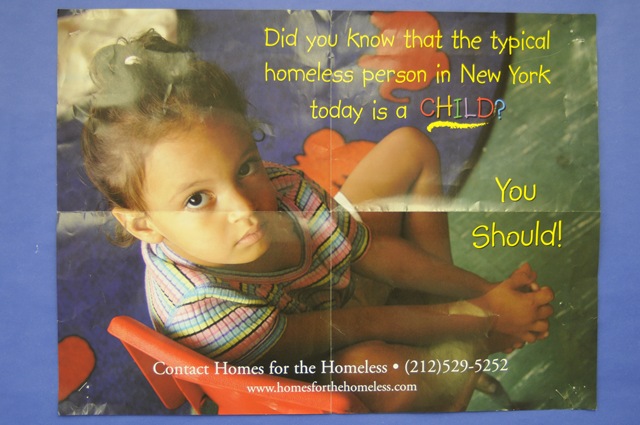
Homes for the Homeless is one of several agencies trying to help the nation’s legion of homeless children.










 The Catskill Chronicle
Leave a comment