Review by Barry Plaxen, Photos by Ken Howard/Metropolitan Opera
LOCH SHELDRAKE, NY (December 13, 2011) – On December 10, 2011, the Metropolitan Opera offered Charles Gounod’s “Faust” in the Live from the Met in HD series.
 The most popular opera in the world at the end of the 19th Century and the beginning of the 20th, one can see why it no longer retains that distinction in this post-Puccinian world with more sophisticated and discerning opera-goers who require different dramatic elements from opera, i.e. leaving the theatre with no questions such as “why did Faust leave Marguerite,” “why did they not marry,” etc., the Faust legend notwithstanding.
The societal shame and shunning of out-of-wedlock pregnancy is no longer the stigma that it was, and the legend is no longer shocking or provocative. And so the drama of the love story was much more interesting in this production than the philosophical elements. Hence, the above (and other) questions come to mind, especially since Faust portrays “love” not “lust.”
Once again, by offering more visuals and updating the plot (to cater to young audiences??), the production was spotty and not always synchronitic with Jules Barbier & Michel Carré’s libretto. Not when the townspeople and farmers talk about their fields and they are dressed like 20th Century laboratory workers. Not when Faust is describing Marguerite’s humble abode and obvious poverty, with the spacious stage filled with elaborate multi-level metal stairways, designed by Robert Brill.
In moments like those, director Des McAnuff’s updating did not work. In most other moments, the updating neither harmed nor helped. Perhaps only at the closing of the opera, when McAnuff “emended” the ending, did one of his ideas work for me – though it was not consistent with the Faust legend or true to the libretto. (Artistic license is always acceptable when something works, eh?) McAnuff made the entire opera a “dream” or “vision” taking place in Faust’s imagination within the brief moment before he lifts to his mouth and drinks his suicide potion.
 But when the music swelled with great beauty and was at its most lyrical and romantic, McAnuff did require the actors to stand still and sing, thereby allowing us to experience and wallow in Gounod’s vocal-yet-symphonic musical lines without the busy distractions of this production’s conceptual staging.
Paul Tazewell’s costumes were befitting the conceptual production, but did not mean much. The wigs and makeup were much more pleasing. There was uninspired choreography by Kelly Devine and adequate lighting by Peter Munford.
As Mephistofeles, René Pape (photo above) was  directed and costumed as a suave and almost dandified devil and so his character was sadly weakened by the director’s idea of a gentlemanly malevolence which did not gibe with his libretto-called-for satanic malevolence towards Marguerite at the end of the opera when she prays for her soul and wins entry into heaven.
Outstanding was Russell Braun (at center in photo above) as Marguerite’s soldier-brother, Valentin. Deeply influenced by and involved in the mores of the time  and his love for his sister, he portrayed his conflict with great passion and clarity. Mezzo Michèle Losieras (photo left) as Siebel, in love with Marguerite, performed well.
Once again, the Met stupidly and insultingly does not supply the names of singers in comprimario roles, so I cannot give deserved credit to the mezzo who sang Marthe and the excellent baritone who sang Valentin’s friend and compatriot, Wagner. It’s time for AGMA, the opera singers union (and the singers’ agents) to address this oversight.
And that brings us to the lovers.
I have waxed ecstatic before about Marina Polavskaya 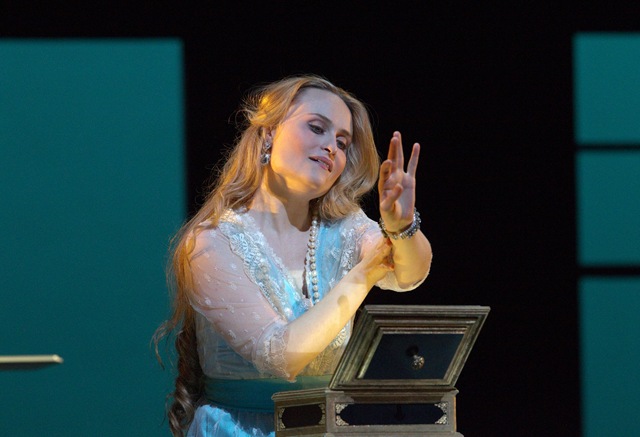 (photo right), (pop-LAV-skaya, as pronounced by hostess Joyce DiDonato.) Without opening her mouth, her face was abloom with innocence and purity, and later on, appropriately, with disgust and revulsion. When she did open her mouth, out came great singing full of emotion and musicianship. (She did seem to me to tire a bit on her high notes at the end of the opera). Her characterization was completely different than my recent viewings of her in “Turandot” and “Don Carlo.” A great actress. A real “star.”
 Jonas Kaufmann (photo left) in the title role was perfection in every way. A world renowned lieder singer also, one can see why – with his remarkable ability to color his tones, and his expansive range of expression, not to mention his beautiful, lyric voice. At the end of Act II, when he sings how much he loves Marguerite, he incorporated an incredible diminuendo prior to and during a descending musical line – a bit sooner than most other tenors I have heard do it – and it was a moment to cherish for a lifetime – when music and drama and situation and characterization all come together and give meaning and great value to the word “opera.” So much so that, as that act ended and the intermission began, hostess DiDonato did not adhere to her planned script as she began to interview him, but mentioned how everyone backstage was thrilled with and moved by his “incredible diminuendo.” It was the highlight of the afternoon, also noticed and appreciated
 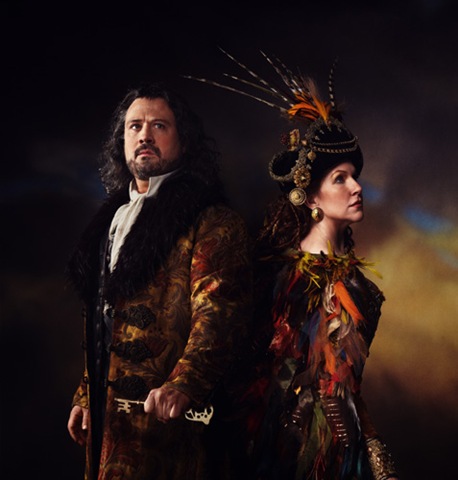 by the entire audience. It took me quite a while to “recover” from the experience and get back into myself. I shall never forget it.
So much for the drama. Gounod’s music was sung superbly by all the main world-class performers. What a joy to see them and hear them, close up with supertitles. Always an incredible and joyful way to experience opera.
The exciting music was dramatically and well-served by conductor Yannick Nézet-Séguin and the wonderful Met orchestra and chorus.
The next opera in the series is “Enchanted Island” (photo right), a new opera with music taken from Handel, Vivaldi and Rameau, on January 21, 2012 at 1:00 p.m. Call 845-434-5750, ext. 4472 for information.







 The Catskill Chronicle
Excellent review! I wish I could regularly read critiques as thoughtful and thorough in the NY Times.
“Artistic license is always acceptable when something works.” I’m going to get someone to embroider a sampler for me with that line!
Cori Ellison, NYC Opera Dramaturg