Review by Barry Plaxen, photos by Ken Howard/Metropolitan Opera
LOCH SHELDRAKE, NY (May 3, 2011) – On April 23, at Sullivan County Community College in Loch Sheldrake, an opera-loving audience braved the rainy forecast and witnessed the Live From the Met in HD “livecast” of Richard Strauss’ opera “Capriccio”.
 Written in 1942, “Capriccio” is Strauss’ last stage work, and is subtitled “A Conversation Piece for Music,” which is THE definitive description – it is a conversation, not a drama, not a comedy, but a conversation. Perfect fodder for the cerebrally / intellectually inclined, rather than the emotionally inclined.
The idea of the libretto came from poet Stefan Zwieg in the 1930s. Strauss later took on the libretto, but finally recruited the original conductor, Clemens Krauss, as his collaborator on the libretto. Most of the final libretto is by Krauss.
But a poet is a poet is a poet. A librettist is a librettist is a dramatist, one would hope. And “Capriccio” is the perfect example of what happens when skilled musicians write a libretto. Ho-hum. Can you imagine what might happen if every poet or librettist attempted to write a musical score?
“Capriccio” is a conversation about whether music is more important than poetry in the creation of a song or opera, but since that is a moot discussion, this opera, as drama, goes nowhere. 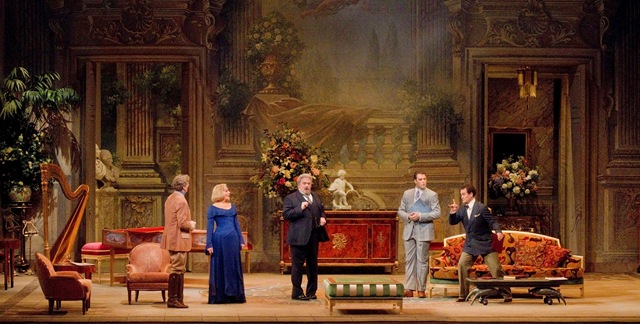 One wonders whether those involved in the libretto ever heard Schubert or Brahms songs or saw a Verdi or Puccini opera, where sometimes music takes precedence, sometimes the words take precedence, sometimes they are equal, sometimes drama or theatrical effect takes precedence, etc. So who needs a discussion about it? Certainly not Bizet or Mozart or Wagner or Menotti. Or me.
The plot is a physical expression of the discussion. A young widowed Countess cannot decide whom she loves, a poet or a composer. And since what the plot is based on is moot, paralleling that, she never makes up her mind. If you enjoy “Lady or the Tiger” plots – where there is no resolution at the end, and “discussion is the thing”, then you will enjoy “Capriccio”.
This Met production is set in the 1920s with marceled hair and flapper-style garb, but Renee Fleming as the Countess (photo top) is dressed out of the period – with exquisite gowns and a contemporary hairdo, looking gorgeous and deliciously unattainable. The music is not as  lush as Strauss’ “Der Rosenkavalier” or “Arabella,” so there is no sumptuous soaring for Fleming to do, and not much in the way of emotional music.
As the composer and the poet who are in love with her, Joseph Kaiser (photo right) and Russell Braun (photo below) are excellent, conveying true visible emotions –  love, jealousy, fear, etc. Peter Rose as
La Roche, a theatre director and entrepreneur, actually states (in the discussion) that words and music mean nothing if the audience doesn’t feel the characters are real flesh and blood. For me, that was the end of the discussion. But not for this Straussian-Kraussian diatribe. Nor was there someone to really care about in the upper class mélange of characters.
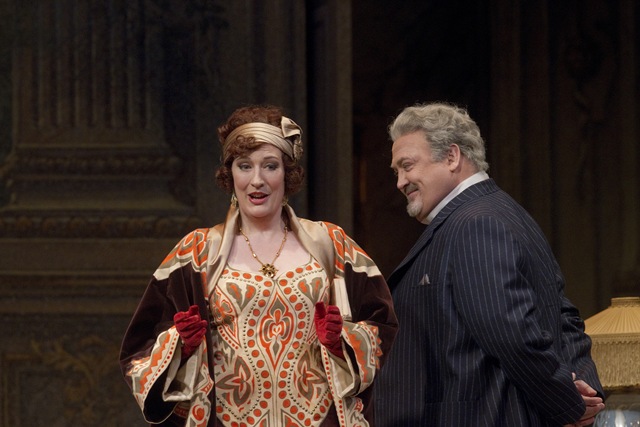 A famous Parisian actress, Clairon, was acted and sung by Sarah Connolly (at left in photo with Peter Rose) who lacks both charisma
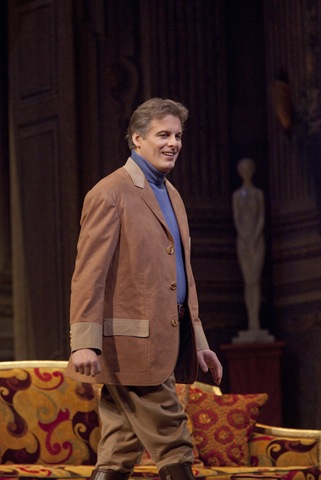 and sexuality. I could not believe Morten Frank Larsen as the Countess’ brother (photo right) – or for that matter, the Parisian male public in general – would be enamored of her. Perhaps if Fleming had a twin sister who portrayed that character, it might have worked for me.
The orchestra was ably conducted by Sir Andrew Davis. The direction by John Cox was as best as can be with a plot that is totally a discussion.
Stay tuned for the review of the next-to-last opera in the “livecast” season: Il Trovatore, a music-drama by Verdi.








 The Catskill Chronicle
Leave a comment