Review by Barry Plaxen, photos by Marty Sohl/Metropolitan Opera
LOCH SHELDRAKE, NY (March 27, 2013) – Francesca da Rimini or Francesca da Polenta (1255–1285) was the daughter of Guido da Polenta, lord of 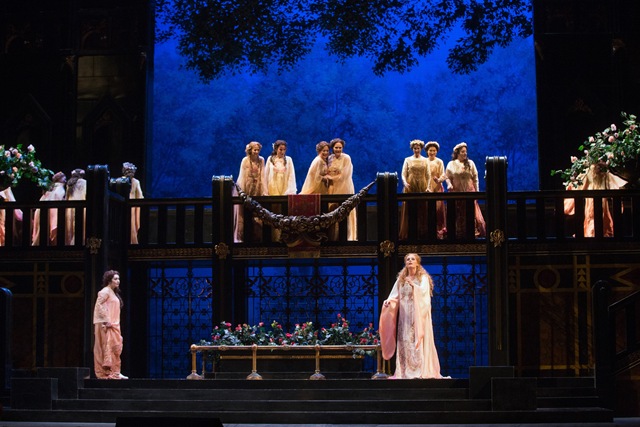 Ravenna. She was a historical contemporary of Dante Alighieri, who portrayed her as a character in “The Divine Comedy.”
Many artists have depicted her love story in paintings and many composers have used it for compositions, including Tchaikovsky’s symphonic poem “Francesca da Rimini,” Arthur Foote’s symphonic prologue “Francesca da Rimini,” and Rossini’s recitativo ritmato for soprano and piano “Francesca da Rimini.” Perhaps Tchaikovsky’s work is the most popular, but it is closely followed by Riccardo Zandonai’s (1883-1944) opera. Born one generation after Puccini (b.1858), Zandonai wrote over a dozen operas of which Francesca is the only one not “all but forgotten.”
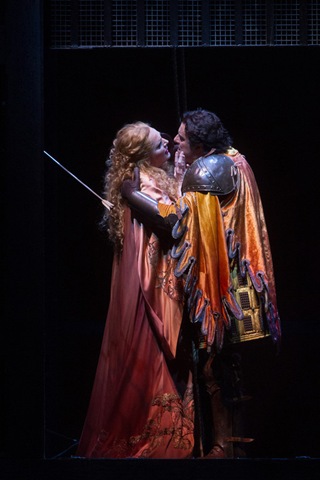 Zandonai’s version is an opera in four acts, with a libretto by Tito Ricordi, after a play by playwright/poet Gabriele d’Annunzio, first staged in 1914. The New Grove Dictionary of Opera states, “it is one of the most original and polished Italian melodramas of the 20th century, [which] combines a powerful gift for Italian melody … with an exceptional command of orchestration.” In Loch Sheldrake at Sullivan County Community College on March 16, 2013, where it was presented as another in the Live From the Met in HD series, that quote was obvious to some and not so to others.
Perhaps it was because the music was more of a cross between Strauss and Debussy with an Italian flavor (if such a thing is possible), and the libretto, thanks to its origins in d’Annunzio’s poetic play, was more poetry than dialogue. Zandonai  was certainly not following in the footsteps of Verdi, Puccini and his (Zandonai’s) mentor Mascagni, all of whom favored dialogue over poetry and over episodic descriptions. So you have those in attendance with no preconceived expectations, happy with the lengthy vocal lines and difficult harmonies (Strauss) and the low key, not very rhythmic except in spots and more descriptive than dramatic melodies (Debussy), and unhappy others like myself, who did not get the “Italian neo-realism character-driven musical-drama” expected, but got episodic poetic vignettes instead.
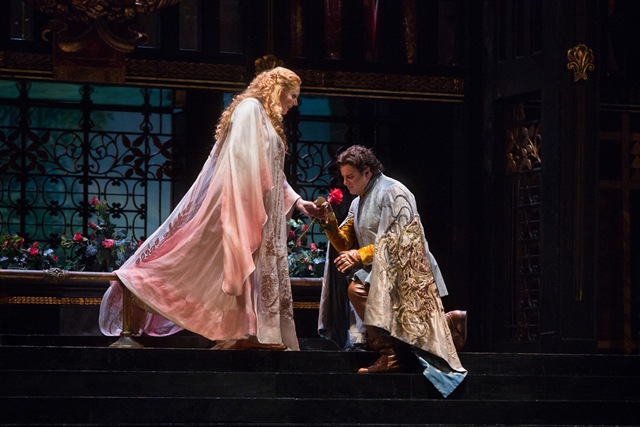 The story revolves around Francesca, married to Gianciotto BUT in love with his brother, Paolo. Much of it is about should she/they consummate their love or should they not. From the start of the opera, you know they will, and from the start of the opera you know Giovanni will kill them. No surprises here. And there are many unanswered questions as to the why and how she was “blackmailed” by her brother into marrying someone other than he whom she thought she was marrying, and that that “he” also knew she was being deceived into marrying his brother.
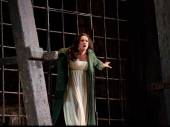
 Interestingly, the highlight of the opera for me had no singing. It happens when, under the impression that Paolo is her destined bridegroom, Francesca falls deeply in love with him at first sight; he also falls passionately in love with her, and they convey those emotions although they do not exchange a single word. And herein lies my chosen review “title.”
The scene of love at first sight was beautifully staged and acted, indicative of most of what I saw that afternoon. That the production outweighed, outshone  and was more moving than the opera itself. More chills went through me thanks to the physical production and the craft of the performers than because of the opera itself.
With outstanding and powerful, majestic sets by Ezio Frigerio, exquisite, historic costumes by Franca Squarciapino and remarkable staging by David Kneuss, who was able to keep as much dramatic momentum as possible going in lieu of the episodic and poetic libretto, all came together perfectly within Piero Faggioni’s visually splendid production and the ever-superb Met orchestra, conducted by Marco Armiliato.
Once again, the smaller roles were sung and acted by world class performers: Robert Brubaker as the “other” brother of Paolo and Gianciotto who plots the deceit with Francesca’s brother sung by Philip Horst, a bevy of luscious 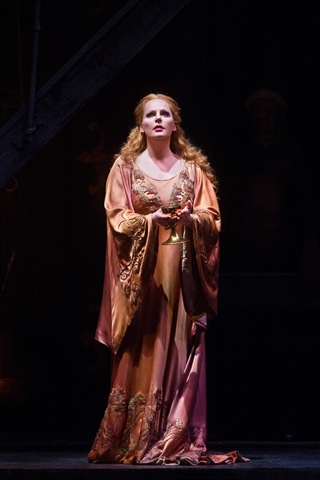
The three leads did as much as they could with the dramatic aspects of their roles, enhanced by the inspired staging and production values that surrounded them. Vocally, Eva-Maria Westbroek as Francesca and Mark Delavan as her spouse Giancotto were in great voice, but  as Paolo, Marcello Giordani was a bit strained in his higher register, unlike his usual bravura singing that I have witnessed in past “livecasts,” which distracted from his strong presence and the sensitive phrasing in his less strenuous passages.
As the un-sung love-at-first-sight moment was the dramatic highlight of the afternoon for me, discovering a great, new voice for the 21st Century was the musical highlight. As Smaragdi, the “head” lady-in-waiting and Francesca’s confidante, Ginger Costa-Jackson (photo right) stole in the show with a mezzo timbre to die for and a stage presence that heralds a future star of the world’s operatic stages.
Opera trivia: Zandonai was among several composers the Ricordi publishing firm considered for the task of finishing Puccini’s “Turandot.” Puccini himself, in his final illness, seems to have supported the choice of Zandonai – certainly conductor Arturo Toscanini looked with approval on this choice – but his son Tonio Puccini, for reasons still obscure, vetoed it. Ultimately Franco Alfano, a student of Puccini, was chosen to complete it.
Next in the series: Handel’s Giulio Cesare, April 27 at noon. For more information, 845-434-5750, ext. 4472.







 The Catskill Chronicle
Thanks Barry, for a thoughtful review with a point of view I have not read before. Keep ’em coming.