Review by Barry Plaxen, Photos by Ken Howard/Metropolitan Opera
LOCH SHELDRAKE, NY (May 7, 2011) – After the last two showings of the Live from the Met in HD series, which included one opera, “Capriccio,” a discussion of whether music or words was most 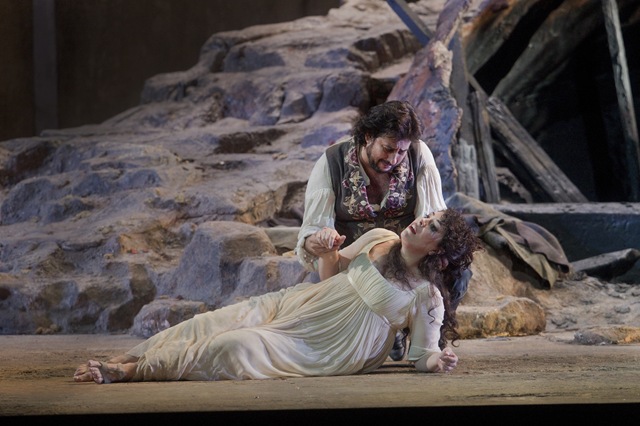 important in song or opera, and another opera which was a hackneyed farce by Rossini, the Met returned to the standard repertoire for the April 30, 2011 “livecast” of Verdi’s “Il Trovatore,” shown locally in Loch Sheldrake at Sullivan County Community College.
Unlike the discussion-libretto in “Capriccio,” Verdi and his librettists, Salvadore Cammarano and Leone Emanuele Bardare, knew when to stress the dialogue, when to use poetry, and when music needs to take precedence. One can see why this opera is standard repertoire.
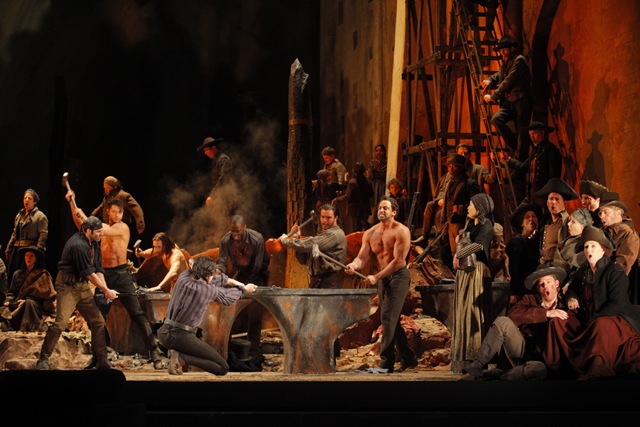 The first two acts are used for exposition in which two characters relate past events involving a Count, his son and a gypsy, from two points of view – third person and first person. Between the relating of the two variations of the past events, Verdi and the librettists interspersed a love triangle containing much love and much hate, taking place during a “civil” war in which the two opposing armies are led by the two males of the love triangle.
The libretto is based on a play titled “El Trovador” but Verdi originally called his adaptation “The Gypsy.” Once can see why – the real drama of the piece lies in the Gypsy’s character, the conflicts raging within her and her resulting behavior. But before it was premiered, Verdi chose to revert to the title of the original and add focus to the love story, probably because of the inspired music that poured forth from his pen for the three lovers.
Like “Carmen” or “Don Giovanni,” “Il Trovatore” contains arias, duets, trios, choruses and musical passages that soar, entertain, thrill, and are highly moving and dramatic. Especially in the two fourth  act scenes, one glorious dramatic/musical moment follows another. A great soaring soprano aria, a dramatic duet with chorus ending with the soprano’s cabaletta, an intensely emotional soprano-baritone duet followed by a soft and tender tenor-mezzo duet, and then the dramatic ending. Masterful opera music, indeed.
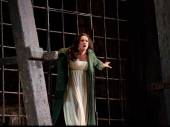
Though the April 30 cast was aware that dramatic believability was paramount, they knew they must sing with great skill and great musicality. And they did. As Leonora, the woman adored by both army leaders, soprano Sondra Radvanovsky (photo left) was meticulous in her major first act aria.. Underlying all the vocal technique needed for the difficult aria, its soaring portamenti and its fast paced cabaletta, was her wonderful ability to communicate her deep emotions. 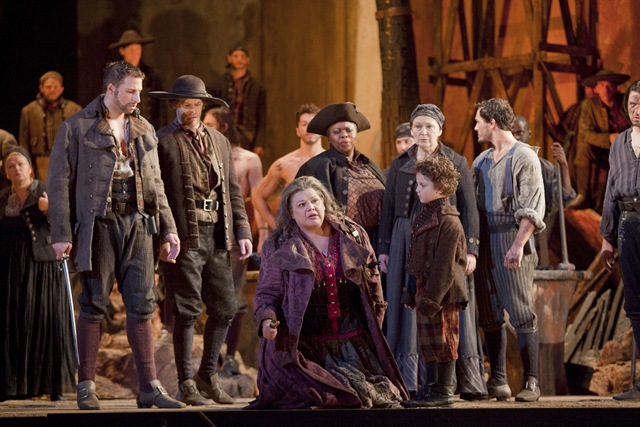 The same was true – and even more so – with her fourth act aria, one of opera’s greatest solos, her duet with the baritone/villain, and her death scene in which her two portamento passages were exquisitely executed.
Mezzo-soprano Dolora Zajick (photo right)is well known for her performance of the confused and conflicted gypsy and sang with great conviction, aware of all that was needed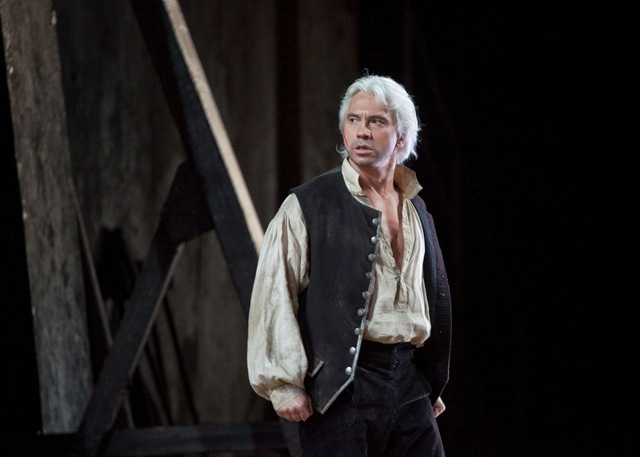 to bring out the drama in Verdi’s music.
Tenor Marcelo Alvarez (top photo) and baritone Dmitri Hvorostovsky (photo left), as the rebel leader and his adversary in love and war, were totally fulfilling in their musical and dramatic roles, though I suspected Hvorostovsky was not in his best voice. But a Hvorostovksy singing to 85% of his ability is far and above what most other Verdian baritones can offer. Rounding out the superb cast, Stefan Kocan as Ferrando, Captain of the loyalist forces, was just about as perfect as the four major performers.
Conductor Marco Armiliato and the orchestra (and the chorus) were excellent, and there was one wonderful orchestral moment – two brief solos in the prelude to the last act prior to the soprano’s great aria, beautifully phrased by the clarinetist and bassoonist.
Next and last of the season’s “livecast” series is Wagner’s “Die Walkure,” May 14 at Noon. 845-434-5750, ext. 4472.







 The Catskill Chronicle
Leave a comment