Review by Barry Plaxen, Photos by Ken Howard, Metropolitan Opera
LOCH SHELDRAKE, NY (December 5, 2012) – Director/designer Jean-Pierre Ponnelle’s (1932-1988) production of Mozart’s, “La Clemenza Da Tito,” staged for the Cologne Opera in 1969, not only put that opera back into the repertory of major opera  houses (I am not even sure if it ever was in standard repertories) but 43 years later, after having been re-created in most major opera houses such as the Metropolitan Opera in the 1980s, it is still the quintessential production of Mozart’s last work for the stage.
“Clemenza” was written to serve an emperor’s coronation and Mozart made the work to suit his employer’s demands and taste which, I assume, was the Opera Seria style that Mozart used in his early not-so-well-known-or-often-performed-today operas, written prior to his opera buffa masterpieces, “Cosi,” “Figaro,” “Giovanni,” and his singspiel masterpieces “Abduction” and “Magic Flute.” Mozart started “Clemenza” after he wrote “Flute,” but completed it prior to “Flute’s” premiere.
Opera Seria features classical characters from antiquity bestowed with princely values and morality, struggling with conflicts between love, honor and duty, with the Italianate musical pattern of alternating sharply-contrasted recitative and aria (that grew out of the Baroque opera style) that started to wane in popularity towards the end of the 18th century as more dynamic and dramatic libretti and more dynamic and dramatic musical orchestration began to take precedence, relegating Opera Seria to near-oblivion, as audiences began to identify more with (then) present-day upper, middle and serving class Opera Buffa characters, rather than historic royalty.
 The Live from the Met in HD performance on December 1, 2012 at Sullivan County Community College enabled those lucky people in the audience to witness that, with “Clemenza,” Ponnelle resurrected the Opera Seria form and imbued it with theatrical magic, theatrical brilliance and theatrical wonderment.
This production is another example of how to direct and design and stage an opera:
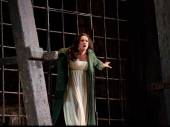
- A sumptuous and sumptuously beautiful set with muted colors, matching the muted colors of the exquisitely beautiful 1790s costumes. Yes, the costumes were set in the time the opera was written, not in ancient Rome when Tito (emperor Titus) reigned.
- Move both the main characters and the chorus so that the open heavy set has movement and kinetic energy – decreasing and increasing the “open cube” spatially while bringing focus to whomever is singing, as with a magical moment in the last act when the entire chorus merely takes one step towards the center of the stage, en masse, and brings your eye and complete attention directly to Tito who is about to finalize his catharsis.
- Imbue the libretto by Caterino Mazzolà, after Metastasio, with as much depth and universality as possible, with physical movement and dramatic motivation.
- If Mozart’s music is not (arguably) as inspired or innovative as we are used to – I could hear strains from “Cosi,” “Abduction” and “Giovanni” – don’t worry, don’t apologize for it. This is an opera style that lies in between Handel and late Mozart, and dramatize and dress it as such. Don’t insult your audience by trying to make it something it isn’t.
- Leave a legacy so that new replacement performers, and the chorus, can be given all the necessary motivations and stage movements to embellish their vocal prowess with total character and plot believability.
 The plot involves who is in love with whom and who wants to marry whom and who wants the throne, no matter the cost. But it is really about loyalty, honesty and clemency, with self-expression, self-awareness and a bit of societal demands thrown in the mix. It begins a bit slowly and melodramatically as characters define themselves, but once they begin to interact directly with each other, melodrama dissipates and your interest increases as you get involved in multiple dramatic soul-searchings that culminate in a highly moral, compassionate and uplifting manner.
Henry Bicket conducted the Met’s superb orchestra. The chorus, once again, performed with great concentration, adding much to the qualities of time, place and situation, especially in the dramatic last act.
 One dramatic weakness is the title, as Tito is not the main character, even though the plot centers around him and the final outcome depends on him. Tenor Giuseppe Filianoti brought all the necessary stature to the role and sang well, if a bit strained on a very few high notes. His conflict and catharsis were vividly and clearly expressed.
Soprano Barbara Frittoli as “the villain” also had a very tiny bit of high note discomfort, and though she may have been somewhat obvious in her villainry in the beginning, her genuineness during her catharsis was extremely and deeply moving. She also displayed a fascinatingly deep and dark chest tone that she used to dramatic advantage.
 Oren Gradus in the small role as the captain of the guard was not on a par with all the others. He looked like a 2012 opera singer with a wig, and his singing and acting was not on the level I have come to expect from the Met’s comprimario singers. He added nothing to the tension and involvement all the other performers brought to this consummate production.
Soprano Lucy Crewe in the role of Servilia, sister of Sesto and lover of Annio, had some exquisitely and rapturously sung moments. Her portrayal of honesty, guilelessness and courage added much warmth to the cold machinations and the confusion of other characters. Her duets with Annio stole the show, so to speak.
Mezzo Kate Lindsey as Annio, friend of Sesto, was magnificent throughout the opera, as a confidante and as a lover. Her warm voice and her flawless acting were a joy to behold.
For me, Sesto is the main character. He, confidante and close friend of the emperor, and in love with the villainess, has a complicated personality. Mezzo Elina Garanča superbly conveyed all the conflict his foolish and disloyal acts caused within his self. Watching Garanča go though his pain, despair and shame was what great theatre is all about – our being able to fully empathize with a character created by an actor who knows inherently how to communicate emotions and thoughts.
Imagine! Elina Garanča convincingly playing Sesto, a “pants role,” after seeing her perfect performance as the sexually seductive Carmen a few years ago! Ecco un artiste!
Crowe, Lindsey and Garanča were also a joy to behold in their duets, ensemble singing and, simply, their presence. Their vocal skills, along with Frittoli’s and Filianoti’s, made the listening aspect of the afternoon a magical event, despite some slightly overlong Opera Seria arias.
No credit is given to the wig and makeup creators, but along with Ponnelle’s sets and costumes they had a great deal to do with the distinguished and exemplary production.
Next up Live from the Met in HD in the Seelig Auditorium are Verdi’s “Un Ballo In Maschera” (December 8) and “Aida” (December 15). For tickets call 845-434-5750, ext. 4377.







 The Catskill Chronicle
Thank you, Barry, for such an informative and sensitive review. It certainly made me sorry I missed such a (almost) perfect performance. Kudos to SCCC for bringing such beautiful and important theatre pieces to Sullivan County.