Review by Barry Plaxen, Photos courtesy of the Met Opera Press Department
LOCH SHELDRAKE, NY (January 11, 2012) – “Les Troyens” (“The Trojans”) is an opera in five acts by Hector Berlioz (1803-1869).The libretto was written by Berlioz himself from Virgil‘s epic poem, “The Aeneid.”
 Berlioz had a keen affection for literature, and he had admired Virgil since his childhood.
The score was composed between 1856 and 1858, but Berlioz did not live to see it performed in its entirety. Under the title “Les Troyens à Carthage,” the last three acts were premièred with many cuts at Paris’ Théâtre Lyrique in 1863. Berlioz complained bitterly of the cuts that he was more or less forced to allow, and his letters and mémoires are filled with the indignation that it caused him to “mutilate” his score.
Some legendary musicologists have been quick to call “Les Troyens” one of the greatest operas of all time, with comments such as:
“In the history of French music, “Les Troyens” stands out as a grand opera that avoided the shallow glamour of Meyerbeer and Halevy, but therefore paid the price of long neglect. In our own time the opera has finally come to be seen as one of the greatest  operas of the 19th century.” (Hugh MacDonald)
British music critic W.J. Turner declared that “Les Troyens” was “the greatest opera ever written.”
Music critic David Cairns described the work as “an opera of visionary beauty and splendor, compelling in its epic sweep, fascinating in the variety of its musical invention … it recaptures the tragic spirit and climate of the ancient world.”
American music critic B. H. Haggin heard in the work Berlioz’ “arrestingly individual musical mind operating in, and commanding attention with, the use of the [Berlioz] idiom with assured mastery and complete adequacy to the text’s every demand.”
In my Internet searching, nowhere could I find any theatre critic saying anything along those lines, and ay, there’s the rub (to quote Berlioz’ other literary favorite) with the opera as seen at Sullivan County Community College in Loch Sheldrake, Live from the Met in HD, on January 5, 2013.
Berlioz is, of course, well known for his orchestral and choral masterworks, his significant contributions to the modern orchestra and his highly melodic and lyrical songs. He is not well known for his three operas, and his erratic libretto witnessed in the Seelig Auditorium could be indicative of why.
 Acts 1 and 2 take place in Troy at the close of the Trojan war. Acts 3, 4 and 5 take place in Carthage. There are really two separate operas here, the first containing only one short, really dramatic scene between Cassandra and her lover Corebus. The second half contains only a few dramatic scenes, with the most highly and dramatically powerful ones being the last two of the opera. Sandwiched in between these well written dramatic scenes are endless hours (yes, hours) of music of great innovation and outstanding orchestration, expressed with inspired beauty – but with an overly narrative libretto offering no dramatic conflict, too much ballet delaying what movement there might be in the story, and not much room for character driven plot twists. These poor people’s lives are either controlled by their rulers or their Gods. No free will here, so not much in the way of interesting human behavior – until the last two scenes, that is.
 What a pity it is that Berlioz never saw his opera in its complete form. He might have seen what scenes work as opera and what scenes don’t, and agreed to necessary cuts and revisions.
Conductor Fabio Luisi led a full orchestra in the pit and an expanded chorus. I have never seen so many people on the Met stage at once. More dancers and supernumeraries than ever before, also.
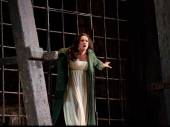
The production by Francesca Zambello added nothing to the scenes, whether they were the dramatic ones or not. There were even some stage props (too abstract to describe) and stage business (a choral conductor with a baton) that were not of the pre-Christian era. And, when only male Trojans and female Carthaginians seem to be sexually celebrating their mutual victory over a war with the Numidians, there don’t seem to be any male Carthaginians around to share i n the festivities. Ah yes, and one very distracting ballet that was performed while a major aria was being sung.
(I am not unaware of the requirements of 19th century French opera regarding ballet, but in my opinion there was too much of it, and, please, not while someone is singing.)
As Berlioz’ music – brilliant orchestrations (but lacking the spectacular melodies of his songs) – ruled the afternoon, he was assisted by some of the Met’s finest singers: Deborah Voigt (Cassandra), Dwayne Croft (her lover, Coroebus), Bryan Hymel (Aeneas), Kwangchul Youn (Narbal, Dido’s adviser), Eric Cutler (Iopas, Dido’s Court Poet), along with the unbilled sailor, Hylas, and Aeneas’ son Ascagne. Hymel was outstanding musically and dramtically in his last scene with Dido, and Cutler and Youn also made strong impressions with their lyrical singing. As Dido and her sister Anna, Susan Graham and Karen Cargill “stole” the afternoon with their delicate, legato Act III duet, just prior to a sumptuously “thick” and lush Berlioz-ian vocal septet which was the musical highlight of the afternoon for me.
After Graham’s and Hymels dramatic (finally!) Act V duet, Graham, though hindered by some weird stage design, succeeded in moving the audience with her “death scene,” which was sparked into existence by Aeneas’ abandonment of her to fulfill his Gods-dictated destiny. Without any understanding of his needs, Dido joins forces with the Gods of Hades, and expresses her anger, hate and desire for revenge, which was for me, a not-so-understandable reason for her suicide.
In 1861, Berlioz wrote in a letter, “I am sure that I have written a great work, greater and nobler than anything done hitherto.” Elsewhere he wrote, “The principal merit of the work is, in my  view, the truthfulness of the expression.” For Berlioz, truthful representation of passion was the highest goal of a dramatic composer, and in this respect he felt he had equaled the achievements of Gluck and Mozart.
But to my ears and eyes, though “The Trojans” does contain the legacy of Gluck’s musical reforms, the opera does not contain Gluck’s and Mozart’s dramatic reforms, which include the theatrical fine art of libretto writing.
I do believe that if Berlioz had been willing to share the responsibility of creating this massive opera with a skilled librettist, what the above music critics said would be echoed by theatre critics.
Next in the Live from the Met in HD Series is Donizetti’s “Maria Stuarda” on January 19. For information: 845-434-5750, ext. 4472.








 The Catskill Chronicle
Thank you Barry, for such a thought-provoking review.