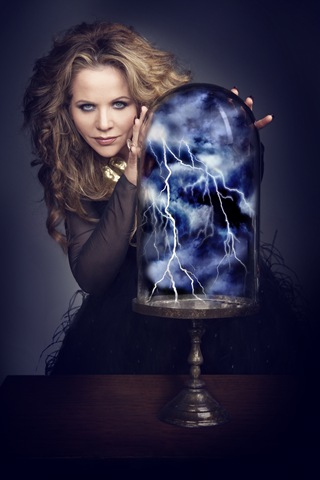
Photo provided courtesy of Dusan Reljin/Metropolitan Opera.
Review by Barry Plaxen
LOCH SHELDRAKE, NY – In 1580, Italian poet Torquato Tasso (1544 –1595) wrote his best known poem, Jerusalem Delivered, a fictionalized account of the first crusade, circa 1099. Various sections (stories) of the poem were used as a basis for many operas, and in today’s world of opera his story of Rinaldo and Armida is somewhat known from performances of Handel’s opera Rinaldo.
In April 2010, the Metropolitan Opera produced a version of the same story written by librettist Giovanni Schmidt that had its world premier in 1817. The opera has never been done at the Met before, and after viewing it “Live in HD” on May 1 in the acoustically perfect Seelig Auditorium at Sullivan County Community College in Loch Sheldrake, one easily understood why.
This adaptation by Schmidt of Tasso’s epic poem, titled Armida, was the brainstorm of Gioacchino Rossini (1792-1868) and was composed during what might be called his “middle period”, after Barber of Seville and Cenerentola. Breaking with convention, Rossini created an opera with roles for – count them – no less than six tenors. “Rossini tenors” are hard to come by, but to find five of a high caliber for a production (one tenor sang two roles in this instance) is often almost impossible. His convention-breaking also includes – I know of no other example – an outstanding trio written for three tenors.
And expanding on convention, for his future wife, soprano Isabella Colbran, Rossini created one of the longest and most demanding soprano roles in the repertoire, containing extremely difficult coloratura passages along with both lyrical and dramatic passages of every sort. In general, most sopranos choose not to take on a role that includes these three different styles of singing.
The story contains a combination of real and imagined historic characters, in addition to mythical and imagined creatures from the netherworld, which aid in the creation of a “grand” opera with scores of beings and the fascinatingly costumed creatures singing, dancing, running, jumping and pirouetting all over the stage and each other. (Yes, Armida has the obligatory fifteen minute ballet that grand opera had to include in the early 19th century).
The production under the helm of Mary Zimmerman was a spectacle. A grand entertainment. And necessarily so, because the cast of characters are all immersed in, and sing about, feelings of hate, rage, jealousy, revenge, pride, killing, manipulating, controlling, etc., and the performers were so perfect in their depictions of these unsavory qualities that it was difficult to find someone with whom to identify and to root for. So the viewer needed the entertaining spectacle to compensate for the lack of any emotional involvement with the characters.
And that also means the viewer had to be heavily involved with the music, more than with the usual combination of music and drama. Fortunately, that was easy to do. Though not as memorable as in the famous Rossini operas, the music was a joy to listen to. Highlighted by incredibly long melodic lines and tempestuously difficult runs and glissandos, the audience thrilled to the technical perfection of the singing actors. And with the appearance of one tenor after another, it got better each time – from superb performers such as John Osborn and then Barry Banks, to the magnificent and charismatic performance of Met star Lawrence Brownlee as Rinaldo.
Which brings us the other reason for producing Armida – Renee Fleming. Claiming not to be a coloratura specialist, or a spinto specialist, or a dramatic specialist, Fleming is capable of singing to perfection in all three styles. (Spinto, from the Italian, “pushed”, is a vocal term used to characterize a voice of a weight between lyric and dramatic.) As the only soprano in the cast, she “competed” with the tenors and with the massive production and “carried the show” with her technical abilities, her charm and her presence.
And, once again, the Met chorus and orchestra need to be recognized for their contributions. Conductor Riccardo Frizza was shown to be “having a ball” conducting the riveting music and his enthusiasm was evident. I guess that’s who this viewer was rooting for.
Thanks again go to Sullivan County Community College for offering this series and giving us the chance to see world class opera close-up. Prior to next fall when the college will present the 2010-2011 season, from June 16 to July 28 on Wednesday evenings, they will “revive” recent Live From the Met HD performances.
Armida..................Renée Fleming
Rinaldo.................Lawrence Brownlee
Goffredo................John Osborn
Gernando................Barry Banks
Ubaldo..................Kobie van Rensburg
Carlo...................Barry Banks
Idraote.................Peter Volpe
Love....................Teele Ude
Revenge.................Isaac Scranton
Ballet Rinaldo..........Aaron Loux
Conductor...............Riccardo Frizza
Production..............Mary Zimmerman
Designer................Richard Hudson
Lighting Designer.......Brian MacDevitt
Choreographer...........Graciela Daniele
Associate Choreographer.Daniel Pelzig
TV Director.............Gary Halvorson







 The Catskill Chronicle
I love people who find humor in my writings. Especially when I mean it to be there!! Thank you, Peggy Friedman…
Barry Plaxen
Thank you, Berry Plaxton, for such a well-written, amusing and informative review of Armida. We are so lucky to have the resource, via HD live broadcast performances, of the Metropolitan Opera’s great productions. Thank you also to Sullivan College CC for making the season possible. My husband and I can hardly wait for next season.