Review by Barry Plaxen, Photographs © Ken Howard/Metropolitan Opera
 (April 1, 2011) – The Live From the Met in HD performance “Lucia Di Lammermoor” at Sullivan County Community College on Saturday March 19 seemed to be hampered by contradictory elements.
I must say that the audience did not share my disappointment as the applause after each and every aria, duet and scene was quite enthusiastic, much more than in recent “live-casts.” Obviously the music was getting to the audience, but I wanted some drama, too.
There was something amiss. And, for me, that something was a lack of passion, which is very surprising when one considers that the conductor, Partrick Summers and the orchestra were so passionate in their delivery of Gluck’s music for the last “live-cast” in February. Not so for Lucia.
Perhaps the blame lies with the librettist, Salvatore Cammarano. The plot, a Romeo & Juliet story is about two warring families who value the continuation of the feud more than its dissolution, thereby ruining their lives.
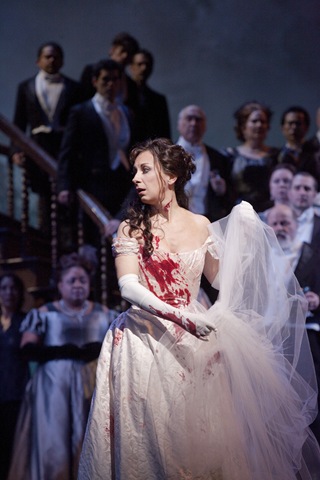 There are too many scenes of exposition in which the story unfolds but nothing happens. No character changes as the opera progresses. No one has a catharsis or a realization of any kind, an element necessary for drama.
Most disappointing, dramatically, is the famous mad scene. Having never seen this opera before, I expected to witness the heroine transitioning from sanity to madness. And especially was eager to see Natalie Dessay “lose it,” as she is one of, if not the greatest singing actresses alive today. Alas, that was not to happen. The librettist has her sane in one scene, perhaps “angry,” leaving the stage and then re-entering a bit later completely mad. I felt cheated. So much for expectations!
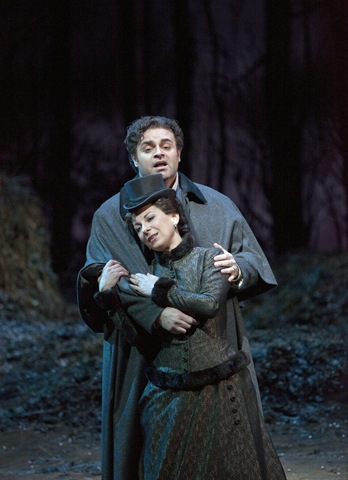 Perhaps the stage director, Mary Zimmerman, was to blame for the lack of passion as it permeated the orchestra pit and the stage, though not in all the scenes. Certainly, the scenes between Dessay and tenor Joseph Calleja as Edgardo, her lover, were very passionate and moving. But when either of them appeared in scenes with Lucia’s brother Enrico, the villain of the piece, performed by tenor Ludovic Tezier, that lack of passion was evident. Was it Tezier’s fault?
Composer Gaetano Donizetti is certainly not to blame, as the opera contains some of his most lyrical Bel Canto music. A second viewing might help me find the reason, and I am more than willing to view it again with another eye, as the singing was quite outstanding.
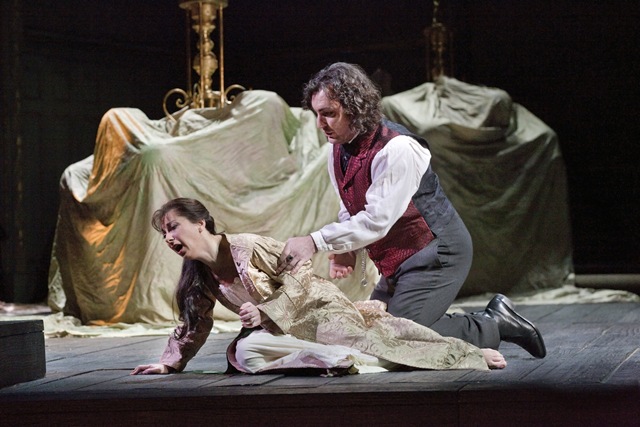 Dessay offered some lovely embellishments and phrasing throughout her entire presence, and Calleja was the afternoon’s big surprise. His voice is quite different than the tenors we have been listeing to the last 50 years, and reminds one of more bravura tenors such as Giuseppe Di Stefano and Mario Del Monaco from the 1940s and 1950s.
Again, the performers in the comprimario roles of Alisa, Normanno, and Lord artura are not listed in the program. Excellent singers all. Kwangchui Youn as the chaplain, Raimondo, sang beautifully.
Happily, the singing was the saving grace of the afternoon, not the drama.
The month of April will have three “live-casts”. April 9 – Rossini’s “Le Comte Ory”, April 23 – Strauss’ “Capriccio,” and April 30 – Verdi’s “Il Trovatore”. Call 845-434-5750, ext. 4472 for reservations.








 The Catskill Chronicle
Leave a comment