Review by Barry Plaxen, Photos: Ken Howard/Metropolitan Opera
LOCH SHELDRAKE, NY (April 13, 2012) – In 1731 French author Abbé Prévost wrote a short novel, “L’Histoire du chevalier des Grieux et de Manon Lescaut.” It was controversial and banned in France 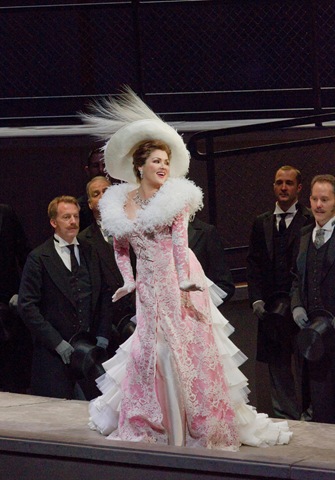 at the time. Despite this, it became very popular and pirated editions were widely distributed. In a subsequent 1753 edition, Prévost toned down some scandalous details and injected more moralizing disclaimers. Many musical adaptations of the novel were subsequently created.
On April 7, 2012 at Sullivan County Community College in Loch Sheldrake “Manon” composed by Jules Massenet, being one the of two works that are still in the operatic repertoire along with a version by Giacomo Puccini, was performed Live from the Met in HD. It is an opéra comique (yes, there is some dialogue) in five acts with a libretto by Henri Meilhac and Philippe Gille, first performed at the Opéra-Comique in Paris in 1884, and set in the mid 18th century during the time of Louis XV, Madame Pompadour, a debauched royal court, et al.
Not so this production: another tiresome and useless operatic updating.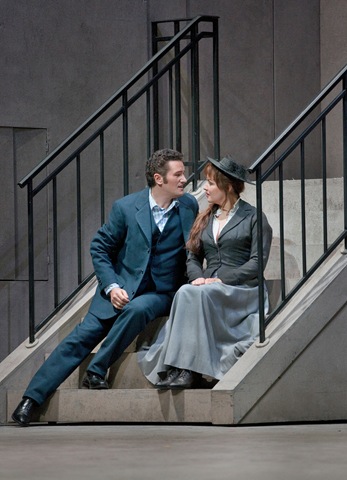
This time the director, Laurent Pelly, chose the end of the 19th century for the action, but neglected to delete all the references to the King and royalty. Nor did he add any liberty, equality or fraternity to this post-revolution updating. Only his costumes were from that Belle Époque period of Paris.
The set by Chantel Thomas was pure 2012, heavy and lugubriously juxtaposed against the elegant costumes and Massenet’s opulent and romantic score that cleverly included Baroque music in the ballet sequence, adhering to the mid 18th century setting of the original libretto.
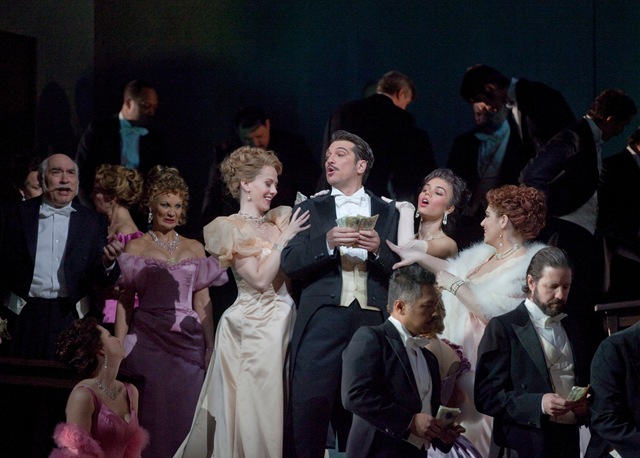
You were constantly jarred out of your involvement in the opera each time there were references to the King and royalty, and also due to Pelly’s choice to have conflicting acting styles. The major supporting actors performed as buffoons in the early acts, set against the realistic portrayals of the leading roles. In the later acts, the buffoons changed their acting style to the serious realism of the protagonists.
Massenet’s 1884 music is the quintessential example of the charm and vitality of the music and culture of that 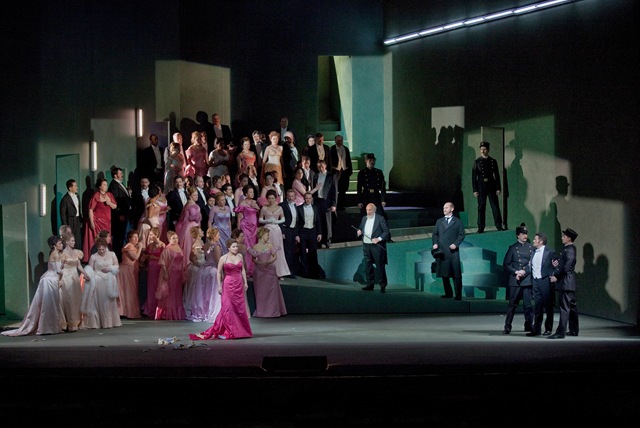 period in Paris. The Met’s new Musical Director, Fabio Luisi, and his superb orchestra maintained all of Massenet’s drama and splendor with romantic lushness, exciting dramatic outbursts and sumptuous colors, all begun with an exquisitely tender and moving clarinet solo in the overture.
The three buffoons, Paulo Szot as Manon’s cousin Lescaut, Bradley Garvin as Manon’s provider of luxury De Bretigny, and Christophe Mortagne as the bad guy Guillot de Morfontaine, were excellent vocally throughout and most convincing once they stopped portraying themselves as buffoons.
David Pittsinger, a superb singer, was the Count Des Grieux, father of Manon’s lover. He added much necessary tension to the opera that the above mentioned buffoons were not able to do until the fourth act.
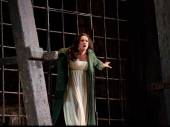
 Piotr Beczala was the Chevalier Des Grieux and super-star Anna Netrebko was the conflicted, petrified-of-living-in-penury title character. Both superb in every respect, Netrebko was in her most facile and expressive voice and tried as best she could to make the somewhat dated libretto about her love for shallow values believable. Beczala sang as befitting a Met leading tenor, with great passion, and, in one of his main arias, with surprising delicacy and exquisite phrasing. When the two of them were alone on the stage, it was opera as we want it to be: totally immersing and making us unaware of ourselves, not to mention being thrilled by greatness.
One positive note for director Pelly – an inspired staging of the male chorus during Manon’s “Gavotte,” with the men tiptoeing in unison to the delightful strains of the music. Or perhaps it was imagined by choreographer Lionel Hoche.
The somewhat unconvincing libretto resulted in my checking into Puccini’s version, which I discovered to be more true to Prevost’s original version, with an infusion of more believable circumstances leading to Manon’s arrest and subsequent deportation to the Louisiana territory.
Next up – La Traviata, April 14 at 1:00 p.m. 845-434-5750, ext. 4377.









 The Catskill Chronicle
Thank you, Peggy.
See you in South Fallsburg at St. Andrew’s concert with the Bronx Opera on Saturday night. No tiresome updatings for opera or Broadway there. Unless Eliza Doolittle sings I Could Have Danced All Night in a disco or swerve version or Violetta performs her death scene in a surrealistic setting.
Barry
What’s a “swerve” version of a song?
Bravo as usual Barry. Excellent review of Manon, and since I did not see it, I enjoyed reading about what I had missed. I bet I would agree with you both about Anna Netrebko’s stella performance, and the messed-up mise-en-scene. We look forward to your insightful reviews.