Review by Barry Plaxen, Photos: Ken Howard/Metropolitan Opera
LOCH SHELDRAKE, NY (January 23, 2013) – Because of the musical and dramatic success of Gaetano Donizetti’s opera “Anna Bolena,” the composer approached “Bolena’s” librettist Felice Romani to write 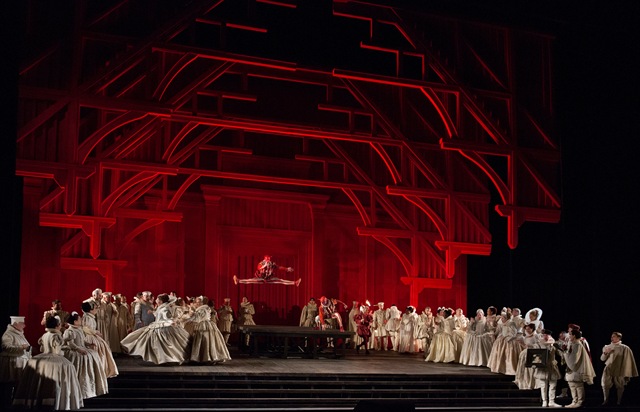 a libretto based on Andrea Maffei’s translation of Schiller’s play about Queens Elizabeth and Mary Stuart. When Romani bowed out, Donizetti obtained the services of 17-year-old Giuseppe Bardari, who had no experience. But with Donizetti having a hand in writing some scenes also, they succeeded in crafting a sometimes workable and sometimes extremely workable libretto.
If “Maria Stuarda” does not contain Romani’s powerful and well-written depiction of human behavior as in “Anna Bolena,” throughout the entire work, it does successfully offer more than mere inklings of human drama, though interspersed with Donizetti’s bel canto expertise taking precedence over drama.
The libretto does not contain much of Schiller’s political and religious references, or the details of those references later incorporated into 19th and 20th Century “renditions” of the story. But there are smatterings of it in “Stuarda,” certainly enough for us to recall other versions of the story we have seen to accompany and enhance our viewing and listening pleasure of the unfolding of the opera. Schiller fictionalized history as have the subsequent versions such as this one.
 The libretto seems to have been created so that Donizetti could utilize the then-in-favor bel canto operatic forms. And therein lies the power that “Maria Stuarda” offers: a choice example of an 1835 bel canto opera with the then present day settings of not-yet-Verdi-like arias, duets, trios and orchestrations.
The Live from the Met in HD production seen by an overly enthusiastic audience at Sullivan County Community College on January 19, 2013, was a musical treat for those who savor bel canto. Though this writer is not generally one of those savorers, I was caught up in the structure of bel canto, and each time something plot-wise of great interest or importance happened, I had a sense of “gosh, I hope she/he/they sing about it before we move on.” This is a usual departure from my preference for dramatic action and I know it was because of Donizetti’s inspired, though just-short-of-brilliant music. Specifically for me: when Elisabetta signs Maria’s death warrant and then sings about her feelings, and when Maria admits to being involved in a plot to assassinate Elisabetta, and sings about it.
And perhaps it was also because of David McVicar’s staging, which seemed to make the music flow with the visual movements of the actors complementing the lyrical lines of the melodic music. The entire production served both the music and the drama in a proper fashion with no extraneous add-ons, add-ins, or add-tos. That is always a joy for me.
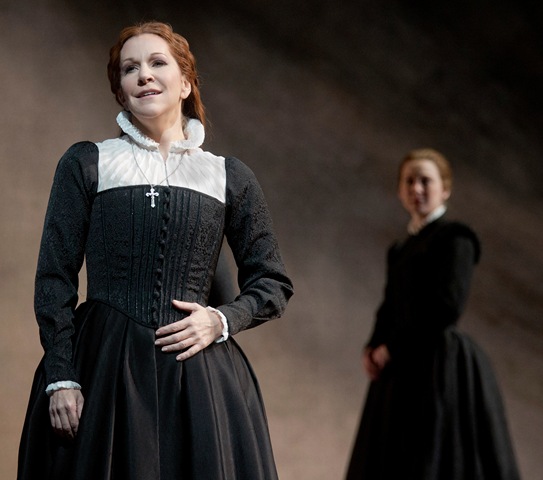
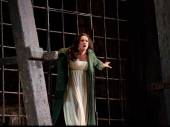
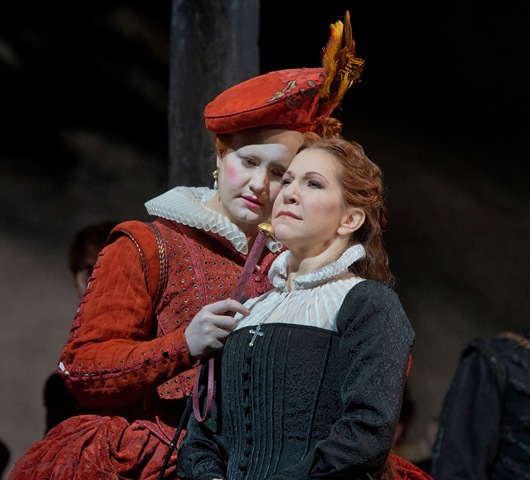 The roles of Maria and Elisabetta were written for sopranos. Many productions, dating from the late 1950s onwards, cast a mezzo-soprano as either Maria or Elisabetta. And for this production mezzo Joyce Di Donato (at right in photo) sang Maria and soparano Elza van den Heever (at left in photo) sang Elisabetta. With exaggerated and fascinating costumes for Elisabetta and stark plain ones for Maria, crafted by John Macfarlane, McVicar offered us a wonderful projection of the differences in the two characters by their different walking/striding, by their different relationships with the others on stage with them, and all following the dictates of the libretto.
The two protagonists sang beautifully. And part of the afternoon’s excitement was discovering a new bel canto star in van den Heever to go along with the well-known abilities of Di Donato. Never once in their performances did we lose any concentration on their emotional communications. And the fictionalized scene of their in-person meeting was high drama, as, out of their fears, they resorted to base and unkind and neurotic and unnecessary accusations, unworthy of high-born ladies.
 As the love interest (fictionalized we are to believe) for both ladies, the Earl of Leicester was also beautifully sung by Matthew Polenzani (at right in photo at right), and he had his moments of aria-duet explanations of plot-happenings. In the two major supporting roles of
 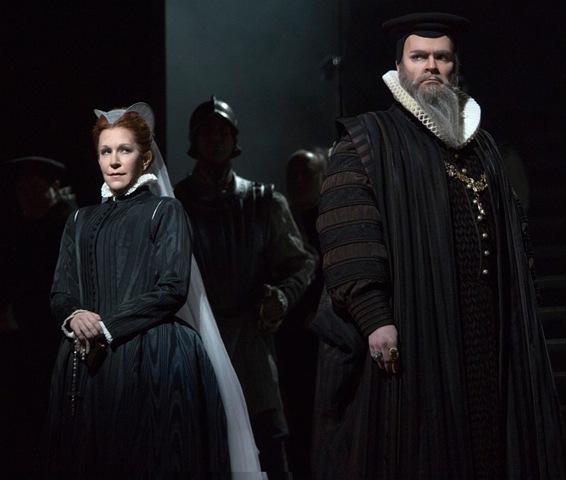 Elisabetta’s Secretary of State William Cecil, and Maria’s custodian Lord Talbot, sung by baritone Joshua Hopkins (at right in left photo) and bass Matthew Rose, we were also given lyrical and dramatic bel canto expressiveness and lush, velvety, deep, male voices. The unbilled singer of Maria’s lady-in-waiting, Anna Kennedy, added much to the compassion Donizetti obviously wanted us to feel for Maria.
 And then there was that other character, the chorus. The Met’s superb chorale, perfectly led by conductor Maurizio Benini, opened the opera with joyous and stage-busy celebratory singing, and then opened the last act pre-execution scene of Maria, standing perfectly still, as a Greek chorus, movingly and morally commenting on the forthcoming horror.
One clever piece of stage business: when Elisabetta’s ladies-in-waiting finish dressing and wigging her in an elaborate outfit for the day’s events, one of them holds a mirror up to Elisabetta for her approval. After a nano-second, without enough time to really see, Elisabetta pushes the mirror away (with mild disgust and some sadness). For me, this was a clever allusion to the possible fact that, notwithstanding all the political and religious ramifications of the entire Elizabeth-Mary enigma that has fascinated Westerners for over five centuries, the situation might simply have been motivated by an extreme case of Elizabeth’s jealousy of Mary’s beauty.
Another nice happening was the fact of the final stage direction once the singing ended, for me, the most powerful dramatic moment of the completely involving afternoon, when Maria in her newly-revealed red smock slowly and deliberately ascends to the scaffold. A final comment on woman’s inhumanity to woman. By both of them.








 The Catskill Chronicle
Thank you, Peggy.
Is it not so, therefore, that Elizabeth was not attractive? My recollections from the Glenda Jackson TV series and a few plays I saw on B’way, are that she never had a pretty face. I know I could be very much mistaken.
I guess the fact that there are religious, political and also pretty-face aspects to the story is exactly why it fascinates us so. Multiple levels and multiple aspects make for great drama.
Barry
Thanks Barry for such a thoughtful and interesting review. I loved both your comments on the performance and the historical background. Another take on your comment:
“After a nano-second, without enough time to really see, Elisabetta pushes the mirror away (with mild disgust and some sadness). For me, this was a clever allusion to the possible fact that, notwithstanding all the political and religious ramifications of the entire Elizabeth-Mary enigma that has fascinated Westerners for over five centuries, the situation might simply have been motivated by an extreme case of Elizabeth’s jealousy of Mary’s beauty.”
Is that she sees in the mirror (12 years have past since the first act) an aging woman, not the beauty she once was. Oh my goodness, all that rouge!
As alluded to in Barry’s brilliant review, “smatterings of it” there may be more religious aspects to this drama than one would initially suspect. The trilogy is more than great theatre.