Review by Barry Plaxen
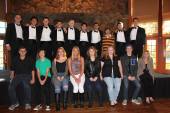
WOODBOURNE, NY (June 17, 2013) – On June 9, 2013 the Sullivan County Community Chorus under the direction of Kevin Giroux gave its annual spring 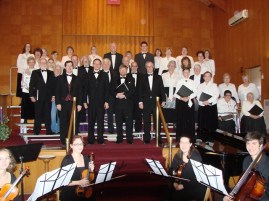 concert in the Immaculate Conception Church in Woodbourne.
The concert, titled “L’Chaim”, was a tribute to Jewish Culture, and most of the program was true to that concept. The major work of the afternoon seemed a tribute to much more than that: a tribute to the human spirit.
A Chassdic Round “Haida” was followed by selections from Sheldon Harnick (lyrics) and Jerry Bock’s (music) “Fiddler on the Roof,” a Yiddish Folksong “Tum Balalaika” and another popularized by Harry Belafonte and Miriam Makeba, “Erev Shel Shosanim,” was included. There were secular and religious texts by classical composers, and two different Ladino songs, one from Bosnia and one from Spain. It was not easy with first hearing to note any difference in Eastern European Ladino music  vs. Iberian Ladino music, but I wondered if there was (is) a difference.
The major work of the afternoon was the “Holocaust Cantata – Songs from the Camps,” for which American composer Donald McCullough (photo right) researched music written in concentration camps, material written by “the common man’s” experience and reflections on life in the camps, rather than the non-programmatic music composed in the camps by well-known incarcerated classical composers.
McCullough did a superb job in finding and then including beautifully written poetic texts to exquisite, melodic music. The level of beauty of the music and the crafted words superseded, overrode, and “softened” any possible horrific reactions to the texts and the vivid narrations that were also included, verifying that through beauty, pain and even horror can be overrode, and one can be uplifted by that beauty, no matter 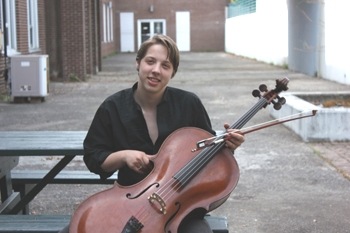 what the subject.
The music seemed to give some understanding as to how people could endure the camps and the horrors. One musical interlude in the Cantata was a Weill-ian Tango lovingly played by cellist Aaron Cush Solberg (photo left), which also fully expressed all the pain and sadness and even some longing for understanding, and went right to the gut and heart with its beauty, making it all palatable and moving.
The Holocaust Cantata contained wonderful music, amazing in its melodic simplicity(ies), yet full of depth and emotion. I thought the wide expanse of emotional feelings was so wonderfully expressed in “melody” throughout, proving you can do it all with melody. That melody is still  (for me) what it’s all about.
And it was brilliant of Giroux (photo right) to add one song to it – following a minute of silence at the end of the Cantata. The “Amen” at the end of “Ose Shalom” by classical composer John Leavitt, with its haunting clarinet solo, gave the audience “closure,” making the Cantata not an ethnic musical work, but a passionate piece of music of unspecified genre, universal rather than ethnic.
 The entire program was very cleverly arranged by Giroux who invited wonderful soloists Aaron Cush Solberg (cello), Anastasia “on the roof” Solberg (photo left, violin), Jared Ratner (clarinet) and Brittany Robinson (flute). Narrators were Steven Kurlander, Mark Starker, Marlene Wertheim, Walter Klein, Charles Barbuti, Robert Freedman and Felicia Kovylanski. The speakers all had ties to the holocaust, either personal or familial, enabling the narrations to be even more poignant.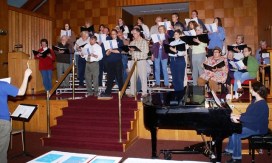
Working “more extra hard” than usual, chorale accompanist Keira Weyant did a yeoman’s job.
Thanks to all involved for the wonderful afternoon, the entire chorus, the vocal soloists, the musicians, the speakers and Maestri Weyant and Giroux.







 The Catskill Chronicle
Leave a comment