Review by Barry Plaxen
ELLENVILLE, NY (March 6, 2012) – Shadowland’s expansion into being the Ellenville region’s cultural center reached another peak on Saturday, March 3, 2012 when Artistic Director, Brendan Burke invited a Beacon-based chamber music ensemble, Madera Vox, to perform.
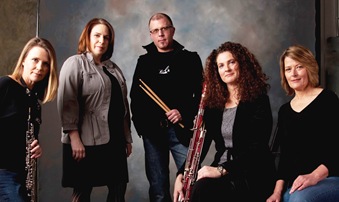 A most unique quintet, Madera Vox consists of oboist Allison Rubin Blitz, bassoonist Cornelia McGiver and pianist Sylvia Bucelli, a not-so-surprising trio arrangement that becomes a bit of a surprising quartet with the addition of percussionist Dave Gluck and a very surprising configuration of a quintet with the addition of soprano Kelly Ellenwood. The addition of soprano Ellenwood in this chamber group expands it into more musical genres than just jazz and classical: an uncategorizable genre. Sorry, America, here is something new that you cannot categorize.
The Madera Vox website contains this quote:”I have never acknowledged the difference between serious music and light music. There is only good music and bad music.” – Kurt Weill
An interesting choice of quotes for this group’s website (as you will see), and helpful in that this music lover is tired of America’s passion for categorizing new music. However, perhaps Weill’s quote is a bit too judgmental. Who does Herr Weill think he is to be the one to suggest what is good or bad.
I will check off his choice of words to the fact that English was not his first language, and I’ll go with Mr. Ellington’s quote instead: “If it sounds good, it is.” No judgment there. Either you resonate with the music or you don’t.
And new music it is (was), starting off with two compositions by Gluck and Ellenwood that announced to the audience what we were in for in the way of sound, melody and rhythm. The addition of a soprano to the mix was the catalyst for all the newness we heard, and Ellenwood seems to have created her own new technique that enables her to express the music unlike that which we are used to.
After the showing-off of the innovative pieces, we were treated to a movement from a most pleasant trio for oboe, bassoon and piano by Bill Douglas. There was no program available (unforgiveable!) and so I do not recollect if Douglas composed the trio for Madera Vox or not.
The highlight of the evening followed: two selections from “Children’s Song” by Chick Corea, a collection of piano pieces that, much like Bartok’s “Mikrokosmos” did, resulted in a new musical language composed in a simple fashion so that young people could absorb new sounds brought to classical music by Corea. Gluck arranged the solo pieces for the group and is to be congratulated, as you could easily sense that his orchestration enhanced the simple pieces, giving them a more emotional, concert-level depth and masterful work on Gluck’s part. If Gluck has not yet arranged the entire composition, we have something to which we can look forward.
Also written for the normal trio configuration of oboe, bassoon and piano, two movements from Peter Hope’s extremely melodic and highly lyrical “Four Sketches” were performed. I wish we could have heard the entire piece. And again this may have been the piece one of the five adept-at-speaking musicians said was written for Madera Vox.
Hopes’ music was followed by a great showcase for soprano Ellenwood’s technique, two pieces by composer Libby Larsen. I was not taken with the poetry of the second piece, “Big Sister Says” as it is not emotionally connected to the male experience. I thought perhaps I was being unfair, but then Dorothy Parker’s poems came to mind – poems that reflect the female experience but yet I find  emotionally moving. The poetry by Kathryn Daniels seemed vapid as it was about what I consider to be superficial values as opposed to Parker’s human values. Gluck arranged these pieces very musically, and they seemed enhanced also.
Not so with his arrangement of Kurt Weill’s “Alabama Song,” It did not sound good to me. Though the arrangement was clever and innovative, it detracted from Berthold Brecht’s lyrics, which are the mainstay of the song and the reason Weill composed down, so to speak, for this Brechtian expression. Ellenwood needed to be concerned about Gluck’s complicated musical arrangement and so the lyrics took a secondary role, even to the point of leaving out the last, but most important, verse. (Maybe because Weill composed down, Gluck was inspired to compose up.)
A short piece by Kurt Cohen followed, also arranged by Gluck that sounded good. And then the group performed a world premiere – not a Gluck arrangement of a Faure song, but a most interesting Gluck concoction from a Faure song (“Après Un Reve”). Gluck explained how he heard elements in the song that suggested jazz and rhythms unheard or unexpressed by Faure. One needs to listen to it without the original in mind, and I was not able to do that on first hearing.
So, Shadowland, please bring back Madera Vox for another concert. My appetite for new, accessible music has been more-whetted and needs to be more-sated. And how about a full evening with intermission instead of a brief hour or so. Madera Vox’s music deserves to be heard. And Ellenville and friends deserve to hear it.









 The Catskill Chronicle
Leave a comment