Review by Peggy Friedman – Photos courtesy of ©Ken Howard/Metropolitan Opera
Nixon in China, an American opera many critics and music writers have praised since its premiere at the Houston Opera in 1987, had its first performance at the Metropolitan Opera on February 2 and was broadcast, live in HD, on 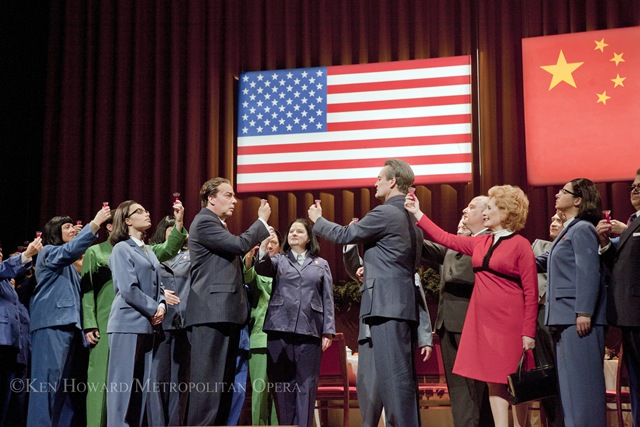 February 10, to international venues in 46 countries, including the Seelig Theatre at Sullivan Country Community College. I was one of the lucky 50 or so local audience members to see this masterful opera written and conducted by John Adams, who also wrote The Death of Klinghoffer, an opera about the hijacking of the cruise ship Achille Lauro in 1985 by the Palestine Liberation Front. He [Adams] and his collaborators are not afraid to use contemporary themes and write music theatre dramas that are actually about something.
Nixon in China features two couples who are alike, but also very different. Both husbands are powerful men on the international political scene, both wives very supportive. One couple shares intimacy without much sensuality, the other couple is lustier but less loving. You have heard of them, Richard Nixon, President of the US, and his wife Pat; and Mao Tse-tung, Chairman of the Peoples’ Republic of China, and his wife Chiang Ch’ing, formerly a starlet in the Chinese theatre, and in charge of ballets lauding the current regime of Chairman Mao, he of The Little Red Book.
Set in 1972 when President Nixon (James Maddalena, who premiered the role in 1987) arrives in China to speak to Chairman Mao (Robert Brubaker) and normalize relations between the two countries. Adams’ score is lush, with glittering tone clusters, and subtle modulations, appropriate for the unfolding action, directed by Peter Sellars (who also directed in ’87).
Opening scene: before the presidential airplane, “Spirit of ‘76” descends onto the stage the formidable Met chorus sings, “The people are the heroes now/ the behemoth pulls the farmers’ plow.” This is a slogan of the Chinese revolution, but by the last act both Mao and Premier Chou En-lai (Russell Braun) seem unsure of what, if anything that revolution accomplished.
Scene 2: The meeting with Chairman Mao. The two world leaders meet, Henry Kissinger (well played by Richard Paul Fink) praises Mao’s writings which he says he uses in his Harvard classes. Mao is self-deprecating. Nixon is enthusiastic, but tries to talk specifics: Vietnam, Taiwan, Japan. Mao is more elusive. Dr. Kissinger states, “Your regime will last one thousand years.” (Shades of the Third Reich from which his family escaped?) and Mao and Kissinger trade snarky remarks about their respective girl friends. Mao says, “Our armies do not travel abroad. Why should we? We have everything we want here.”
The Chairman is very old, can hardly walk, and is supported by three young women in military garb. Poet Alice Goodman’s prophetic libretto has a satisfied Mao predicting that, “our plunge/Into the New York Stock Exchange/Will line some pockets here and there.”
Scene three: A banquet with the usual toasts at which Premier Chu (Russell Braun) toasts to patriotic fraternity and President Nixon replies, toasting the Chinese people and the hope of peace. Nixon is enjoying himself more than Mrs. N.
Act II, scene 1: Pat Nixon’s (Janis Kelly) sings an aria about her life and ordinary, comforting things in USA. American music themes, reminiscent of Aaron Copland’s folk tunes are heard. Pat and Dick are much more sympathetic than usually portrayed – I found myself believing that this was their actual character.
Scene 2: In the evening the Nixons attend a performance of The Red Detachment of Woman, a revolutionary ballet devised by Mao’s wife Chiang Ch’ing (Kathleen Kim). In it, a Kissinger-like character (also played by Fink who can dance as well as sing), a lecherous Simon Legree, beats a beautiful young woman of the people. Pat and then Dick rush to her defense. Reality and artifice are blurred, but the Chinese do not come off well in this agit-prop hokey ballet about the ascendancy of the proletariat. Pat gives the dancer a rifle, and she starts shooting capitalists. Pat is beside herself, so is the Chairman’s wife. The ballet is inventively choreographed by Mark Morris. The set, dominated by a portrait of Chairman, is designed by Adrianne Lobel, lighting by James F. Ingalis, and costumes by Dunya Ramicova.
Act III: The meetings and banquets are over. There are six beds on stage, and the characters discuss and soliloquize on past and present events. The most tender moments are shared between Pat and Dick, who sings of his time in the Pacific Theatre in WW2 and describes, “Nick’s snack shack – I traded spam for hamburger,” “ and you gave each pilot,” Pat sings, “a hamburger & beer.” They are affectionate, but not sexual. Mao is sexually serviced by one of his soldier-women, then dances and performs oral sex with his wife, who is dressed in a sexy cheongsam. Chou concludes the opera asking whether anything they did was good.
Nixon in China is musically and dramatically first rate (at least the first two acts, Act Three, because it is so meditative, is a bit stagnant and long at 33 minutes). It deals with a real situation and the real people who changed the world. It  involves the audience making them consider the characters of President Nixon and Chairman Mao, who actually are another couple in this work, convoluted reflections, in a subtle way, of each other. Dr. Kissinger and Premier Chou are their henchmen. Although the characters are based on fact, they become almost mythic; their power is world-shaking, but they themselves sometimes doubt the permanence of their actions.
Watching the opera in HD, instead of live has the advantage of beautiful close-ups and wonderful backstage interviews with the principals. Of course, nothing compares to hearing the Metropolitan Opera Orchestra live, but the visual experience at the Seelig Theatre is mesmerizing. The Met uses 11 cameras to shoot its HD productions; two are boom cameras, hanging from the balcony. Live at Lincoln Center broadcasts use only two cameras.
The next Met Live in HD presentation is Gluck’s Iphigenie en Tauride, on February 26. Tickets are $20. Comparable orchestra seats at the Met at Lincoln Center, $250. Don’t miss this opportunity.
Captions – Top left – James Maddalena (Nixon), Russell Braun (Premier Chou) and Janis Kelly (Mrs. Nixon) toast to Sino-American friendship. – ©Ken Howard/Metropolitan Opera
Bottom right – James Maddalena (Nixon) and Janis Kelly (Mrs. Nixon) comfort a ballet dancer. – ©Ken Howard/Metropolitan Opera
*Peggy Friedman has written many theatre reviews for New York City publications and for WOR Radio. She has performed with Paul Austin at the Liberty Free Theatre, and her poems are included in the up-coming Alchemy Club anthology. She lives in Neversink with her husband, Robert.








 The Catskill Chronicle
Peggy-
Thank you for the astute review.
I enjoyed most your last paragraph (since I did not enjoy the libretto at all, and ergo the opera in general) as I often wondered how many cameras were used. Like you I find many advantages to the Live in HD format and urge people to take advantage of the Loch Sheldrake airings.
What was a positive experience for me was the music. Very lyrical – and the sublime performances – and the orhcestra and chorus. But without a libretto that has meaning and value for me personally, there is no dramatic value to the opera.
For me, it would be nice to listen to the opera again, but not to see / watch it.
Best,
Barry Plaxen