Review by Barry Plaxen
SHANDELEE, NY (August 21, 2011) – Cellist David Requiro (photo below left) and pianist Cullan Bryant returned to Livingston Manor to perform again in this year’s Shandelee Music Festival on August 11. Three disparate cello / piano sonatas were played.
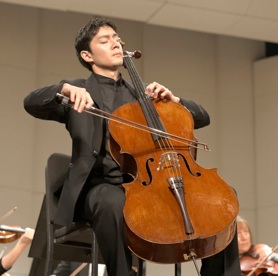 First on the program was an early work by Richard Strauss, composed when he was seventeen and revised when he was nineteen. Strauss had not yet found his personal “voice,” so the Opus 6 work has little of his Straussian harmonies and melodies, and is definitely, as the program states, influenced by Beethoven, Mendelssohn and Schumann. For me, that is a good thing as it takes what those masters did and brings their romantic style of work forward into a more “modern” but still highly romantic language. It suggested to me that had Strauss continued in that vein instead of in the direction he went, he might have brought Brahmsian romantic ideas into the 20th century and so might have composed in a language or style that now does not exist.
Strauss’ sonata is extremely romantic with a plethora of melodies, all of them quite beautiful, and with no innovative rhythms. It is a glorious work, sensitive, moving, and totally uncerebral. The first and third movements were played with great skill and much feeling by both world class musicians. But the second movement afforded the audience one of those magical experiences, as it was a slow movement and the cello was more easily heard than on the rest of the program (there was an acoustic problem or the piano was mostly too loud). Mr. Requiro’s phrasing for this lush, remarkable Andante movement was some of the finest cello (or any instrument) playing and musical phrasing I have ever heard. Every note was carefully, intuitively and exquisitely nuanced with great sensitivity and feeling. I am sure there were a few non-dry eyes in the house.
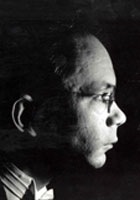 The second offering was a sonata by Pierre Jalbert (b.1967), written in 2008 during which Mr. Bryant (photo right) played both on the keys and inside the piano. I quote from the program’s liner notes. Mr. Jalbert states, “…it consists of four contrasting movements….anchored by the slow first movement, the longest and most substantial of the piece. The second, scherzo-like movement is a study in constant motion and shifting accents. The third movement features the cello as a solo instrument with the piano simply providing faint echoes of the cello’s music. This movement grows in intensity and eventually accelerates directly into the last movement, which features frenetic, syncopated, dance-like rhythms shared and passed between piano and cello.” The audience was quite appreciative of this work, skillfully and intensely performed by Requiro and Bryant.
Last on the program was Chopin’s Cello / Piano Sonata, a late work, opus 65. Chopin performed the last three movements in Paris, the last time he played in a concert prior to his early “transition”. It is a work of great beauty, though it may seem complicated to the untrained ear because of his harmonic inventiveness. It certainly is an “original” in that sense.. There is also beauty in the fact that the sometimes the cello dominates, sometimes the piano and so it is a joy to follow the “conversation” between the instruments. It was masterfully played by both wonderful artists.
The highly appreciate full-house audience was treated to an encore: Chopin’s famous and highly romantic Nocturne for piano, the (I think) E Flat Major, Op. 9 # 2. Nocturnes are generally melancholy with a melody over broken chords. This rendition was beautifully arranged for cello and piano, with Mr. Requiro phrasing the melody as he did in the Strauss sonata and Mr. Bryant outstanding also with almost all of his broken-chord part, simply taken from the left had portion of the piano score and arranged for left hand only. It was a tasty piece of easy-listening dessert after the not-so-easy listening requirements of the more difficult and serious Chopin sonata, providing for an even more fulfilling evening for classical music lovers.







 The Catskill Chronicle
Leave a comment