Review by Barry Plaxen, Photos: Ken Howard/Metropolitan Opera
LOCH SHELDRAKE, NY (December 8, 2011) – On December 3, 2011, Handel’s “Rodelinda” was shown as part of the Live from the Met in HD series at Sullivan County Community College in Loch 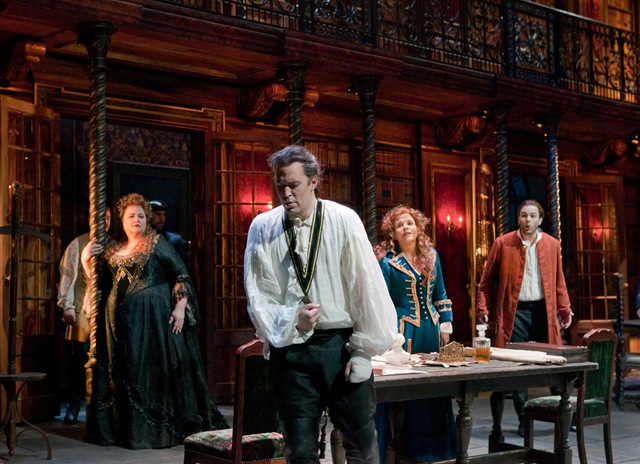 Sheldrake.
The opera dates from 1725 and was written to be performed in a small intimate theatre. Originally, there were minimal sets, and there are only two duets and one quintet at the finale. All the rest of the music is arias. There is no chorus or ballet.
Director Stephen Wadsworth chose to ignore all of the above, and opted to create a production that filled the large Met stage and ignored the basics of this particular Baroque opera: “stand still and sing.” He brought the opera into the post-classical age by creating a multitude of stage business and character motivations that are not inherent in the libretto by Nicola Haym. Let it be noted that the actors said they loved Wadsworth’s “additions.”
The actors were busy ripping papers off of pads furiously, 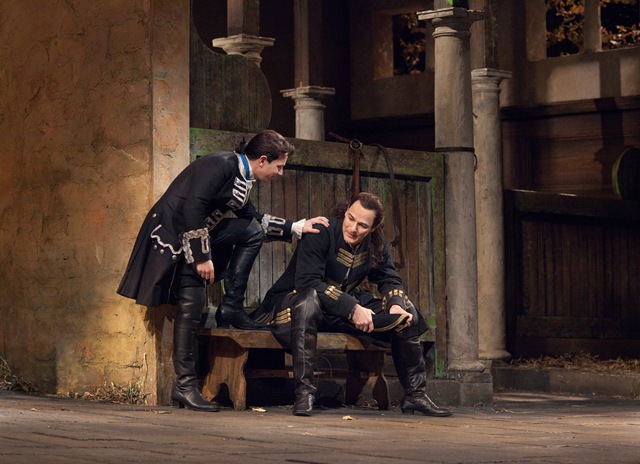 furiously throwing crunched wads of paper on the floor, furiously manhandling many props and crashing them onto the floor with great fury, and three soldiers in boots constantly clomping loudly across the stage for no reason with lots of loud sound and great fury – sound and fury – all “signifying nothing.”
My credo – if it ain’t in the libretto, don’t make it up. There’s a reason it ain’t in the libretto. This libretto was mostly explanations of feelings and desire, repeated over and over. I finally realized that to enjoy the music I had to stop reading the supertitles once they started to repeat what was being said, and just listen to the music. For me, all the unmotivated stage business detracted from Handel’s and Haym’s intention. There is drama in the music – the “variations” and embellishments to the original melody of each aria – and not in the spoken words.
However, when the music, itself, suggested stage movement, it worked beautifully, as when Stephanie Blythe twirled herself around a pole to a lovely refrain.
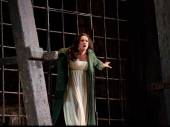
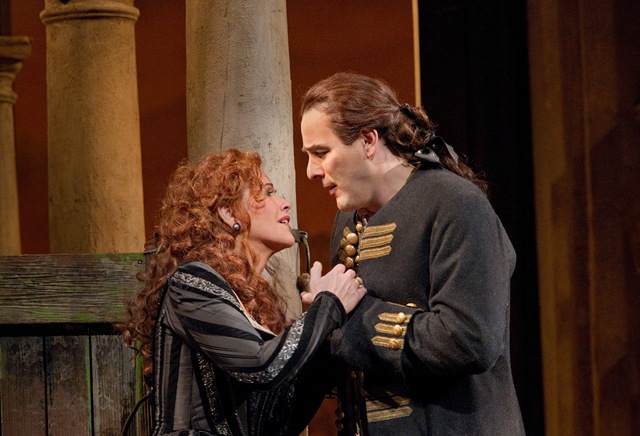 The music was not Handel at his operatic best – I am a fan of his “Julius Caesar” – but the singing from all involved was, in a word, superb. Renée Fleming (photo left with Andreas Scholl) in the title role of the Queen of Lombardy, happy to be playing a mother, and also she-of-the-perfect-voice, Mongaup Valley’s gift to opera, Stephanie Blythe (photo below with Joseph Kaiser) as her sister-in-law, the princess Eduige, Andreas Scholl as Bertarido the King (brother of Eduige), Iestyn Davies as the loyal courtier, Joseph Kaiser as the throne-usurprer-villain-turned-friend and Shenyang as the real villain, Garibaldo. The plot is contrived, convoluted and somewhat cliché, so I won’t go into here. It is unimportant and only an excuse for the singers to sing. And boy, do they!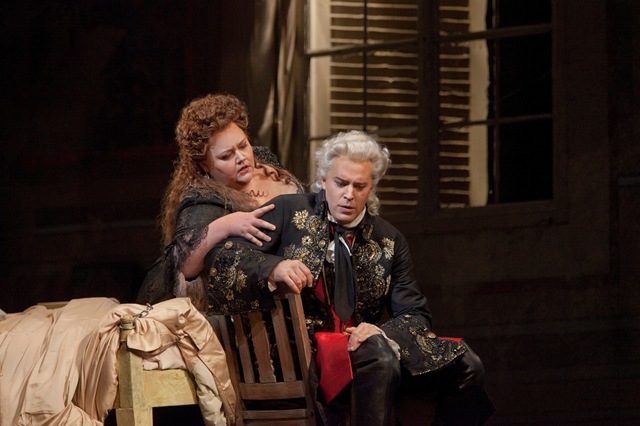
Tenor Kaiser and Baritone Shenyang were up to the world-renown Fleming and Blythe and their standards. The most exciting part of the afternoon for me was the two countertenors Scholl and Davies. Seeing and hearing two in one opera was most unique and very interesting as each had different voice production and each timbre was unlike the other. Scholl, as the faithful husband of Rodelinda, had a very clear “head sound,” while Davies had that contralto quality most often associated with countertenors. I wonder which was closer to the original castrato sound.
They also had the more beautiful arias and one sumptuous melodic duet. The audience was quite thrilled with all the singing, as was I, and there was more applause after each aria than usual.
Harry Bicket conducted a wonderful baroque orchestra with both baroque and modern instruments. The set by Thomas Lynch was most innovative but unnecessary. Colorful, utile and historically interesting costumes were created by Martin Pakledinaz.
Once again, the Met stupidly and insultingly does not supply the names of singers in comprimario roles, so I cannot give deserved credit to – in this case – the silent actor who played Flavio, Rodelinda’s young son. The child actor was always believable, never losing his concentration or intrusive to the singers, and his controlled presence added much to the emotions that were conveyed while the adults sang.
The next opera in the series is Gounod’s “Faust” on December 10 at 12:30 p.m. Call 845-434-5750, ext. 4472 for information.








 The Catskill Chronicle
Leave a comment