Review by Barry Plaxen, Photos by Ken Howard/Metropolitan Opera
LOCH SHELDRAKE, NY (December 12, 2012) My last review (“La Clemenza Da Tito,” December 1) was a diatribe about how to direct an opera. This review is just the opposite.
 If you were to consider “Middle Verdi” to be the years 1851-1862, you would see that Verdi’s most melodic operas (with the exception of “Aida”) were from that period: “Rigoletto” (1851), “Il Trovatore and “La Traviata” (1853), and “La Forza Del Destino” (1862). Sandwiched within those masterpieces is the 1859 “Un Ballo In Maschera.” If not as popular as the others, in many ways it is equally as melodic.
With a libretto by Antonio Somma, based on a libretto by Eugène Scribe for an 1833 opera by composer Daniel Auber, the plot revolves around the the true-story of the political-conspiracy assassination of Sweden’s King Gustav III. Scribe invented a romance between the King and the wife of his secretary and best friend.
Verdi’s opera underwent a series of transformations because of censorship regulations involving the portrayal of the murder of a King onstage and a political situation in France in 1858. At various times it was set in Sweden, and later on in Boston. On December 8, 2012, the Live from the Met in HD production at Sullivan County Community College was set absolutely nowhere. Not in Sweden, not in Boston, not even in Loch Sheldrake.
This mid 19th Century romantic opera is a wellspring of melodic invention, melodic inspiration and orchestral brilliance, and this production by David Alden tries  its best to sabotage Verdi’s music and Somma’s excellent dialogue-driven libretto. But Alden’s conspiracy to assassinate the King of Italian Opera fails. Despite the unfounded liberties he takes, Alden simply cannot override Verdi’s genius.
Alden’s staging of the “Overture” sabotages Verdi’s attempt at musical mood-setting with illogical visual distraction, requiring the King and the Page to meaninglessly cavort onstage. When the curtain rises, the Page says, “… here is the King,” but you have already seen the King for ten minutes. What’s more, mid 19th Century social mores have meager dramatic value when not portrayed in that time period.
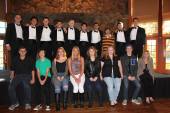
As the Page, Kathleen Kim (center left in photo above right) was hampered by Brigitte Reiffenstuel’s ungainly and distracting costume. But it could not fully sabotage Kim’s delightful voice, which was at its best in her final aria.
 As the King, tenor Marcelo Alvarez (center right in photo above) sang very well, with his oft-thrilling timbre, complementing his sincere heart-felt actions.
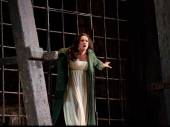
As Amelia, the object of the King’s affections, Sondra Radvanovsky (photo left) was sabotaged by Reiffenstuel and set designer Paul Steinberg. She looked unattractive, and her garments were hardly appropriate for a mid 19th Century woman forcing her to move in an ungainly manner. But the genius of Verdi once again rose above it and, though she is not a great soprano in the sense of a “star,” she sang well, did some lovely legato and pianissimo effects  and empathetically conveyed her love for the King and the deep pain that it caused.
As her husband, and the King’s best friend, (photo right) Dmitri Hvorostovksy (yes, that great baritone “star”) sang beautifully, if not as lyrically as he has done in the past. A great artist. A great stage presence. Forceful, sensitive and communicative.
Several unbilled performers in comprimario roles sang and acted well, but often were sabotaged by Alden’s unwarranted attention to illogical scenic devices and props.
The great Met Chorus was sabotaged in just about every way, not just with Reiffenstuel’s foundationless costumes, but with trumped up props – My God!, all those unwarranted and unjustified props, from opera glasses to umbrellas twirling around distracting you from the emotional singing. Every time some prop or 1930s or 1940s costume appeared from some bottomless pit of conjured-up fabrication, whatever depth of emotion you were feeling from the music and the wonderful singers was momentarily interrupted. But the genius of Verdi always won out, and after a few notes you were back into your involvement with the libretto, the music and the performers.
The music was exquisitely and dramatically offered up by the Met Orchestra under the baton of  Maestro Fabio Luisi. No hampering or manipulating of Verdi here. He wouldn’t dare. So why would a stage director?
And what word is better than exquisite? Perfect? Perhaps no words can describe Ms. Scene-Stealer who steals scenes with her absolutely incredible voice – yes, it is perfect – it is superb. It is one of the great voices of our time. Surrounded by a chorus, sabotaged once again with fallacious and un-Gypsy-like costumes, Stephanie Blythe (photo left) and Verdi’s genius overrode the unjustified visual goings-on, and her Gypsy fortune-telling scene was a marvel of musical expression which added much to the movement of the plot when she advises Amelia what to do about her feelings of love, setting up the entire plot progression. This time, Blythe also amazed me with her body movements that coincided with the force of the orchestral rhythms in her, sadly, only one scene. (I would have to assume – and admit – those movements probably came from the director.)
The production’s baseless costumes and surreal set for the actual masked ball could not sabotage Verdi’s incomparable melodic and dramatic last act.
Viva Il Re!
Verdi’s “Aida” is next on December 15 and, if I may do a dreadful thing and steal someone else’s words without permission – “a new idea is being tried – the opera will take place in ancient Egypt.” 845-434-5750, ext. 4377.








 The Catskill Chronicle
Go Barry, your review is right on the mark, as far as I am concerned. Wonderful singing and playing from the pit, terrific emotional content, but oy, the staging! So glad you continue to cover the Met Opera’s HD broadcasts. And thank you Sullivan County Community College for bringing them to us.