Review by Barry Plaxen, Photos: Marty Sohl/Metropolitan Opera
LOCH SHELDRAKE, NY (March 1, 2012) – “Hernani” is a play by Victor Hugo that was a part of an ongoing major controversy between classical drama lovers and those who felt romantic drama was a 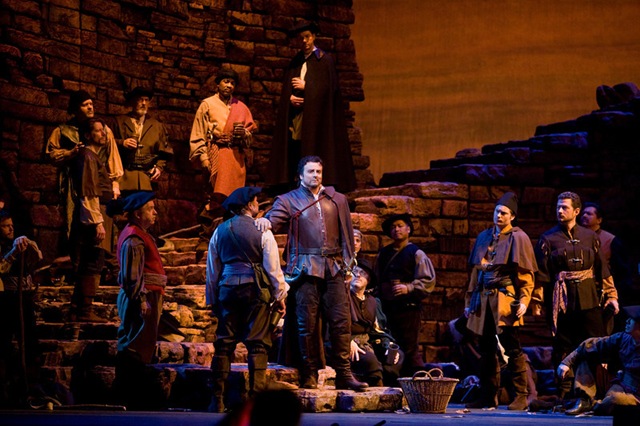 valid medium also. The play opened in 1830.
Today, the drama is more remembered for being the inspiration of Verdi’s opera “Ernani.” The first production took place in 1844. Stangely, in 1904 it became the first opera to be recorded completely.
Set in a fictitious version of the Spanish court of 1519, it is based on courtly romance and intrigues. With a libretto by Francesco Maria Piave, it is a story of three men in love with the same women: a banished nobleman-turned-outlaw, Don Carlo the King of Spain and Don Ruy Gomez de Silva, a nobleman and elderly uncle of the young lady.
At the pre-peformance presentation of the Live From the Met in HD series on February 25, 2012 at Sullivan County Community College in Loch Sheldrake, we were treated to two speakers instead of the usual one – because there was a mix-up in who was scheduled to speak that afternoon. So the two presenters laughed and immediately began a wonderful collaborative effort. First Marjorie Feuerstein of Shandelee Music Festival whet our appetites with an excellent explanation of the history of the opera and where and how it fits into Verdi’s progression as a dramatic opera composer. Then Tom Caltabellotta, a well-known Sullivan County opera singer, sharpened our desires even more as he spoke of the story and music – the plot and specific vocal and orchestral moments of beauty and drama.
Sadly, their presentation was the highlight of the afternoon for me as the opera production was a disappointment. (It should be noted that much of the audience applauded a good deal and so obviously people were enjoying the singing.)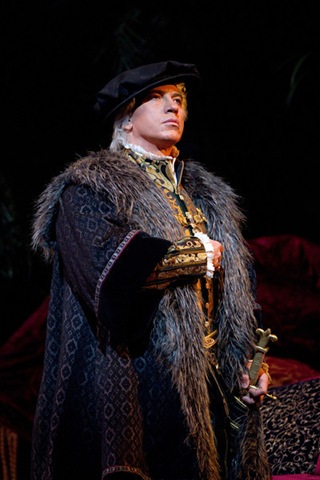
In the title role, Marcello Giordani (at center in photo top) was not in good voice. One might assume he had a mild winter malady. Dmitri Hvorostovsky (the King, in photo right) and Ferruccio 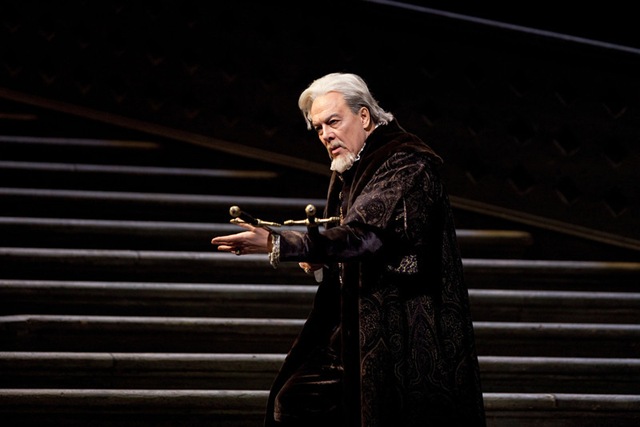 Furlanetto (the elderly uncle, in photo at left) are known for their singing and acting greatness, recently witnessed in Verdi’s “Don Carlo.” In Act I of “Ernani” their prowess was not evident. In Act II, there was an inkling of it. In Act III in was finally evident.
When two of the planet’s greatest singing-actors do not continually thrill, one begins to wonder why, and begins to search for reasons other than saying “it (the opera) just doesn’t work.” Having seen “Ernani” a few times in the mid-60s, as it was a favorite vehicle of 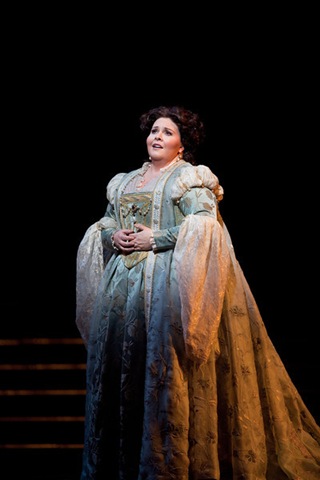 Leontyne Price’s, I know it can work. At the two intermissions, and when it was over, much discussion was going on about why it was not working.
Was it because the protagonist was not in good voice? Was it because the libretto is inadequate?
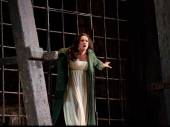
Was it because the role of Elvira was portrayed by Angela Meade (photo right) who is not a world class singer and is not beauteous and /or magnetic as a woman or performer to attract three men? Meade did not emit any dramatic tension until the last scene in the opera when she did some lovely legato singing and finally seemed emotionally involved.
Well, it could have been any and all of the above, but I think all the above leads to the fact that the fault lies with the director. In this case, who? The program says “Production by Pier Luigi Samaritani” and “Staged by Peter McClintock.”
Which of them is responsible for the mis-casting of Meade as Elvira (probably Met Director Peter Gelb). Which of them is responsible for the lack of tension? Which of them is responsible for our not feeling the three men are in love with Elivra? Furlenetto did convince me of his amorous feelings, but only in the last act prior to his demanding Ernani kill himself as per an agreement-of-honor they make in Act II. (The story’s theme is a romantic perspective of honor between men.)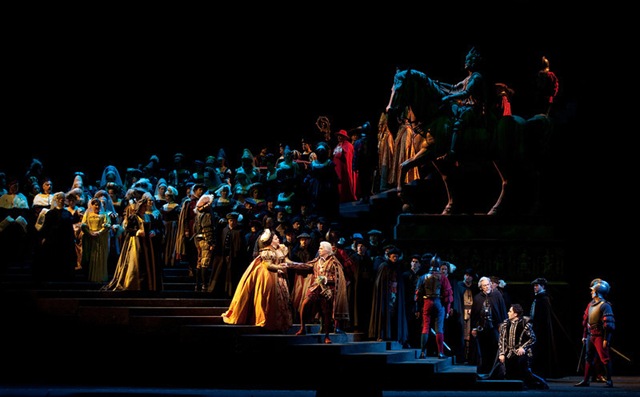
But I suspect the culprit is Samaritani, as he is responsible for the overall effect, and for the first time, I felt the Met orchestra conducted by Marco Armilliato did not draw out any drama from the music as it always does, and I felt the superb Met chorus did not help create the aspect of an “atmosphere” as they always do. But exactly what is missing, what Samaritani did not instill in all involved, I still cannot put my finger on.
Thanks to the intermission showings of the set changes, we did see some of the Met’s greatness in that beautifully expedited technical aspect of the producing of the opera.
Our thanks once again to Sullivan County Community College for giving us the Live From the Met in HD series. I look forward to the next showing: Massenet’s “Manon” with Anna Nebtrenko on April 7 at Noon. Call 845-434-5750, ext. 4377.
~~~~~~~~~
And don’t forget the SUNY Sullivan simulcast of “The Enchanted Island,” originally scheduled for January 21, has been rescheduled for March 10. The broadcast will take place at 12:55 p.m. For more information call the college box office at 845-434-5750, ext. 4472, between 9:00 a.m. and 4:00 p.m. on weekdays.








 The Catskill Chronicle
Hi, Barry. This is very nicely written review. I did not see the performance, but I do want your permission to print it and use it in my Sullivan Correctional Facility Comp 1 class. Your opening is exactly what I’m striving to impress on my students. The rest of the essay follows the opening very nicely indeed. I hope you’ll let me!
Cheers!
Gandalf WJFF