Review by J. A. Di Bello, photos by Marty Sohl/Metropolitan Opera
LOCH SHELDRAKE, NY (March 21, 2013) – Dramatic irony, as is oft noted, is a situation developed in a drama that is understood by the audience but not by the characters in the play. Consider the  concept of lust, adulterous lust and the circumstances under which its tantalizing twists might thrive within the family Malatesta, (Mal di testa, intentional pun?) of Rimini. The narrative might whimsically be titled “Tutto in Famiglia,” as in “All in the Family.” It seems innocent enough, until one recalls the American sitcom of the same name. “Francesca da Rimini” is beyond reasonable doubt a situation, but there’s no comedy here and the connection, if any, remains remote until the search deepens to discover the origin of the American sitcom: the widely popular British television series “Till Death Us Do Part.”
And death it is that invades the Malatesta circle, smothering the simmering passions of a sensuous Francesca and her husband’s fated brother, Paolo. Through time, the narrative of this tantalizing, unholy union remains familiar to all but the dimmest of literati. Its plot and subsequent twists are the materials from which stories, music and the visual arts are conceived. Francesca da Rimini, a contemporary of Dante, was immortalized in his “Inferno,” where the Circle of Lust is the second circle of hell. Tchaikovsky’s fantasia further presents a symphonic interpretation of the legend, while “The Death of Francesca da Rimini and Paolo Malatesta,” by French visual artist, Alexandre Cabanel is a provocative reminder of this tale of woe. In a more contemporary setting, the British vocal ensemble Mediaeval Baebes created a popular musical piece in 2002 called the “Circle of the Lustful.” The lyrics direct from Dante, are sung in medieval Italian, and translated here by Allen Mandelbaum:
One day, to pass the time away, we read
of Lancelot— how love had overcome him.
We were alone, and we suspected nothing.
— Dante, InfernoV.121-138
Following an absence of twenty-seven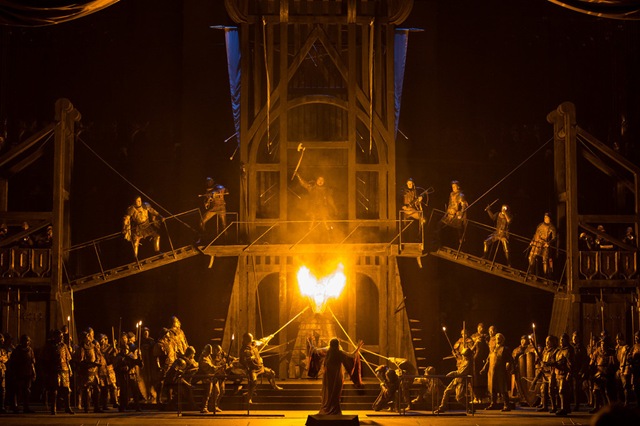 years, the Metropolitan Opera’s resurrection of Zandonai’s “Francesca da Rimini” is an eager, enthusiastic presentation. It serves the purpose of providing audiences an unbridled reminder of post-romantic Italian verismo opera. Frequently symbolic, it also supplies realism, lust and violent passion delivered without restraint. Complementing that tradition on the stage of the Metropolitan Opera are the impressive and lavish sets of Enzio Frigerio; each of the four acts is functionally designed to enhance and accommodate the actions and requirements of a frequently slow moving plot. More impressive, however, is the costume design by Franca Squarciapino, especially those of Francesca, as adequately presented by Eva-Maria Westbroek in the potentially titillating title role.
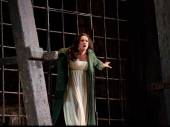
 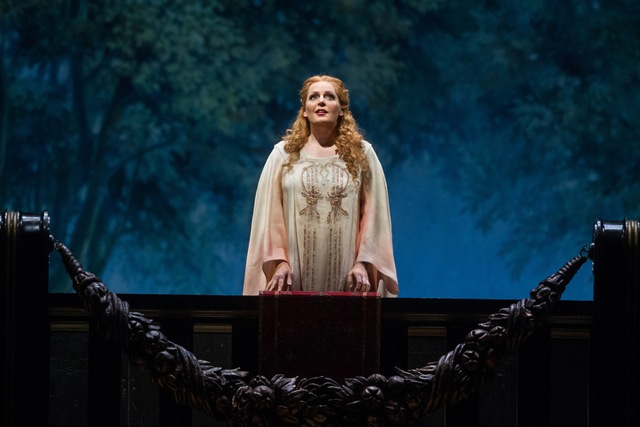 Her costume colors reflect the burning passion of developing love and barely controlled sexual desires, moving from light, warm pastels to deepening shades of red. Ironically, they ascend to a level that registers a degree or two above those exhibited by Ms. Westbroek (photo left), who while exercising superb vocal talents was never able to convince this observer that she was even warm, not to mention over flowing with the level of sexual anticipation found in the libretto.
Marcello Giordani (photo right below) as Paolo is the quintessential Italian tenor. His ability to hold the stage during transitions and project the longing and desire called for in the libretto is without question on target. The quality of his voice and level of devotion to the art of Italian opera is evident 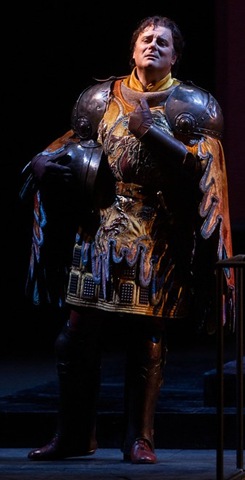 by his enthusiasm. Paolo’s duet with Francesca at the conclusion Act 3, “Paolo se Perdonato” demonstrates his ability to physically demonstrate his character’s guilt as an actor as well via his instrument of choice: the voice. But perhaps a greater indication of acting ability is found in the delivery of the “duet” in Act 1, where neither Francesca nor Paolo vocalize a solitary note. It’s a memorable and dramatic aria for the chorus, as Paolo and Francesca slowly, without hesitation enter into a lusty world of forbidden love.
In addition to the Francesca and Paola are Paola’s two brothers, 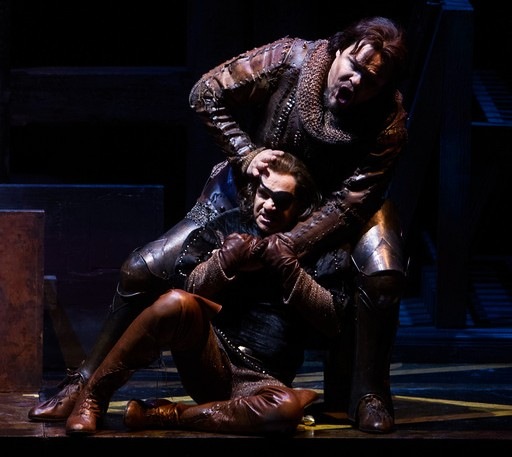 Gianciotto the husband of Francesca brilliantly played by Mark Delevan (top in photo left) and Malatestino distinctively and decisively delivered by Robert Brubaker (bottom in photo left). So determined and strong are the portrayals of these characters that each independently approaches the point of upstaging the whole production. Each is technically and vocally superb with a dominating stage presence. Malatestino’s duet in the initial portion of Act 4 is perhaps the darkest and strongest of all operatic duets, as it foreshadows the violent and brutal end that awaits Francesca and her ill-fated lover.
Marco Armiliato is one of today’s most respected opera conductors appearing quite confident and comfortable with the melodies and harmonies of Riccardo Zandonai’s “Francesca da Rimini.” As noted, “Francesca …” has been absent from the stage of the Metropolitan Opera House for a period of 27 years. Though it is said absence makes the heart grow fonder, the reason for this omission is not clear. Perhaps the cause is a lack of familiarity or reluctance on the part of the house to engage in verismo scores or productions so full of emotions and sentimentality. Riccardo Zandonai’s work deserves the honor of being included in the repertoire of Italian verismo opera, appropriately united with the other Italian composers Mascagni, Leoncavallo, and of course Giacomo Puccini.







 The Catskill Chronicle
Leave a comment