Review by Barry Plaxen
JEFFERSONVILLE, NY (August 2, 2012) – The July 28 Gala Grand Finale for Weekend of Chamber Music’s (WCM) 2012 Summer Music Festival began with another of Co-Director Andrew Waggoner’s  pre-concert talks at 7:00 p.m. Waggoner (photo left), always enthusiastic, humorous and informative in his deliveries, concentrated on explaining the differences and also the links between “absolute music,” “poetic music” and “programmatic music.”
The music began with the first of two works each by three composers, and the ever-sensitive and communicative pianist Tannis Gibson performing two Debussy Preludes, “The Girl with the Flaxen Hair” and “The Hills of Anancapri.” I use the English translations of the titles on purpose. These were Wagonner’s examples of poetic music, impressionist musical works that are meant to depict, in these two cases, a particular image in the former piece and a sensory remembrance in the latter. What is fascinating is that Debussy put the titles of the works AFTER the end of the music, not on the usual “title page.” This fact indicated that Debussy meant his poetic  music to be heard (and NOT seen??) as absolute music if the performer and / or the listener wish it so. Ergo, a “link” between the poetic and the absolute!
Wagonner, possibly a bit presumptuous in his statement that George Crumb (b. 1929) might be America’s greatest composer …
“In the 1970s when complex, dissonant, cerebral works were everywhere, Crumb offered a dark brooding Romanticism and an unparalleled sensitivity to sound” (Michael Broyles)
… had given us an excellent history of Crumb (photo right), a major composer of programmatic music. (Berlioz’ “Symphonie Fantastique” was mentioned as an example of that ilk. It has a definite story line and the music reflects the story. Tone poem or symphonic poem is another way of  saying programmatic music.)
Very much like WCM Co-director and WCM creator Judith Pearce, Wagonner is clever at programming and Crumb’s “Sonata for solo cello” (1955), an “absolute” compositional exception to his usual programmatic works was performed by, also ever-sensitive and communicative, Caroline Stinson (photo left). The early work – Crumb was a student of Boris Blacher in 1955 – (I have had the thrill of working with Blacher in my student days in Boston) – is full of chromatics and contrasting timbres. Though an “absolute” work, it could be considered conceptual in its thought-provoked melding of multiple forms of musical structures, i.e toccata & siciliana, and multiple musical techniques, i.e .pizzicato & harmonic overtones.
 This was followed by an absolutely gorgeous absolute work, Mozart’s “Piano Quartet in g”. K.478, for which Pearce’s familiar world class performers, Gibson (photo right), Nurit Pacht, and Stinson were joined by violist Max Mandel. Mandel was so in evidence with his playing, that at first I said to myself, “boy, Mozart really composed a great part for the viola”. Not so. As I continued to listen, I realized that Mozart composed an accompanying part with no innovation or surprises, and that it was Mandel’s overwhelmingly expressive playing and heartfelt phrasing that was riveting me. He and Stinson also beautifully played their duet-accompaniments to Gibson’s and Pacht’s melodies. Pacht, a great baroque and contemporary artist, did not seem to be as comfortable with Mozart as she has been, for me, with Bartok or Bach. Nonetheless, it was a very moving performance and
  the audience’s reaction was so exuberant that Pearce began the second half of the program referring to that reaction in her brief speech for financial support.
The second work by Debussy was “absolute”: his “Sonata for Violin and Piano.” No images here of a Scandinavian lass or an Adriatic hill. Just pure music with Pacht (photo left) very much at ease and Gibson very much attentive to Pacht’s skilled delivery.
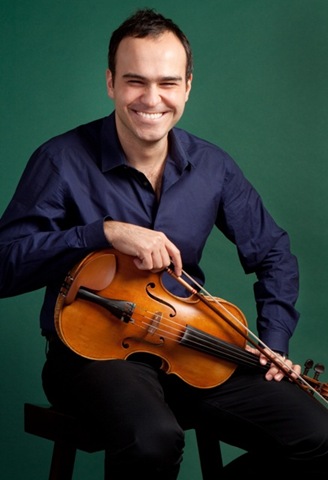 Pacht, Mandel (photo right) and Stinson then played the second of the Mozart selections, two “Preludes and Fugues after J.S. Bach”, K.404a. Mozart’s second offering on the program was very much in contrast to his first, and perfectly programmed (and played) in between the Debussy Sonata and Crumb’s “Vox Balaenae (Voice of the Whale)” (1971) which closed the program.
This major programmatic work was composed for three masked players, electric flute, electric cello and amplified piano. Crumb had the players masked because he absolutely (sic) did not want personalities to interfere with the hearing of his music. He failed. Music is music, and musicians are artists. They cannot sit or stand still. They express beauty with all their body language, too. The slow and definite lifting of a hand after it has plunked a pizzicato note, the whole-body movement after taking a deep breath and playing a difficult or slow passage on the flute and singing at the same time, the rising tush on the piano bench as the music goes from pounding to tinkling. You can’t hide physical communications. Needless to say, these self-induced communications very strongly enhanced my enjoyment of the music.
Crumb titled his movements to suggest the beginnings of the earth, various “…ozoic” periods and the end of the time with no humans on the earth. I began to listen to the music with concept and titles in mind, but I couldn’t continue. After hearing the first movement I was so engrossed in the music that I told myself to stop thinking of Crumb’s intentions and just listen, thereby not connecting his titular epithets to the music. So, he may have succeeded in depicting those programmatic epithets. (Actually, I know he did, as there were those in the audience who said so. Those who resonate with programmatic and conceptual, music.)
After I began to just listen without thought, it came upon me that it WAS a great piece, even if only because it was also deeply moving as absolute music. Deeply. So Crumb succeeded in that “Vox Balaneae” can be heard on various levels, as either or both types of music – and even poetic – all three! (I could go into a diatribe on aligning the work with Verdi’s Requiem, the only composition that  immediately comes to my mind as absolute, programmatic and poetic, but I won’t.)
With Pearce (photo left) playing the flute and singing at the same time, Pearce and Stinson whistling and Gibson reaching into the piano to strum or dampen the strings, I knew Crumb had totally succeeded. In what? I cannot say. I can only say that the music was strongly affecting as absolute music, all his cerebral processes notwithstanding. I am not skilled ‘musicologically’ enough to describe his use of tone, timbre, rhythm, pitch, harmony, etc., Suffice it to say, and I know other lovers of absolute music in the audience agree with me, that the ability of the piece to stimulate emotion and feeling overrode any need for us to analyze how or why it did. Along with those in the audience who did / do understand and resonate with the programmatic aspect of the masterpiece, we all were one with the powerful performance of the powerful work.
It is here I wish to make note of, and thank all those involved in bringing all that is available to us in Sullivan (and Orange) County like the innovative Crumb work, the Mozartian warhorse and Debussy’s impressions. A plethora of fine, high-end musical entertainment from 1400A.D. to 2012 A.D is handed to us on a silver platter. The A-Z gamut of musical composition is just about fully fed to us by various music organizations and performers all year long. Remarkably so. We just need to dine (or pig-out) on the more-than-just-musical-crumbs handed to us. And, in the case of Crumb’s piece, “taste” something we never ate before.
Mmmmm, good.







 The Catskill Chronicle
Leave a comment