Review by J. A. Di Bello, Photos: Ken Howard/Metropolitan Opera
LOCH SHELDRAKE, NY (January 23, 2013) – According to Hoyle, the claim mentioned in this title is absurd and harshly rejected. Yet, carefully join and position that regal combination on the stage of the  Metropolitan Opera and the Queens speak for themselves. It is by means of this poker-savvy theatrical device that the Metropolitan Opera’s HD production of Gaetano Donizetti’s “Maria Stuarda” is propelled to the peak of even a modest opera goer’s “bucket list.” The two queens,
 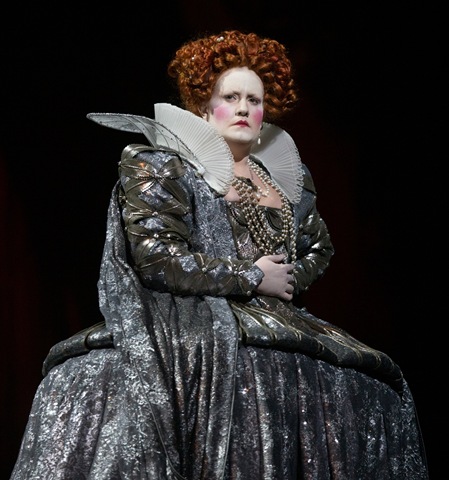 mezzo-soprano Joyce Di Donato (photo left) in the title role as Maria Stuarda and soprano Elza van den Heever (photo right), as the blustery Elisabetta have definitively and impeccably placed on the stage the finest of presentations, each vocally illustrating for public consumption the precise and fine art of bel canto.
John Macfarlane’s intelligently conceived set with a front curtain display of the bloodied royal crest of Elisabetta and his period-conscious costume design combine effectively with the brilliant lighting arrangements of Jennifer Tipton. 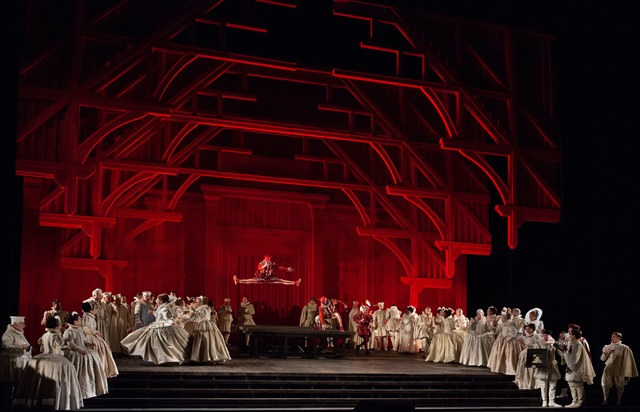 Lekos and soft Fresnels expose the symbolic and prophetic world of royalty, as it existed in 16th century London. The set, as it should, is designed to reinforce the mood and atmosphere of the production’s setting, thus creating a complete composition – picture. Of special note are the symbolic and prophetic reds adorning the Place of Whitehall and the stick-like black and white of the wood at Fotheringhay Castle.
Elza van den Heever brings to life Elisabetta, Queen of England, as majestically regal and arrogantly proud. Ms. van den Heever’s most recent triumphs are reported to be “outstanding role debuts as two formidable Handel characters, Armida in Rinaldowith the lyric opera of Chicago and the title role of Alcina with the Opera National, Bordeaux.”
Her Act One aria “Ah! dal cielo discenda un raggio” (“Ah! may a ray of light from heaven”) is an 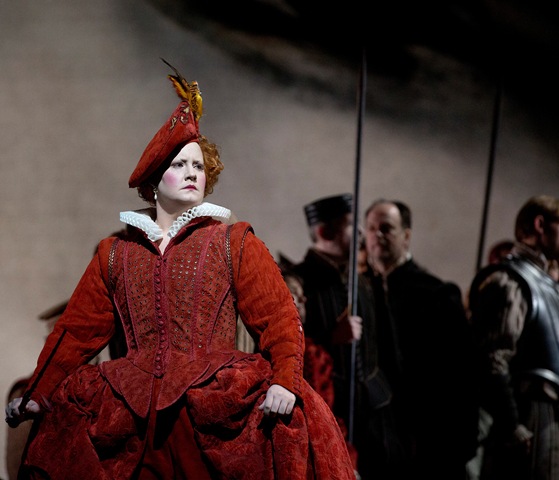 opportune beginning for an exploration of the bel canto style. The piece is most demanding as it begins calmly but as the alternatives and seriousness of the situation become more evident; Elisabetta displays agitation as she seeks guidance from God. The turmoil of her dilemma, the execution or pardon of her cousin and romantic rival for the affections of Roberto, the Earl of Leicester, is reflected in her music. As the voice breaks into the bel canto style including runs, it allows Elza van den Heever to demonstrate her efficient ability to “run” from the high notes to a low notes with precise phrasing and a complementary tone.
The dedication and accompanying talent of Elza van den Heever to her role as of Elisabetta are without dispute. It is reported further that to accommodate the bulky wig used by Elisabetta, Ms. van den Heever had her head shaved. This alteration or physical accommodation is a great and personal sacrifice and may be appropriate in HD productions where full head close-ups will display hair lines and may prove to be a visual distraction. True, numerous actors gain or lose weight to accommodate a particular role or character and shaving the head may be but a single step in that direction. It has happened in the past and certainly will be a part of the future. One might hope, though, that the opera house, in an effort to accommodate the particular vocal requirements does not return to the early eighteenth century use of the vocally captivating “castrati.”
It is at Fotheringhay Castle that the majesty of the bel canto begins to truly unfold. Maria enters and 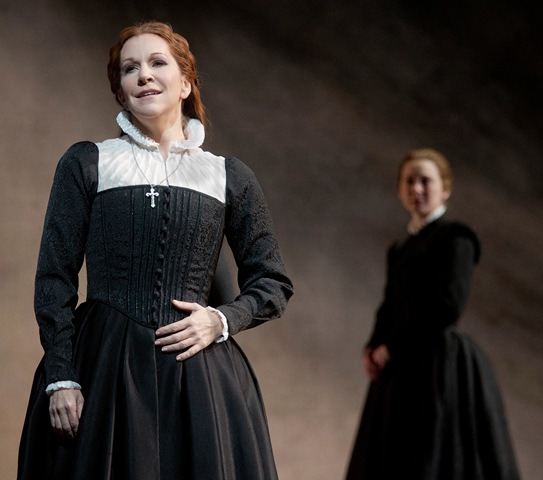 vocally confronts the reality of her confinement, “Nella pace del mesto riposo.” What finer vocal perfectionist to consider than Joyce Di Donato, a three time Grammy Award nominee and current mistress of Bel Canto. She not only delivers a performance that borders on perfection but presents an exquisite Bel Canto tutorial. Mezzo-sopranos are frequently but not always cast in the title role of this, the second of Donizetti’s famed Tudor Trilogy. Fortunately, there are those that firmly believe there is no substitute for Joyce Di Donato in this special genre and especially in the role of Maria Stuarda. She presents an amazing stage presence accompanied by the ability to produce a consistent tone while maintaining long,
 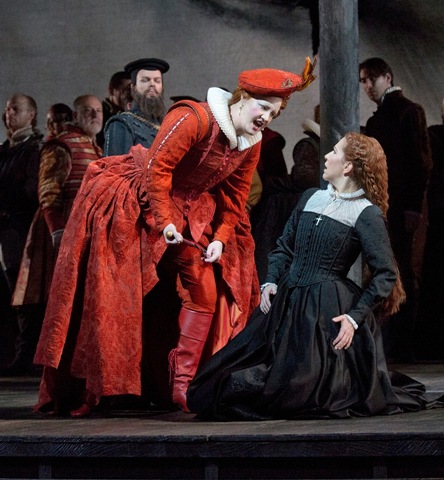 sustained phrases.
There are some that say the meeting between Maria and Elisabetta never took place. So what and why talk about it? It does not matter! The confrontation scene is perhaps one of the most demanding and beautiful in the whole opera. The tempo increases in direct proportion to the insults thrown. It is simply good theatre, highlighting a riveting and a cherished performance by two great and multitalented professionals.
The final and inspired arias of Maria are engrossing, overflowing with emotion and drama. Dressed in ceremonial red the scene clearly depicts her spiritual ascension as a Catholic martyr. In the world of bel canto this may be as good as it gets. For it is here in this sequence that one is enlightened: The voice stands naked on the bel canto stage. The runs, leaps, the lows and the highs do not allow for sloppiness. The voice is the acrobat on the high trapeze. A vaulting gymnast on the uneven parallel 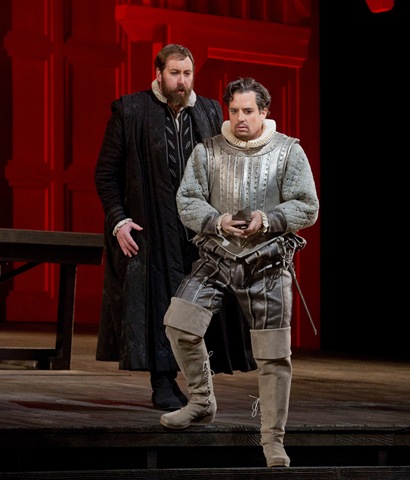 bars, miss and you’re down for all to see. The scenes are emotional and especially haunting in HD. She has confessed to God and the peacefulness found in her full facial close-ups clearly reflect a Maria full of grace!
The three males, the three Jacks, in this production of Gaetano Donizetti’s “Maria Stuarda” function primarily as stage props, with the appropriate function of facilitating the story line. Talbot and Cecil are adequately and brilliantly portrayed by Matthew Rose (at left in photo) and Joshua Hopkins respectively. However the remaining Jack and consistent with the quality of vocalists on stage, is Matthew Polenzani (at right in photo), a gifted lyric tenor who portrays the “all-flash-no-cash” Roberto, Earl of Leicester. His talents are clearly evident in this and other productions of the Metropolitan Opera House. Valiant as his efforts are, the cards continue to speak for themselves: Two Queens Beat Three Jacks!








 The Catskill Chronicle
Excellent review! I particularly like the sentence “The voice stands naked on the bel canto stage” and the joke about castrati — although who knows, Mr. Di Bello may start a trend!