Review by J. A. Di Bello, Photos by Ken Howard/Metropolitan Opera
LOCH SHELDRAKE, NY (February 20, 2013) – With questionable motivation the box-office managers of the Metropolitan Opera have billed Director Michael Mayer’s new and revised rendition of Giuseppe 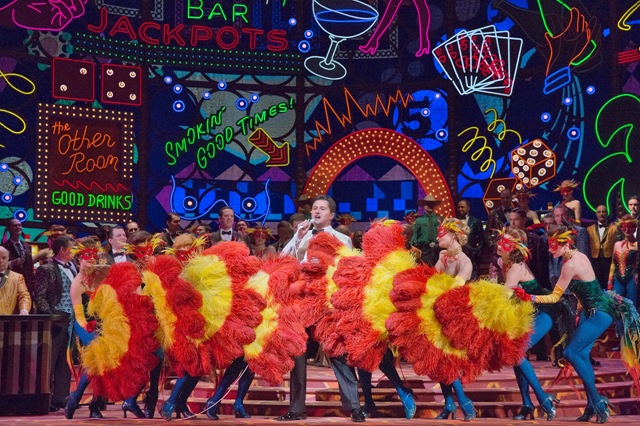 Verdi’s opera seria, Rigoletto, as a “tragedy” and a “betrayal.” But, the opera with all of its fine arias, exciting duets and one of the most magnificent quartets ever written for the opera stage, Rigoletto stands pure, as unadulterated, exquisite melodrama! Tragedy it is not. And what of the touted betrayal? It is quite evident in the libretto, of course, but true betrayal is found in the hands of Michael Mayer. He has mutilated Giuseppe Verdi’s timeless masterpiece.
Alterations beyond the simple done-before setting change from 16th century Mantua, Italy to 1960s Las Vegas exceed in number that is accommodated here. But one simple rule from this writer’s recollection of Stage Direction 101 is the potential impact that firearms, used as props, have on an audience. Even the most intense and sophisticated theatre goers face distraction when a firearm is pointed in their direction. The prop was unnecessary and frankly silly. Furthermore, and in line with a discussion of firearms, the apparent execution of Monterone on stage is what theatre goers in Athens once referred to as obscene, ob skene.
As stated by Joseph Wechsberg, author of Verdi and noted correspondent for the “New Yorker,” Giuseppe Verdi was an Italian patriot, whose passion at mid-19th Century was in step with the unification of Italy and the legendary heroes of the emerging republic, Giuseppe Mazzini and Garibaldi. Reportedly graffiti of the time supporting Italian unification often read, “Viva Italia; Viva Verdi.” He was aggressively and stubbornly Italian reflecting his peasant origins and pugnacious manner. As a traditionalist he brandished a hostile resentment of Austrian censors and any who dared alter his work. Verdi was furious when he learned that changes were being made in the New York production of Aida. So intense was his anger, he told his agent that Aida must be withdrawn if any changes were made!
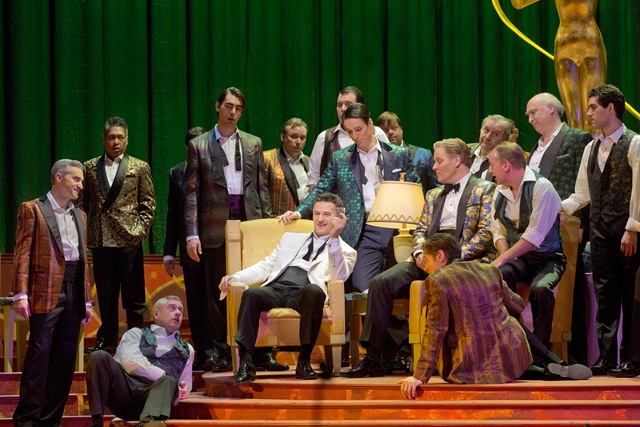 Originally, the action of this melodrama is initiated and sustained by a 16th century Italian Count, Monterone. “Sii maledetto!” he says, cursing Rigoletto and the Duke. A credible threat in that setting. The drama even concludes with the same word uttered by a defeated, humiliated Rigoletto, “Ah, la maledizione!” Mr. Wechsberg, however, attempts to convince an audience that a curse delivered by a twentieth century Arab, apparently adrift in the wrong desert, carries equal malice. The Arab is an irrelevancy and the motivational curse evaporates into the desert air!
The cause for the Met’s engagement of Director Michael Mayer and his compulsion to change remains unclear. Giuseppe Verdi’s Rigoletto is considered by numerous managers as box office gold. As written it is known to draw and play to full houses. Perhaps the plan is to attract youthful patrons, but how young can one be to be familiar with the “Rat Pack”? Maybe it’s a scheme to attract the Broadway crowd. Mr. Mayer directed two recent Tony Award-winning musicals: Spring Awakening and American Idiot. No more be said.
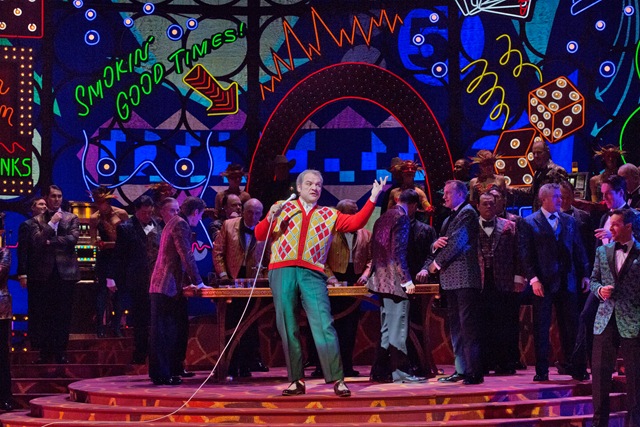 Faith in all that’s good is rewarded! The multi-talented cast selected to deliver Verdi’s magnificent opera soars above the pedestrian fray, saving a masterpiece of the Italian opera repertoire. Željko Lučićs (photo left), a burly baritone, stands above the others in the title role. His hulking shape as Rigoletto represents a convincing and potentially threatening character on stage. The delivery of Rigoletto’s soliloquy truly and with passion portrays the man’s agony. And the parlando as he and Sparafucile discuss the terms of the plot while the orchestra continues with the melody represents an important aspect in the development of opera as a theatrical form..
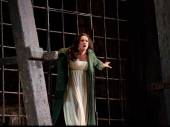
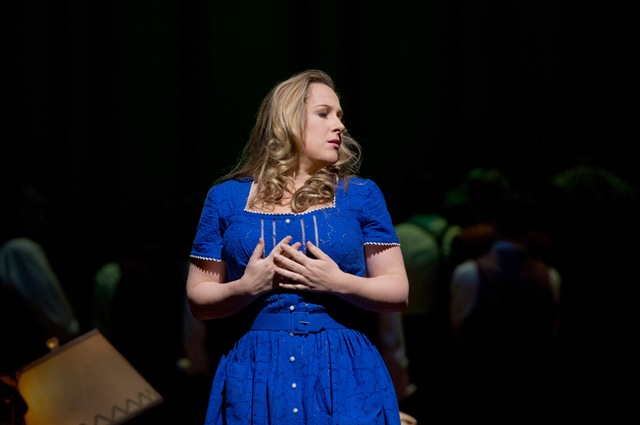 Complementing the title role is Diana Damrau (photo right), a noted soprano who represents impassioned Gilda, Rigoletto’s virginal daughter. Her voice elegant and pure delivers “Caro nome” with extraordinary clarity. But note, her finest moment in this opera is in the final act. It is here that Verdi has composed the magnificent quartet “Bella figlia dell’ amore.” Of course, as a quartet it is shared with three others: Rigoletto, the Duke and Sparafucile’s sister, Maddalena, graciously portrayed by Oksana Volkova (at right in photo below). Its level of difficulty and perfection of delivery is unsurpassed. Štefan Kocán as Sparafucile is one serious basso. His portrayal creates a credible and ruthless assassin.
Polish lyric tenor Piotr Beczala (at left in photo left) radiates as the young and fancy Duke of Mantua. He moves about the stage with  agility and the unmistakable arrogance of a cynical seducer. His delivery of the “Questa o Quella” early in the first act is an early indication of his abilities. In the final act of this melodrama, the quality of delivery is exposed. Verdi’s “La donna é mobile” is beautiful and musically simple. A San Gennaro crooner on the corner of Hester and Mulberry is wonderfully entertaining with “La donna…,” but Verdi’s greatness is not delivered. It is here that Mr. Beczala shines, as he is intelligent and vocally able to convey the frivolous, lecherous character of the Duke, fully displaying the greatness of Verdi!
Sets designed by Christine Jones accompanied by Susan Hilferty’s costumes are attractive, functional and appropriate for Director Michael Mayer’s vision of Las Vegas in the 60’s. The lighting design especially as utilized during the storm was effective and represented the evil that existed on the stage. Above the previously mention fray is the young conductor Michele Mariotti, his skill and ability to work with what must be New York’s most accomplished orchestra members will not go unnoticed or unrewarded. Verdi operas require extreme coordination and flexibility to convey their intended purposes. Mr. Mariotti has mastered and fully utilizes the skills necessary to be the conductor the Metropolitan Opera’s full orchestra.









 The Catskill Chronicle
Leave a comment