Review by Barry Plaxen
LOCH SHELDRAKE, NY (November 8, 2012) – The second “Live from the Met in HD” presentation of the 2012-2013 season was much less successful than the first, “L’Elisir D’Amore,” two weeks ago in Loch Sheldrake.
 Giuseppe Verdi’s “Otello” (1887), based on the Shakespeare play “Othello,” is considered his masterpiece. By whom? By just about every musicologist and “operacologist” that ever lived since its premiere in 1887. Because the above fact has eluded me since I first heard and saw the opera over 50 years ago, I did some research before I began to write this review, and read musical analyses all about the wondrous orchestration Verdi was inspired to compose to Arrigo Boito’s libretto. According to everything I read, yes, his use of the orchestra is a marvel of dramatic musical composition. The orchestration of the “musical storm” at the onset of the opera and the later situational events, plus his ability to express human behaviors and emotions with tonal colors and rhythms are remarkable.
BUT – here’s the rub – why is it necessary for someone like myself, an avid opera goer/lover, to have to read explanations about Verdi’s genius. Why can I not hear it instead? There seems to be a lack of communication between Signor Verdi and myself. Is it due to an inability of mine or his?
I can only base my answer to that question on the opera and Requiem Mass that he composed prior to “Otello.” The Requiem is my favorite piece of music of any genre. The melodic invention the work contains is, to me, unequaled. That same genius of melodic invention is inherent in “Aida.” But when seeing and hearing “Aida,” I am fully aware of Verdi’s orchestrational genius also. I hear every orchestral nuance that accompanies his singers and the libretto. Is it that I need melody in order to “hear” everything else? Perhaps.
“Otello,” not arguably, lacks the plethora of melodies found in Verdi’s other successful works. And a production that lacks great drama emphasizes  that fact. This was the case on October 27, 2012. Based on previous “actors” I have seen in the roles, notably Jon Vickers, without an expressive tenor in the title role to bring out the drama in the story, you become aware that something is lacking, and in my case, I pinpoint that as a lack of melody.
Johan Botha (photo right) was a totally inadequate Otello. Though his singing was excellent, he lacked depth and subtlety, unable to convey the emotional instability  that induces the madness that drives a man to kill the woman he loves.
His inadequacy carried over to his scenes with Iago, performed well by Falk Struckmann (photo left) but not by Botha. Botha is not a communicator, not a team player, so to speak. So Struckmann’s performance relied totally on his own work with no feedback from Botha to spur Struckmann to continue with his Machiavellian manipulations.
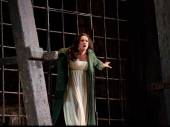
This inability to give and take dramatically was highly in evidence in the scenes between Otello  and Desdemona, performed by Renee Fleming (photo right). There was no spark between them. There was no indication of any love, between them. Fleming did her best (as always) and gave her all to create some magic and drama, but there was no “take,” and so their scenes together were totally impotent.
I remember being petrified that Jon Vickers was going to “really” strangle Renata Scotto, (I have been told she was petrified of that, too) but that  did not happen here. After Fleming’s outstanding singing/phrasing of her Willow Song and Ave Maria, where, unlike most of the opera, every orchestral nuance is easily noted, we were back to the lack of drama that was evident throughout the afternoon.
Michael Fabiano (photo left) was excellent as Cassio and, as usual, no credits were given in the program for Emilia, Rodrigo and the other comprimario roles, so I cannot mention the names of these excellent performers.
The technical aspects of the production were also excellent, with Semyon Buchkov conducting the superb orchestra and the superb chorus, with sets by Michael Eargan and costumes by Peter J. Hall that were true to the period and the libretto. Only if we were able to see another tenor in this production, would we know how much director Elijah Moshinsky might be at fault for the lack of drama and the lack of empathy for Desdemona’s murder.
The next Live from the Met opera at Sullivan County Community College is a new one by Thomas Ades, also based on a Shakespeare play, “The Tempest” on November 10 at 1:00 p.m. 845-434-5750, ext. 4377 for tickets and information.








 The Catskill Chronicle
Thank you again. Peggy.
it is truly amazing how others can love a performance and relate to it quite deeply when you are bored to tears. I have friends who loved it.
Barry
Ah Barry does it again. A most provocative review that I enjoyed especially because I have never seen the opera.