 By Barry Plaxen
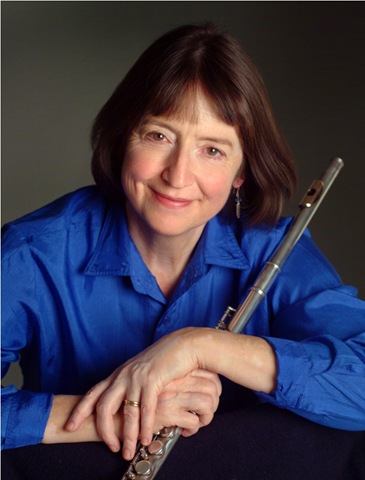
Giving attention to the theme of the 2010 Summer Music Festival “Chaos, Color and Contrast,” Artistic Director Judith Pearce (pictured at left) again chose a very contrasting program period-wise for the fourth and final Weekend of Chamber Music (WCM) concert on July 24 at the Eddie Adams Farm in Jeffersonville.
All the works were musically colorful, the list of composers (Haydn, Bartok, Debussy, Faure and Henri Dutilleux) extremely contrasting period-wise, and though the skies opened up during the outdoor after-concert reception in memory of a dear WCM friend, Lois Burrill, nothing about the glorious ending to the Festival was chaotic. Again, as mentioned in the three previous WCM 2010 reviews, the programming was spectacular in that the works performed offered an incredibly wide infusion of contrasting sounds and colors for our ears.
The Classical period offering was the (most likely very early) Haydn Flute Quartet # 2 in G, and having in mind the Festival’s theme, I was so aware of the colors and technical skill emanating from the performance that I was not paying attention to any kind of recognition of form for which Haydn is known. So it seemed like a formless Mozartean Divertimento, rather than a structured flute quartet.
Ten of the forty-four Bartok “Violin Duos” from the 1930s followed, a repeat of part of WCM’s July 22 program in North Branch. (See separate review “WCM’s Duo Violin Concert.”) Each selection was based on various ethnic folk tunes, and the genius of Bartok was evident. The variety and range of colors and sounds and rhythms and scales and harmonies and melodies were all masterfully created with just two voices. An awe-inspiring achievement.
The Impressionist period piece was Debussy’s “Sonata for Cello & Piano (1915),” a mature work. It was the first of a planned series of six sonatas. Debussy only completed two others, the “Sonata for violin and piano” and the “Sonata for flute, viola and harp.” This sonata is quite short, as instrumental/piano sonatas go. It is typical of Debussy’s style, and is quite demanding technically for the cello. It contains a good deal of false harmonics which are always colorful to hear and fun to watch being created. Because it is a masterwork, it has become a mainstay of the cello repertoire.
The “Contemporary” piece, Dutilleux (b.1916) “Sonatine for Flute and Piano,” is an early piece. It was written in 1943, only a few years after Bartok’s duos, but it sounded more modern to me than Bartok. Dutilleux is almost 100 years old and still composing. His music follows Debussy and Ravel, Bartok and Stravinsky. He really is not of a particular school, and his syncopations are jazz-like. Revered as a major composer of the second half of the 20th Century, artists no less than Mstislav Rostropovich and Isaac Stern have commissioned Dutilleux (pronounced due-tee-yerh) to write works for them.
 The Romantic period was in evidence with Faure’s, Piano Quartet # 1 in c, Opus 15. An early masterpiece, stylistically it seemed more Romantic than French, which is to say that it really follows in the footsteps of Schumann or Mendelssohn. Since Berlioz was not a chamber music composer, nor were Gounod and Lalo, it is difficult to think of a Classical or Romantic French composer who might have influenced Faure. Obviously, Faure is his own man, and it was really quite clear with this piece that his voice is unique and ergo HIS music style is THE French influence on later Gallic composers, both Romantic and Impressionistic. His colors and textures were, to me, the most emotional of all the program, so wondrous that I never had time to consider how his new-French sound contrasted with the other pieces.
Ending the concert with Faure’s piece was a clever choice of Pearce’s because it has a deep and profound (and gorgeously somber) Adagio movement, an outstanding work of art in itself, followed by a burst of energy in the last movement. All in all, a “perfect” piece.
The evening received its stamp of informality with a, once again, half-hour pre-concert MusicTalk by composer/musicologist Andrew Waggoner and Judith Pearce’s always warm welcome. And this time also by Tannis Gibson’s reversing of her July 17 red-top & black-bottom Spanish flair skirt, with a black-top & maroon-bottom flair skirt. Charming.
The World Class performers for the evening, Judith Pearce, Flute; Nurit Pacht, violin; Yuval Waldman, violin/viola; Caroline Stinson (above right photo), cello and Tannis Gibson, piano were technically thrilling to watch and emotionally moving to listen to. So much so, that if I were asked to create a theme for the WCM 2011 concerts based on both this particular offering and the entire Festival, I would choose “Powerful, Powerful and Powerful.”







 The Catskill Chronicle
Leave a comment