Review by Barry Plaxen
LOCH SHELDRAKE, NY (December 16, 2010) – Carlos, Prince of Asturias, also known as Don Carlos (1545-1568), was the eldest son and heir of King Philip II of Spain. His mother was Maria Manuela of Portugal, daughter of John III of Portugal. Carlos was mentally unstable and imprisoned by his father in early 1568, dying after half a year of solitary confinement.
 In 1787, German dramatist Friedrich Schiller wrote his first historical drama loosely based on the events surrounding Carlos’ life, concentrating on Carlos as a “republican figure” who attempts to free Flanders from the despotic grip of his father. Schiller believed in personal freedom and democracy.
In 1867, Camille du Locle and Joseph Mery wrote a libretto for Giuseppe Verdi, based on Schiller’s play. Probably at the insistence of Verdi, the opera seems to concentrate more on how the Inquisition controls the lives of all involved in various ways. Verdi was also a believer in personal freedom, but his opera seems to be a plea for separation of church and state. At least that is how I viewed it on December 11 at the Live From the Met in HD performance at Sullivan County Community College in its beautiful Seelig Theatre.
Over the twenty years after 1867, cuts and additions were made to the opera, resulting in a number of versions. No other Verdi opera exists in so many versions. It is Verdi’s longest opera, and we saw a full version with its Italian title, Don Carlo.
The story is based on Don Carlo’s love for his betrothed, Elisabeth (with a “z” in the Met titles) of Valois, who was married instead to his father as part of the peace treaty ending the Italian-French war of 1551-1559 between the Houses of Habsburg and Valois. The libretto is “spotty,” sometimes with dramatic dialogue, sometimes with prosaic declamations. The work is at its best as “opera” with the former, rather than the latter.
The music placement is very interesting, with major arias for the main characters coming one after the other but only in the last two acts. Prior to that, Verdi’s genius is apparent by his creating dramatic music that befits the plot and what is transpiring, more so than music befitting the five major characters.
 In the title role, Roberto Alagna (photo left with Marina Poplavskaya) was not in as good a voice as his recently shown performances in Romeo and Juliet and Carmen, and his acting was not as focused and clear as in the other two operas. Possibly because Carlo is torn between too many facets of his life, father-church-love-freedom-trust-loyalty-responsibility-pain, and it was difficult to convey them all due to the time constraints of the libretto.
Bartione Simon Keelyside as Rodrigo, Carlo’s friend and King Phillip’s confidante, and basso Feruccio Furlanetto as the King, did not have any difficulty in either portraying their roles with clarity, or singing superbly, though Keenlyside was a tinge too 20th century.
Sadly, the program does not list all the singers, and there were wonderful performances in two of the male comprimario roles, the “ghost” of Carlo’s grandfather and (I think) Count Lerma.
On the distaff side, mezzo-soprano Anna Smimova was also a bit spotty, achieving success with honest, deep emotions in her “confession” scene, rather than earlier in her singing of a ballad and her major “self-exposing” aria.
 But the afternoon truly belonged to the wonderful soprano, Marina Poplavskaya as Elisabeth (photo right). Seen earlier this year as Liu in Turandot, she was as vocally excellent and dramatically valid. Her magnificence lies in her ability to communicate so intensely and move you to tears by her singing, or her acting, or her overall aura. Her youthful Elisabeth was a perfect performance.
Sets and direction were adequate. Costumes were wonderful to look at, colorful and seemingly historically accurate.
Along with Poplavskaya, there were other great moments. There is a cello solo in the introduction to King Phillip’s major aria that was played with remarkable and astonishing use of color, expression and beauty. Throughout the performance, conductor Yannick Nezet-Seguin and the entire wonderful orchestra brought forth the power and force of Verdi’s innovative, dramatic orchestrations on a level I would guess has never been equaled for this opera in that opera house.
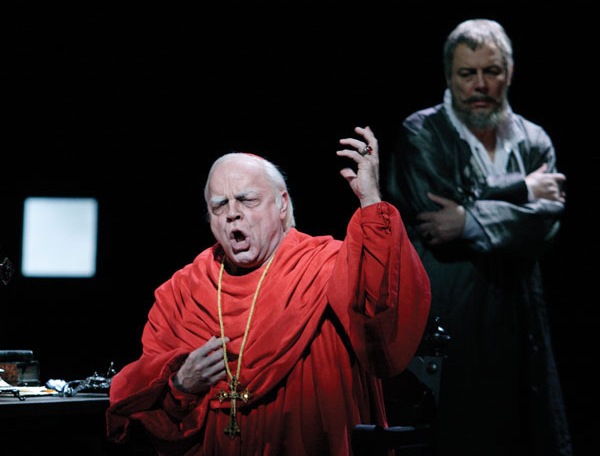 And there was one scene stealer: Eric Halfvarson (seen at left with Feruccio Furlenetto as Prince Phillip). It was obvious in this production directed by Nichloas Hytner that the opera’s villain was the church, or, if you will, the Inquisition. Halfvarson as the Grand Inquisitor portrayed the most evil human being I have ever seen on the stage. He reeked venality, baseness, malevolence. He was corrupt, execrable, vicious, vile and stinking. (And his vocal prowess was “damned” good too.)
January 8 is the date of the next Live From the Met in HD showings, Puccini’s La Fanciulla Del West at 1:00 p.m. For tickets: 845-434-5750, ext. 4472.








 The Catskill Chronicle
Leave a comment