Review by Barry Plaxen; photos “Iphigenie en Tauride” – Ken Howard/Metropolitan Opera
(March 7, 2011) – Baroque operas were not performed much until a revival after WWII. Up until that time, Christoph Willibald Gluck’s (1714-1787) operas were the earliest operas to be found in major opera houses.
 Gluck wanted to change what he called; “the mistaken vanity of the singers, the too great complaisance of composers, which resulted in splendid and beautiful spectacles” that to him were “ridiculous and wearisome.”
Gluck wanted opera to be “drama” first, with music serving the drama, unlike Baroque opera where a librettist like Metastasio could authorize 30 different composers to use his libretto for an opera, thereby relegating music to a decorative function.
 Gluck reformed the over-stylization of Italian opera and in doing so, created what we know today as “opera.” This was due to what was going on culturally in Europe at the time, the move away from the baroque forms in all parts of life into the advocacy of classical antiquity. It also encompassed Voltaire’s humanist philosophy, Rousseau’s return to nature and the Enlightenment philosophers.
We know there were composers other than Gluck who began opera reforms; reforms were also happening to French opera, and in the German Mannheim school, and these carried over to Italian operas. It is not known if any of these other reforms influenced Gluck who wrote operas in more than one language. But Gluck eclipsed the other reformers, most likely because his music is “better.”
 And that was totally in evidence on Saturday, February 26, 2011 in the Seelig Theatre of Sullivan County Community College, where the Live From the Met in HD performance of his late opera “IphigénieEn Tauride” (1779) was viewed by a most surprised and enthusiastic audience. Surprised at the beauty and dramatic quality of the heretofore-unknown-to-them music, and enthusiastic over the powerful production.
The plot of this opera is very convoluted; suffice it to say, that Iphigénie was brought to the barbaric land of Scythia by the Goddess Diana and here, many years later, she encounters two strangers to Scythia: her brother, Orestes, and his loyal friend Plyade, not knowing who they are and they not knowing who she is. It is her “job” to slaughter any strangers who come to Scythia. Don’t ask why. This is mythology.
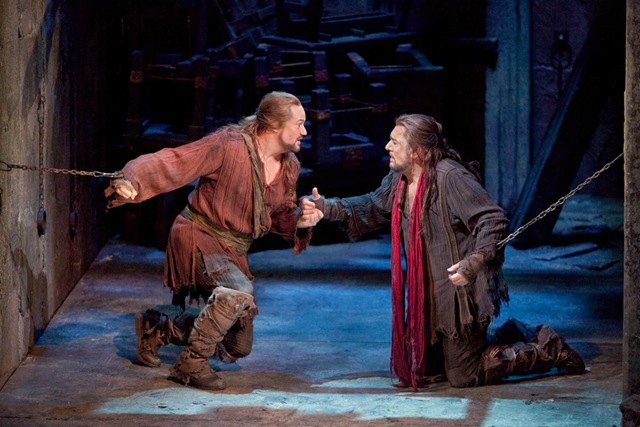
As the opera unfolds, you meet the three main characters 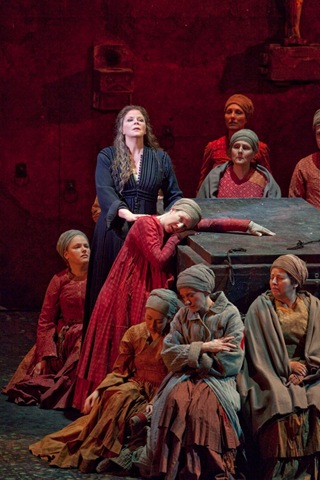 and get to know them in the first two acts as you witness Iphigénie’s confusion with her forced-into-exile lot and the Damon and Pythias relationship of the two tenors. Then you sit through the last two acts waiting on tenterhooks for the inevitable recognition scene. But – oh, as you wait – what wondrous music and drama.
Iphigénie decides she will kill only one of the strangers, and let the other escape. So she, Orestes and Pylade must decide “together” who will die and who will live. Very dramatic. All the while, your heart cries out for them to know they are siblings, and for these “good” people who are rightly angry with the Gods for creating this unfathomable situation.
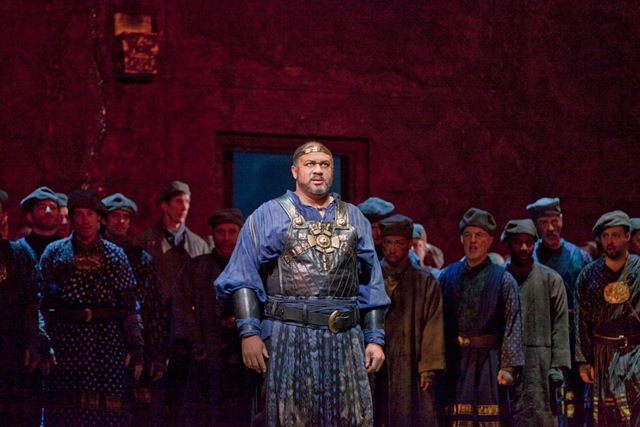
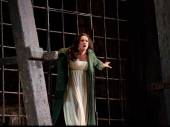
Susan Graham sang the title role magnificently. With a bit of a cold, she seemed to cut back only once in the last act, saving her voice for the exquisite finale. A magnificent 70-year-old Placido Domingo (remember him?) was her brother Orestes and a magnificent Paul Groves was Pylade. Gordon Hawkins was heartless and cruel as King Thoas of Scythia. Sadly, the program does not give you the names of the comprimario players, all excellent.
It was an afternoon of world class singing, great (shall I say magnificent?) acting – never have I seen Domingo act anywhere near as movingly and profoundly as this. Great direction (by Stephen Wadsworth), with a great orchestra conducted by Patrick Summers, a great chorus, and for once, ballet at the Met (choreographed by Daniel Pelzig) that was not sexual in nature, but reflected the militancy of Scythians against the enlightenment of Greeks. And with costumes designed by Martin Pakledinaz that seemed to make characters in a Greek frieze relieve themselves of their bas-plaster caste and come to life.
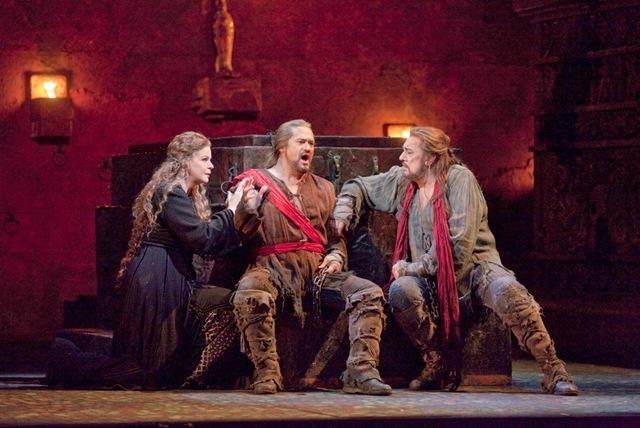
 Director Wadsworth chose to have Agamemnon and Clytemnestra interpolated in the action by mimes which made the mythological saga even more immediate and dramatic. His directorial moment of ecstasy (for me) was when the three protagonists have to democratically decide who is to live and who is to die. He had them sit extremely close together on a bench in front of the slaying altar, with Iphigénie squeezed between them as she then takes both the hands of her beloved brother and his beloved friend as they confront the painful and tragic business at hand. An incredibly moving moment – another that will remain on my list of great dramatic moments in opera.
Once again I repeat that this venue to view opera cannot be equaled. Not on recordings, in movies or, for me, live at the Met itself. The performance interviews were hosted by soprano Natalie Dessay who will sing the title role in “Lucia Di Lammermoor” in the series in March 19 at 1:00pm. Call 845-434-5750, ext. 4472 for tickets.







 The Catskill Chronicle
Ah Cavalli- L:a Calisto. YES.
Rameau – eh maybe.
I think you will feel the same about my forthcoming review of “Lucia Di Lammermoor” – that you felt as if you were present
BUT are happy you were elsewhere. 🙂
Barry
Barry! I had planned to attend this HD broacast at Seelig, but life intervened, and I could not get to it. Nevertheless, your write-up is superb! I almost felt as if I were present at the performance, and I regretted even more missing it. It’s an opera I’ve always liked a great deal. Now if only they’ll do a Rameu opera for me and a Cavalli!
Thanks for your insightful essay.
Cheers!
Gandalf