Feeds:
Posts
Comments

DSC_1399 

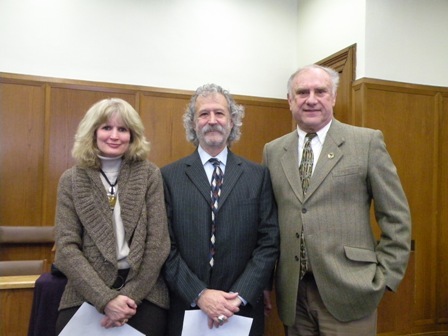
Left to right – Jack Strassman, Dr. Don Simkin and Susan Kraycer. – Provided photo

LIBERTY – Dr. Don Simkin, dentist, President of the Livingston Manor Rotary Club and partner with Exceldent of Western Sullivan, presented checks of $500 each to the Rotary Clubs of Liberty and Livingston Manor on Wednesday night, January 20, at the regular meeting of the Liberty Rotary Club.

Jack Strassman, President of the Liberty Rotary Club and Susan Kraycer, Polio-Plus Chairperson of the Liberty Rotary Club, accepted the donation from Dr. Simkin.

The donation from Exceldent, located in Liberty, fortifies the efforts of both clubs and furthers the ability of Rotary International to eradicate polio from the world. Rotary International is the world’s first service organization.

Both the Liberty and Livingston Manor Clubs focus on youth in their communities.

Liberty provides thousands of dollars in college scholarships, while Livingston Manor operates Rotary Park and presents the annual Ice Carnival for the recreational benefit of the youth in the community.

Those interested in joining Rotary are welcome to attend a weekly meeting of either club. Livingston Manor meets on Tuesday nights at Lanza’s on Shandelee. Liberty currently meets at Charlie’s on Main Street in Liberty on Wednesday nights. Both meetings begin at 6:30 p.m.

Story by Leni Santoro – Photos by Lori-Rubinstein-Fleck – Poster design by rubyflecks creative consulting.

FoodRaiser2010Rocks11x17Folder copysmall MONTICELLO Community Unity with Sullivan County Federation for the Homeless and Stacy and Friends recently announced that the 2010 Great Sullivan FoodRaiser will take place on Saturday, January 30 from 5 p.m. to “whenever” at  Mr. Willy’s Restaurant in Monticello.

Last year’s event, which raised more than $14K, featured dozens of area musicians, young and old alike, with proceeds benefitting local food pantries throughout Sullivan County.

According to Steve White, Sullivan County Federation for the Homeless (SCFH) program administer, between 350 and 400 people attended last year’s event. This year’s event promises to top last year’s gathering. Local area musicians, Stacy and Friends, invite all musicians and friends to listen or play music throughout the evening.

Stacy and Friends are a group of musicians that started to play together in White Lake in October of 2007. The concept was to create an informal environment for local musicians to meet and play together and to give people who love to hear music an opportunity to hear some great local talent.

Stacy Cohen of ‘Stacy and Friends’ belts it out at last year’s event.

Last year Stacy and Friends got involved with Community Unity and the Sullivan County Federation for the Homeless and helped to raise over $14K for local food pantries.

This year’s “friends” line-up includes; The Rausch Brothers, Dennis Newberg, Stacy and Friends, SJP, Aldo’s Group, Inner Urge, Lot 14, Stacy, Steve, Antoine and Friends, 3rd Degree, the Sommerville Brothers, Doc Sheinfeld’s Band, Jason Rosen, Rick Nestler and Dan Berger, the Sam Allen Band and, unconfirmed – but expected – Tony Dance, Albie and Headroom. Know a musician or a band who would like to join in the fun? Spread the word – everyone is welcome.

Throughout the evening guests, as well as musicians, are welcome to come and go and come back again. Like what you see and hear? Go home, grab a friend and come back for more great music.

Musicians come in all sizes. (left) Maredith Parks (right) Sara Jane Sorensen at last year's FoodRaiser.

A suggested donation of $5 or any increment of $5 is welcomed at the door with all proceeds going to any or all food pantries throughout Sullivan County. There are 15 food pantries in Sullivan County.

“At the door, each person attending has the option of picking the pantry they want their donation to go to,” said White. “ A running total is kept and monies are apportioned accordingly.”

Anyone unable to attend the event can send donations to: Sullivan County Federation for the Homeless PO Box336 Monticello, NY 12701. Feel free to mark the food pantry of your choice that you wish your donation to go to.

Sullivan County’s local area food pantries are a vital resource for many families in the county struggling to make ends meet. While some of the families in the county who take advantage of food pantries are jobless and even homeless, many fall into the category of the “working poor.” These are families whose “bread winners,” even with two or three jobs, still cannot afford to supply the basic nutritional needs of themselves or their children.

Lori Rubinstein-Fleck assists Channel 6 with an interview with Bill Fleck of SJP during last year's event.

The current economic crises is adding to the amount of families taking advantage of food pantry services. For example, “the Federation saw their numbers go from 28,000 meals and 35,000 pantries in 2008 to 35,000 and 44,000 in 2009,” remarked White. “I don’t know the numbers for the other pantries, but I’m quite sure they have experienced the same dramatic increase with the numbers continuing to rise this year.”

If you or someone you know is need of food pantry services there is a booklet  that lists the names and address of Sullivan County food pantries. It is available at the Department of Health and Family Services and the Sullivan County Federation for the Homeless.

The 2010 Great Sullivan FoodRaiser will take place on Saturday, January 30 from 5 p.m. to “whenever” at  Mr. Willy’s Restaurant in Monticello. A snow date is set for Saturday, February 6; same location and time.

Mr. Willy’s Restaurant is located at 3695 Route 42 South in Monticello. For additional information, contact Stacy Cohen via www.stacyandfriends.com.

_DSC0030

Story and photos by Ted Waddell

SULLIVAN COUNTY – While there may not be a pot of gold at the end of the rainbow, a lot of folks in the county are hoping that for the homeless in the area, there’s going to be a light at the end of the tunnel.

Sullivan County has a housing task force within what is known as the Continuum of Care, which consists of a broad range of members representing various groups concerned with the issue of homelessness.

The group meets on a monthly basis, alternating between the full continuum and work group, and is co-chaired by representatives from Rural Sullivan Housing and the Recovery Center.

Spearheading the continuum (as identified in the Sullivan County Federation for the Homeless’ Grant proposal to create a local homeless women’s and children) are the following members/groups: Rural Sullivan Housing Authority, Recovery Center, USDA, American Red Cross, Sullivan County Division of Health and Family Services (DHFS), Sullivan County legislators, CACHE, Monticello Housing Authority, Sullivan County Teen Pregnancy Support Network, Sullivan County Federation for the Homeless (SCFH), Senior Legislative Action, and NYS Assemblywoman Aileen Gunther.

Also listed as continuum of care member organizations: NYS Office of Alcoholism and Substance Abuse, Sullivan County Department of Children and Families, Sullivan County Department of Planning and Development, Monticello Code Enforcement, Sullivan County Veteran’s Agency, Sullivan County Department of Community Services, Liberty Housing Authority, Woodbridge Housing Authority, Sullivan County BOCES, Sullivan County Community College (SCCC), Fallsburg Police Department, Monticello Police Department, Liberty Police Department, Woodbridge Police Department, Sullivan County Center for Workforce Development, Council on Alcoholism and Drug Abuse Services of Sullivan County, Rehabilitation Support Services, Inc., Rural Opportunities, Inc., AIDS Related Community Services, Sullivan County Office for the Aging, along with individual members Debra Issman and Desmond McNamara.

A Member of the Housing Task Force Talks About Homelessness

_DSC0056 David P. Kreuter, chief administrative officer (CAO) for the Recovery Center is a member of the Sullivan County Housing Task Force within the Continuum of Care.

“Sullivan County is framed a little differently than most counties which call their housing task force a continuum of care, [but] here we have a housing task force with several sub-set committees, and one of them is a continuum of care,” he said, noting that in essence while the names may vary, the functions are in essence the same.

As required by the U.S. Department of Housing and Urban Development (HUD), agencies that receive grant funding to serve the homeless, counties must conduct a point-in-time (PIT) count of their ‘homeless’ at least every two years, preferably annually.

“It’s a snapshot of what the homeless population looks like,” said Kreuter, noting that sheltered homeless as individuals and families are counted, and in addition an attempt is made to include those folks living in unsheltered situations such as abandoned building, broken down bungalow colonies or as the British would say “sleeping rough” out in the woods or in derelict cars.

Last year, the total number of people who presented themselves as homeless in Sullivan County (PIT dated 1-28-2009) was 245 and another three people living in unsheltered situations.

Administrative records documented several subpopulations: veterans (7), mentally ill (10), substance abuse (20), domestic violence (3), and youth under the age of 18 (100).

Virtually everybody ‘in the know’ says the real number of homeless are probably three-times the reported number, and some contend that conducting a homeless count during the winter fails document a transient population that frequently heads to warmer climates or vets who seek seclusion in a county that is far and wide geographically.

“I think most counties would say they are under-reporting, you just can’t count everyone who is homeless at any particular time,” said Kreuter.

“Around here I’ve heard stories about people living behind Walmart at different times, or in abandoned bungalows somewhere behind the road up to Walmart.”

His take on whether the homeless population is on the rise?

“It’s increasing, especially the type of people that you don’t stereotype as homeless, people who are suddenly unemployed…there’s the saying that some people are two paychecks away from poverty,” replied Kreuter.

The Housing Task Force Looks at Creating a Homeless Shelter in the County

The SCFH recently submitted a proposal for a $1.5 million grant to convert their existing facility into a shelter for homeless single women and women with children, a proposal that is backed by numerous local agencies including the Recovery Center.

Several years ago, Kreuter worked at a homeless shelter he said was turned into a modified shelter from “just a shelter”, as a model for providing a broad range of services at a central location.

“In the long run, central locations are more cost effective than scattered sites and moving people around,” he said.

“The county is bound by law and statute to help people,” said Kreuter, adding that “Homelessness is not just a physical state of being…people often need follow through.”

“You lose a job or your house, and all of a sudden your kids are in a place you’d never want them to be, and for some people that psychological impact just paralyses them…they need supportive case management and follow up to break the cycle [of homelessness].”

He said the largest homeless population in need of housing and other services are single males, but they are often the hardest to locate “because they come with the scariest parts of homelessness, what scares people are crime and violence.”

“If you’ve ever visited a homeless shelter at its worst, they can be scary places…[but] the new model of homeless services really speaks to centralized services, both for cost effectiveness and positive outcomes.”

Kreuter said that in 2008, the Recovery Center provided services to approximately 1,100 people, and he estimates that of that number 10%-15% would be indentified as homeless by the federal government’s definition of ‘homeless’.

“When you define homelessness, it’s a syntactical challenge.”

_DSC0293adjusted

Elevator Going Up! Liberty’s Brandon Tompkins soars to the rim as Monti’s Jesse Kapito defends the glass.

Story and photos by Ted Waddell

LOCH SHELDRAKE – The 2nd Annual Sullivan County Coaches vs. Cancer Classic was held Tuesday night, January 19 at Sullivan County Community College’s Paul Gerry Field House.

Sullivan County’s “Coaches vs. Cancer”; Jason Semo of Liberty and Monticello’s Chris Russo.

The fundraiser featured a repeat battle between two local teams who competed against each other last year, the Indians of Liberty High and the Monti High Panthers.

Last year, Liberty defeated their rivals 61-55, and in the 2nd Annual Classic the Indians squeaked by Monti 66-59.

For those sports fans with a statistical mindset, the Indians won by 6 points in 2009 and a year later edged their competition by 7 points at the buzzer.

The game was big deal in the county, as it attracted several hundred basketball fans who showed up to watch a war on the boards and pay a small admission fee that was donated to the American Cancer Society’s “lifesaving mission to eliminate cancer as a life-threatening disease.”

After a couple of coaches each pledged $100.00, the final tally was $1,060.

Former Panther’s coach Dick O’Neill provided some play-by-play commentary by Cable 6 Sports.

The game was well covered by the local media and included Dick O’Neill who coached boy’s varsity hoops at Monti for 25 years. O’Neill, back from retirement, was on hand to provide play-by-play analysis and commentary for Cable 6.

“The coach’s association statewide supports this,” said O’Neill. “We’re trying to do the right thing for mankind, and in these times every little bit helps.”

Asked what it’s like to be on the bench, he replied, “Wonderful, I don’t miss it for one second…39 years is enough!”

O’Neill started coaching basketball at Burke in 1973, and retired from the Home of the Panthers two years ago.

“It’s not all just about basketball, it’s about life’s values, things like self-discipline and commitment,” he said of the game of painted lanes and distant glass. “It’s kind of like a family thing, it’s been a great trip for me.”

Coaches vs. Cancer derives from an idea promoted by Norm Stewart, former head coach of the University of Missouri’s men’s basketball program, member of the National Association of Basketball Coaches (NABC), and a cancer survivor.

To get the ball rolling for what evolved into a nationwide program, Stewart challenged fans to pledge a dollar amount for every three points posted by his team during the kickoff season.

Since 1993, Coaches vs. Cancer has raised more than $50 million through the efforts of over 2,000 Division I-III college coaches and more than 100 high school coaches around the country.

Liberty’s Chris Soto reaches for the ball.

“This is something Jason Semo (Indians coach and Liberty’s athletic director), Chris Russo (Panthers coach), Doug Murphy (Monticello’s AD) and I had been talking about for a couple of years,” said Chris DePew, Sullivan’s AD and former head coach of the Generals.

“We’re really excited about having two of our local teams here at the college, it’s an important thing for all of us,” he added.

And now for the backstory.

The 2nd Annual Sullivan County Coaches vs. Cancer Classis was dedicated
to Jack Semo, father of the Indians coach, a man who is fighting for his life against cancer.

“This means the world to me and my father,” said Liberty’s coach, who added that the Indians dedicated the game to one of their players. “We played 32 minutes for Calvin Henry,” said Semo. “He doesn’t see a lot of time, but he’s there every day at practice.”

As a 2nd grader, Henry “battled through cancer and overcame it, and every day lives with the challenges of staying on top of it.”

Liberty’s Herman Drayton in the paint.

Midway through the first frame, Monticello’s Kenny Sanders, Jr, tied it up 8-8 at the free throw line, but seconds later Liberty went ahead to gain the lead, an advantage they never yielded although throughout the remaining minutes the Panthers kept fighting back.

At the close of the opening period Liberty’s Chris Soto fired off a ‘three’ after picking off a last ditch effort by the opposition to keep the ball from going out of bounds, in a play in which the Panthers hoopster sent the ball over his shoulder backwards into Soto’s eager hands.

At the half, Liberty was up by seven points (37-30).

Early on in the third period, the Panthers (4-8) had battled back to within three points (39-36), but half way through the frame the Indians were back up by 10 points.

Liberty (4-8) drew the curtain on the third frame with a ’three’ from outside the arch, while at 7:15 in the fourth Monti’s Jesse Kapito sank a ‘three’, followed up with a ‘three’ by Liberty’s Juan Pena.

The Indians outpaced Monti in the game’s first frame 28-14, while in the second period the Panthers outgunned Liberty 16-9.

Sandwiched between Monti’s Matt Strong and Frank Small, Liberty’s workforce Brandon Tompkins retains possession.

In the third period, Liberty edged Monti 19-13, and in the final frame the Panthers out scored the Indians 16-10.

Liberty’s leading scorers: Eddie Byrd (14 points), Chris Soto (13 points including three ‘3’s’), and although not attaining double digits, Eddie Soto posted a ‘3’ and Dontrae McLauren picked up a pair of ‘3’s’.

Monticello: Jesse Kapito (13 points including a ‘3’), Juan Pena (10 points including a ‘3’), and Kenny Sanders, Jr. posted 10 points.

Stats from the free throw line: LCS 7/14 (50%), MCS 12/30 (40%)

“We battled back, I’m really proud of our guys, said Chris Russo, coach of the Panthers. “They could have called it an early night, but really battled hard and
made a game of it.”

Monti’s Matt Strong fends off Liberty’s Brandon Tompkins.

“Jason’s guys did a great job…we just couldn’t match them,” added Russo.

As a coach who’s own life has been touched by the specter of cancer affecting his dad, Semo said of the game, “It’s all about the battle, and these teams signified what he battle is all about.”

To view more photos or to purchase prints from Battling Cancer on the Basketball Court visit the Chronicle on Zenfolio.

Story and photos by Carol Montana

DSCN6289

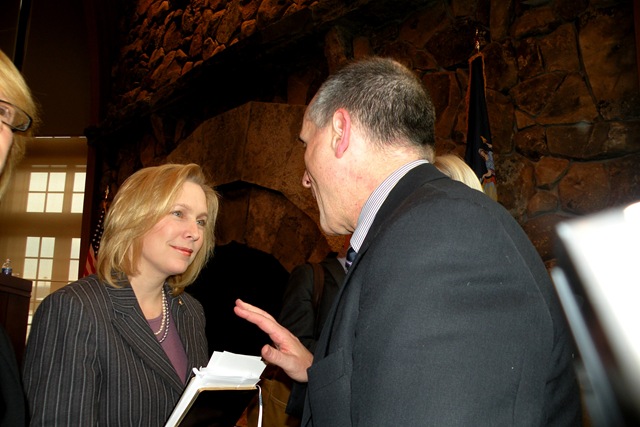
BETHEL – Appearing in the museum building at Bethel Woods Center for the Arts, New York State’s junior senator Kirsten Gillibrand was greeted enthusiastically by over 100 members of the Sullivan County community on January 15.

Introduced by Assemblywoman Aileen Gunther, Gillibrand was paying her first visit to Sullivan County.

After some brief remarks, Gillibrand took questions and comments from the audience of business owners, business support organizations, advocacy groups and concerned citizens.

“Obviously the biggest challenge we have right now is the economy … in parts of upstate NY {unemployment} is as high as 15%,” said Gillibrand, emphasizing that, in her travel around New York State, the number one issue is jobs. “We have a couple of ideas on the table that I think will help Sullivan County. One of the things you want to look at is tax policy. … One of the best ideas is giving a tax credit for every job created. …”

DSCN6256Gillibrand also spoke about access to capital for small businesses. She favors working with credit unions to increase the amount they are able to lend. “Two-thirds of all new jobs are created by small business,” the senator said.

Also in favor of off-casino gaming, Gillibrand promised to continue working with Secretary of the Interior Ken Salazar to get the ban on off-reservation gaming overturned.

Noting that Sullivan County is an agricultural county, Gillibrand said that the price of milk is too low. “It’s an important time to fight for our dairy farmers – when a dairy farmer goes out of business, a lot of other businesses go out of business.”

HPIM6330And then, regarding a topic that is on everyone’s mind, Gillibrand turned to health-care reform. The reason we need reform, she said is “because the costs are too high for everyone. The average family spent about $5,000 just a couple of years ago. Now it’s $12,000, and in the next few years it will be $24,000. Now, if our average family county income is $45,000, how in the world is a family going to be able to afford health insurance at $24,000 a year? They can’t.”

Gillibrand reported that 47million Americans don’t have access to health insurance. “This bill will cover 94% of Americans, it’s a vast improvement. It moves the country away from emergency-room care to preventive care, and it lowers the cost across the board through competition. No one can be denied coverage because of preexisting conditions. All preventive care must be covered.”

The senator also talked about how she had wanted a Medicare-for-all option. “We didn’t get that. We also didn’t succeed in getting a public option. What we did get was an exchange of not-for-profit option, which will still create competition. …” Gillibrand considers the current state of health-care reform “a step in the right direction.”

DSCN6242Additionally, Gillibrand talked about making sure the country’s financial industry works, and tackling banking regulatory reform.

Questioned about gas drilling, Gillibrand noted that, while we need alternative energy, it comes down to protecting our natural resources, “… if it can’t be done safely, it can’t be done. … If you pollute your basic resources of clean air and clean water, you can’t protect your family, and it’s that simple.”

After the Q & A session, Gillibrand met with some of the media and explained why it was important to her to visit every county in New York State. “I’m here to represent all of New York, and there are significant issues. It’s important that I hear directly from New Yorkers. It’s important that I hear directly from New Yorkers about their priorities, their concerns, and what I can do to make a difference and that’s what today was about.”

DSCN6288 Asked about stimulus monies and when there were going to be job programs for those who are not in high-tech industry and construction, Gillibrand said “… there were tax cuts for small businesses, seniors, veterans, middle-class families and so some of those would also help entrepreneurs and the arts. The president is focusing on infrastructure and energy is because they’re the highest growth energies … they create jobs for decades. On energy: if we can be ahead of China, India by developing those renewable sources we will create more jobs in our communities to get our economies moving, which means more customers for artists and photographers. For every new job that’s created, that employer will get a 15% tax credit on that. So if that’s a $50,000-a-year job, they’ll get a $7,500 tax credit, so that should also help get more money out there.”

To see more photos from Senator Gillibrand Visits Sullivan County, visit The Catskill Chronicle on Zenfolio.

_DSC0391

A real eagle fan! Kids created all sorts of eagles at the Tusten-Cochecton Branch of the Western Sullivan Public Library in Narrowsburg. 

Story and photos by Ted Waddell

John A. DiGiorgio is pictured in the DVAA art gallery with one of his magnificent eagle portraits from Alaska.

NARROWSBURG – Eagles rule once a year in the tiny but art-rich riverside village of Narrowsburg as in January EagleFest flies into town.

Founded nine years ago by John A. and Yoke B. DiGiorgio, directors of the Delaware Valley Eagle Alliance (DVEA), the festival was designed to create public awareness about eagles.

Since then the award winning festival has become a popular venue to educate folks about the nation’s proud symbol of freedom and independence.

The DVEA is a not-for-profit organization “dedicated to increasing awareness, understanding and promoting conservation of our wildlife and
natural environment.”

Chad Gasiorek of Shohola, PA, has been carving ice for 14-some years.

EagleFest 2010 featured guest speakers from several conversation groups, each addressing critical areas of ecological importance: Delaware Valley Raptor Center, University of the Sciences in Philadelphia, Pocono Environmental Education Center, Conservation Science Program/Cornell Lab of Ornithology, Raptor Trust, University of Scranton and the Pocono Wildlife Rehabilitation Center.

Of particular note was “Eagle Updates” hosted by Don Hamilton of the National Park Service (NPS) at the Upper Delaware Scenic & Recreational River (UPDE), which featured Eric Stiles of the New Jersey Audubon and the New York State Department of Environmental Conservation (DEC).

A 2010 EagleFest poster by Craig Stewart of Callicoon.

While there weren’t a lot eagles in the skies on Sunday, January 16, folks flocked to the deck overlooking Big Eddy to watch Chad Gasiorek of Shohola, PA use an electric chainsaw, a few handheld cutting tools and lots of imagination to create the magnificent birds of prey out of blocks of ice.

Movies were screened at the local firehouse, and a variety of activities were available for kids at the Western Sullivan Public Library including “Adventures of Christopher Otter” by John and Teresa Crerand, Ed Wesley’s interactive puppet show “Farmers Garden”, and  storytelling and crafts with Maureen Cokkingham.

To view more photos or to purchase prints from Eagles Rule in Narrowsburg visit the Chronicle on Zenfolio.

SULLIVAN COUNTY – Thunder 102, Sullivan County’s home for Country music, and the Town of Thompson have teamed up to sponsor the Thunder-Thompson Dollars for Haiti Radiothon to aide recent earthquake victims in the Caribbean republic.

On Thursday, Jan. 21, Thunder 102 will broadcast the Thunder-Thompson Dollars for Haiti Radiothon live from Crystal Run Healthcare in Rock Hill, N.Y. from 6 a.m. until 8 p.m. The event will raise funds for victims of the catastrophic 7.0 magnitude earthquake that shook the Republic of Haiti on Tuesday, Jan 12.

Thunder 102 and the Town of Thompson are asking residents across the Hudson Valley and Catskills to show their support for the cause. According to the International Red Cross, over 3 million people were affected by the natural disaster and further reports have indicated the death toll could reach one hundred thousand.

“The night it happened I was sitting in my warm house, eating a hot meal, and watching television when it hit me- these people don’t have these luxuries,” said Town of Thompson Supervisor Anthony Cellini. “Deputy Administrator George Cooke called me a few minutes later, and it was then we both realized we had to help.”

Thunder 102 morning show host Paul Ciliberto added, “Tony called and asked us to help with this fundraising effort and we want to do all we can to get the word out. In the past, we have experienced a great response in similar situations and we’re optimistic that our ThunderHeads and everyone in Thunder Country will once again answer the call.”

Ciliberto will kick off the event with Cellini and Cooke during the morning show, Ciliberto & Friends, and the radiothon will continue throughout the day with Sakell in the Afternoon, hosted by Mike Sakell. The event will run into the evening hours.

Thunder 102 and the Town of Thompson are also calling on businesses and nonprofit organizations to become involved in the event by becoming guests on the show. Interested parties can contact Anthony Cellini at (845) 794-2500.

Additional donations can be mailed to Thompson Town Hall, c/o Thunder-Thompson Dollars for Haiti Radiothon, 4052 Route 42, Monticello, N.Y. 12701. For daily event updates and further information, please visit www.thunder102.com.

PICT0173

In this 2006 photo, flood waters crash against the bridge leading from Main Street to Livingston Manor School. – Leni Santoro photo

PHILADELPHIA  – The U.S. Army Corps of Engineers, Philadelphia District, has launched an Internet Web site to help coordinate the Flood Damage Reduction and Environmental Restoration Feasibility Study being done in the hamlet of Livingston Manor, N.Y.

The Web site, http://www.nap.usace.army.mil/Projects/livingston_manor/index.htm, catalogs prior reports conducted in Sullivan County , N.Y., local news articles, as well as maps and data collected as part of the study.

“The Army Corps’ new Web site will help keep local residents apprised of all the work being done as part of the Flood Damage Reduction and Environmental Restoration Feasibility Study being done in Livingston Manor,” said Rep. Maurice Hinchey (NY-22). “I was pleased to secure $796,000 from Congress for this and other flood mitigation work in the Upper Delaware River Valley .  We must do whatever we can to limit future flood and protect against the loss of life and property.”

The study is in response to flooding throughout the Livingston Manor area of the Upper Delaware River Basin and is a cost-share project with the Corps of Engineers and the New York State Department of Environmental Conservation. The study will examine the problems, needs, opportunities and potential alternative solutions for flood risk management and ecosystem restoration within the 100-square-mile watershed.

_DSC0025adjusted

Vernon Isaac, assistant cook at the soup kitchen gets ready to serve from hot veggies.

Story and photos by Ted Waddell

MONTICELLO – It’s a good thing to fill a hungry mon’s belly.

From April 2008 to April 2009, the soup kitchen served more than 34,000 meals.

“When I come into this kitchen, it’s like I’m a king on a throne,” said Vernon Isaac, assistant cook at the soup kitchen run by the Sullivan County Federation for the Homeless (SCFH).

Isaac grew up on the island of Caribbean island Antigua in the West Indies, and has lived in the U.S. for 40-some years.

Along the way, he’s been homeless, worked as cook in Harlem, and cooked for the homeless for three years at the Pine Street Inn, a homeless shelter for men and women in Massachusetts before coming to the county’s only soup kitchen about a year ago.

“I’ve been there, done that between the bad times and the good, and I’ve been homeless at times,” said Isaac.

“I know what these folks are going through, it’s a tough life mon.”

Herbert Hovencamp III isn’t homeless, but he enjoys a free nutritious lunch on his day off.

If you want to get a read on if homelessness is on the rise, ask a guy who been there, a cook who serves meals to folks down on their luck.

“I guess it’s the economy,” said Isaac. “Nobody have no work, nobody have no jobs for the homeless, and it’s getting worse.”

“Every day I see more people in here every week, it’s just brand new faces…I know the regulars.”

Isaac said he goes home and sleeps well because of the satisfaction he gets from serving meals to folks in need, whether they’re ‘homeless’ or just hungry for a piping hot meal.

“Folks come in the door hungry and go out smiling because they have full bellies,” he added.

Isaac knows his way around the streets, and with that perspective in mind, has an idea of what makes some people tick.

Luis Rodrigues, head cook at the soup kitchen.

“I realize that a lot of crime goes on, because a mon who can’t find nothin’ to eat might say to himself, ‘If I have my stomach full, I don’t think about nothin’ else, and I don’t break the law’.”

“If a mon hungry enough, he’ll do whatever he can to feed himself,” said Isaac. “Not that it’s right, but sometimes he has no other choice. If a mon’s stomach is full and he has a warm jacket on his back, it’s all right.”

On any given day of the workweek, the SCFH soup kitchen provides a hot nutritious meal for more than 100 people daily, along distributing approximately 140 pantry bags every week.

From April 2008 to April 2009, the soup kitchen served more than 34,000 meals and handed out over 6,000 pantry bags.

During the winter warm clothing is a welcome ‘side dish’ at the soup kitchen.

Everyone is welcome to eat at the soup kitchen, although there are eligibility requirements for the food pantry; individuals can’t have incomes more than 185% of the poverty rate, and must provide proof of household size, and proof of income.

The soup kitchen serves hot/cold breakfasts Monday-Friday from 9:00 a.m. to 10:30 a.m., and hot lunches Monday-Friday from 12 noon until 1:00 p.m.

The food pantry is open every Friday, while emergency food pantries are 24/7 (call 845-798-8774).

For more information about the SCFH soup kitchen, call 845-794-2604

To view more photos from Homeless in the Land of Plenty – Part VIII visit the Chronicle on Zenfolio.

59269883Haitian First Lady Elisabeth Debrosse Delatour, President Rene Preval and Barth Green, M.D., professor and chairman of the Miller School’s Department of Neurological Surgery,and Co-Founder with Project Medishare discuss the earthquake relief efforts in Port-au-Prince on Wednesday. Having a staff presence in Haiti before the earthquake, Project Medishare was the first group on the ground with U.S. doctors. (Photo courtesy Joe Raedle/Getty Images)

NEW WINDSOR – In an effort to help in the relief efforts following the Jan. 12th earthquake in Haiti, Community Blood Services is collecting medical supplies at its donor centers in New York and New Jersey to send to the earthquake-ravaged country.

Community Blood Services, whose has its headquarters in Oradell, New Jersey but operates donor centers in New Windsor and Warwick in New York, is working with Project Medishare for Haiti, Inc. to provide them with the much-needed medical supplies. Project Medishare is a non-profit organization dedicated to sharing its human and technical resources with its Haitian partners in the quest to achieve quality healthcare and development services for all.

Supplies are being collected through January 31st. Community Blood Services, a non-profit organization that supplies blood and blood products collected from volunteer donors to more than 30 hospitals in New Jersey and New York, will send the items to Project Medishare, who will get the supplies to Haiti. For more information, call toll free 1-866-228-1500.

“As a community blood center who has many dedicated volunteer donors and contacts with the health community, we felt it was important to come together to help the people of this devastated nation,” said Vernon Reed, vice president of development at Community Blood Services.

“Haiti needs our help quickly,” he added, explaining the quick turnaround for collecting the supplies. “It’s really important to get these supplies to those who need them as quickly as possible.”

Supplies needed include:

  • Ace bandages
  • Alcohol swabs
  • Aspirin
  • Band aides (all sizes)
  • Bleach
  • Green soap
  • Hand sanitizer
  • Hydrogen peroxide
  • Ibuprofen
  • Iodine
  • Neosporin
  • Sterile gauze (2×2; 2×4; and non-sterile rolls)
  • Surgical sponges
  • Tape (surgical and paper)
  • Tums
  • Tylenol

Supplies can be dropped off at the following locations:

New Windsor Donor Center (NY), 575 Hudson Valley Ave., Suite 206, Tuesday, 1 to 5 p.m.; Wednesday, 4 to 6:30 p.m.; or Saturday, 8 a.m. to noon.

Warwick Donor Center (NY), 20 Grand St. near the Mount Alverno Center, on Mondays and on Thursday, Jan. 21, 11 a.m. to 5 p.m. or Sunday, Jan. 24, 9 a.m. to 1 p.m.

Paramus Donor Center (NJ), 970 Linwood Ave. West, Monday through Friday, 9 a.m. to 5 p.m., or Saturday or Sunday, 8 a.m. to 1 p.m.

Lincoln Park Donor Center (NJ). 63 Beaverbrook Road, Suite 304, Tuesday or Wednesday, 1 to 6:30 p.m. or Saturday, 8 a.m. to 1 p.m.

Sullivan_County_pistol_license

Sullivan County Government Center, 100 North Street, Monticello, NY.

MONTICELLO -  County Manager David Fanslau has announced that the County has added links on the County website (www.scgnet.us) to recognized charities that have been established to aid the victims of the devastating earthquake in Haiti last week. There is also information provided by the Federal Bureau of Investigation regarding fraudulent charities.

“The Earthquake victims in Haiti are in desperate need of assistance with the basic necessities like clean water and shelter. Please consider donating to recognized relief efforts if you are able,” said Legislature Chairman Jonathan F. Rouis.

The links to recognized charities set up for Haiti relief efforts may be found on the main page of the County website, on the right side of the page under links.

“The Citizenry of Sullivan County have showed their compassion for the victims of tragedy on countless occasions, and once again there is a need to call upon our residents to assist the victims of the horrific earthquake in Haiti last week,” added Legislature Vice Chairman Elwin “Woody” wood.

“As the Chair of the Public Safety Committee, I have witnessed first-hand the damage natural disasters have unleashed on its victims. For those that have the ability to donate to relief efforts in Haiti, I encourage you to do so, through a recognized charity, to aid the Haitian earthquake victims,” said Minority Leader Leni C. Binder.

“Sullivan County is a community rich with diversity, but united with compassion for all. It is time fall all to be thankful for what we do have, and reach out to the Haitians in their time of great need,” said Legislator Jodi Goodman

The following charities and their links have been placed on the Sullivan County website:

Established Nonprofits Working in Haiti

· Action Against Hunger

· Action Aid USA

· ADRA International

· American Jewish Joint Distribution Committee Inc.

· American Jewish World Service

· American National Red Cross

· AmeriCares

· CARE

· Catholic Relief Services

· ChildFund International

· Christian Reformed World Relief Committee

· Clinton Bush Haiti Fund

· Convoy of Hope

· Cross International Inc.

· Direct Relief International

· Doctors without Borders

· Episcopal Relief and Development

· Fernande Valme Ministries Inc.

· FINCA International, Inc.

· Friends of Hopital Albert Schweitzer Haiti

· GlobalGiving

· Grant Foundation dba Hopital Albert Schweitzer

· Haitian Health Foundation

· Hope For Haiti

· International Orthodox Christian Charities

· International Relief and Development Inc.

· Lutheran Disaster Response

· Mercy Corps

· Mission Aviation Fellowship

· Oxfam America

· Partners in Health

· Project HOPE

· Save the Children

· Salvation Army

· Shelter Box USA

· United States Fund for UNICEF

· United Way of America

· World Hope International, Inc.

· WORLD VISION INTERNATIONAL

The FBI issued a statement to remind Internet users who receive appeals to donate money in the aftermath of last Tuesday’s earthquake in Haiti to apply a critical eye and do their due diligence before responding to those requests. Past tragedies and natural disasters have prompted individuals with criminal intent to solicit contributions purportedly for a charitable organization and/or a good cause.

Therefore, before making a donation of any kind, consumers should adhere to certain guidelines, to include the following:

· Do not respond to any unsolicited (SPAM) incoming emails, including clicking links contained within those messages.

· Be skeptical of individuals representing themselves as surviving victims or officials asking for donations via e-mail or social networking sites.

· Verify the legitimacy of nonprofit organizations by utilizing various Internet-based resources that may assist in confirming the group’s existence and its nonprofit status rather than following a purported link to the site.

· Be cautious of e-mails that claim to show pictures of the disaster areas in attached files because the files may contain viruses. Only open attachments from known senders.

· Make contributions directly to known organizations rather than relying on others to make the donation on your behalf to ensure contributions are received and used for intended purposes.

· Do not give your personal or financial information to anyone who solicits contributions: Providing such information may compromise your identity and make you vulnerable to identity theft.

FALLSBURG – At the monthly Board of Directors meeting of the Fallsburg Lions Club on January 14, members magnanimously answered the call from Lions Club International Foundation (LCIF) Chairperson Al Brandel for support of disaster relief to the victims of the horrible earthquake in Haiti on January 12 by  donating $1000 to Haiti Earthquake Relief.

haiti2 LCIF had already awarded an immediate Major Catastrophe Grant of $50,000. Contributions from Lions Club all over the world have begun pouring in to increase that number dramatically. The Fallsburg Lions Club donation of $1000 aids in increasing the amount of support to Haiti’s earthquake victims.

Lions have always been there to offer hope and healing to people who are in desperate need. As stated by Lion Brandel, “It’s through Lions’ commitment to serving those suffering from the earthquake’s devastation will receive some sense of normalcy.”

Timely Talk From the Red Cross in Fallsburg

Schafman-Behan-Cascone Just prior to the horrible earthquake that devastated Haiti, the Fallsburg Lions Club hosted John Cascone, Senior Coordinator, Mass Care & Sheltering, Lower Hudson Valley for the American Red Cross in Greater New York, at its monthly dinner meeting on January 7 at Nardi’s Frankie and Johnny’s Restaurant in Hurleyville. 

Mr. Cascone spoke about the need for volunteers, financial donations, and providing of meals and set up spaces to feed and house people that have been dispossessed by man-made and natural disasters. 

He addressed the role of the Red Cross globally in times of great need, even though he was focused on the Hudson Valley. 

If people wish to volunteer their time, their money, a facility for use in community emergencies, or any related services, they can contact Mr. Cascone at (845) 673-5695 or through e-mail at casconej@nyredcross.org

* In the above photo left to right are Fallsburg Lions Club President Larry Schafman, Secretary Miranda Behan, and Red Cross on Greater New York Senior Coordinator of Mass Care & Sheltering for Hudson Valley John Cascone.

_DSC0066adjusted

Vernon Isaac, SCFH assistant cook, prepares lunch for the staff.

Story and photos by Ted Waddell

SULLIVAN COUNTY – It’s a tough job trying to break the cycle of poverty, but the folks at the Sullivan County Federation for the Homeless (SCFH) are attempting to help the ever increasing number of homeless in our economically stressed rural community with an estimated year round full time population of approximately 75,000 people.

According to the mission their statement, “The Sullivan County Federation for the Homeless is committed to developing individualized and community
wide plans for disadvantaged people to break the cycles of poverty that cause indigent people to be homeless and hungry. To this end, we will provide education to consumers, goods, and services to those who are without resources.”

Steve White, SCFH program administrator was the head tennis pro at the Concord Hotel for 25 years ago before the once proud Catskills resort fell on hard times and closed.

Steve White, SCFH program administrator, talks to a homeless client on the phone.

About ten years ago, he started volunteering at the federation, then joined the board of directors, was later elected chairman, and then took over as director last year.

“I always wanted to do something to help in the county,” said White. “There has to be something more than just yourself.”

“Yes, there are people who take advantage of the system, but sometimes luck just doesn’t go your way, and there’s got to be someone there to help in the community and society you live in.”

In addition to White, the SCFH staff includes Esther Tyler (program coordinator) and Luis Rodriguez (cook).

The board of directors: Sam Wohl (chair), Cesar Loarca, L.C.S.W. (vice-chairperson), James Lyttle (treasurer), Rhetta Eason (secretary) and Frank McGreevy, Carl Silverstein, Kathy LaBuda, Father I. Smith, Ida Crawford, Betsy Smith and Norty Hyman.

According to White, the SCFH gets by with assistance from several annual funding sources: approximately $125,000 from the NYS Homeless Housing and Assistance Program (HHAP) which provides money for the soup kitchen; about $74,000 from the U.S. Department of Housing and Urban Development’s (HUD) Housing Opportunities for Persons with AIDS (HOPWA) Program; and another $14,000-$15,000 from the U.S. Federal Emergency Management Agency (FEMA).

“With the FEMA money, anyone can walk in and if we deem them eligible, we help them with a month’s rent or a heating bill to keep them in their place and warm,” said White.

Details of the mural painted on the SCFH building by an inmate at a local correctional facility.

Without a ‘little help from their friends’ White said the SCFH wouldn’t be able to survive: Marty and Ellen Bresky of Murray’s Chickens, producers of free ranging and drug free chickens “the federation and the people of Sullivan County owe them an incredible debt”, Walmart got on board three months ago to donate left-over food, Shoprite “has been giving us bread and pastries for years”, and the concessionaire at Bethel Woods Center for the Arts “after a concert, they call us and we go over and pick up” what’s left after the music plays.

“Without that help we wouldn’t make it,” said White.

In explaining the scope of the area’s homeless situation, White said the numbers of homeless and at-risk of homelessness “have always gone up, but in the last couple of years it has increased dramatically…the lack of jobs, the squeeze on working people, and oil and gas prices have gone through the roof.”

“There are no jobs here, and the economic conditions being what they are, the rest of the country has caught up to Sullivan County.”

The SCFH is located in what used to be the old Jewish Community Center, then the Foothills Youth Recreation Center that Harry Rhulen gave to the village.

The SCFH recently submitted a $1.5 million grant proposal to convert part of the building into a shelter for homeless single women and homeless mothers and their kids in an effort to get them into a safe and structured living environment and out of expensive, yet mostly deplorable rented rooms funded by local tax dollars.

Services Provided by the SCFH

The federation’s soup kitchen provides a hot nutritious meal for more than 100 people every day Monday-Friday and distributes about 140 pantry bags of food per week.

Last year (April 2008-April 2009), the federation served over 34,000 meals and distributed more than 6,000 pantry bags (48,000 individual meals) to those in need in our economically hard-pressed community. There are no eligibility requirements to eat at the soup kitchen.

To be eligible for a food pantry, folks must have incomes that do not exceed 185% of the poverty lever, proof of household size, and proof of income.

  • The SCFH soup kitchen provides a hot/cold breakfast Monday-Friday from 9:00 a.m. to 10:30 a.m.; hot lunches Monday-Friday from 12 noon to 1:00 p.m.; a food pantry every Friday; an emergency food pantry 24/7; and a clothing pantry.
  • For the homeless, the SCFH offers assistance with locating housing, tenants rights information, information and referrals, networking with other social services agencies, advocacy of behalf of clients, tips for renters, and assistance with managing a budget.
  • The SCFH provides emergency rental and utility payments as well as short-term case management to people living with HIV/AIDS. An eligible person could receive up to five months of emergency payments annually in any combination of rental or utility assistance, but they must provide proof of their HIV/AIDS status, proof of household size, proof of income, and proof of residence (additional information may be required).
  • The federation’s holiday events include the Annual Doug Miller Thanksgiving Day Dinner, Christmas Eve Dinner, and Easter Sunday Brunch.

How to Contact the SCFH

Office hours at the SCFH. located at 9 Monticello Street are Monday-Friday 9:00 a.m. to 5:00 p.m.

Emergency food pantry services are available 24/7, call 845-798-8774. For more information about services offered by the federation, call 845-794-2604, FAX 845-794-3620 or email SCFH@hvc.rr.com

To view more photos from Homeless in the Land of Plenty – Part VII visit the Chronicle on Zenfolio.

Story and photos by Ted Waddell

_DSC0024

Steve White, Sullivan County Federation for the Homeless (SCFH) program administer takes a close look at the proposal to build a shelter for homeless women and children.

MONTICELLO – Women and kids are looking for shelter from the storm.

At present, although the problem of homelessness is increasing in an impoverished local area beset by economic woes, there is no shelter for the homeless, except in county-funded hotels and motels.

The Sullivan County Federation for the Homeless (SCFH) is at the forefront of a plan to create a shelter for homeless single women and women with children at the Federation’s existing building located at 9 Monticello Street.

Along with several agencies, folks at the SCFH are concerned about substandard living conditions provided with county funds at privately owned emergency homeless shelter motels rooms.

A detail of the mural painted by an inmate tells an emotional story.

As of January 1, 2010, there are a total of 165 emergency shelter rooms available to homeless single men, single women or families: Catskill Motel, Liberty (4 rooms); Budget Inn, Liberty (15); Howard Johnsons, Liberty (2); Roscoe Motel, Roscoe (4); Heritage Inn, Monticello (22); Liberty Motel, Liberty (10); Lakeside, Loch Sheldrake (28); Delano, Monticello (22); Travel Inn, Monticello (25); Days Inn, Wurtsboro (2); Lincoln, Liberty (14); Ocean Surf, Parksville (2); and the Raceway Motel, Monticello (15) for a reported average length of stay of approximately 85 days.

Although Safe Passage via CACHE, a not-for-profit agency, operates a women’s shelter with dedicated beds for both women and children who are victims of domestic violence, there are no beds in the county dedicated to runaway and homeless youth.

Two community based agencies in the county offer limited transitional housing, but both are at 100% capacity: Rehabilitation Support Services (RSS) hasa total of 52 beds in 24 residences and 28 apartments, dedicated to formerly homeless individuals who have a metal health diagnosis, and the Recovery Center provides seven beds for transitional housing to formerly homeless individuals with a substance abuse diagnosis.

In a request for grant funding to establish a homeless shelter for single women and kids, the SCFH quoted the Sullivan County Division of Health & Family Services (DHFS) who on July 1, 2009 reported “…we have 250 adults and children in emergency housing-motel placement. In addition, untold numbers are staying with friends temporarily due to being ineligible for our programs either by income or sanction.”

On January 27, 2007 Jonathan Rouis, chair of the Sullivan County Legislature faced the issue of a lack of a homeless shelter during his annual county address.

In part, he said, “As the cost of living continues to rise, our legislature must continue to develop a permanent housing solution for our county’s homeless population. We spend a tremendous amount of money housing homeless individuals and families at private establishments, and we need to develop a solution that expends our resources more efficiently.”

“It is my hope that by co-locating these individuals and families in one secure location, we can ensure they receive the medical attention and workforce development training needed to help them regain their footing and lead more productive lives…”

According to the U.S. Department of Housing and Urban Development (HUD), the fair market monthly apartment rent in Sullivan County is as follows: 1 bedroom $541.00, 2 bedroom $694.00, and for a 3 bedroom apartment, $831.00.

Yet in a recent story published exclusively online by The Catskill Chronicle, is was disclosed that the county’s DHFS was paying a private landlord at the Delano in Monticello $1,690.00 each month for a stiflingly cramped room a single mom shares with her two kids, ages four and six years old.

“Yes there are people living in abandoned buildings and things of that nature, but the majority of [the homeless] go through social services and are in motels all over the county,” said Steve White, SCFH program administrator.

“There isn’t one room available, there is a waiting list, [and] the Section 8 housing list is a mile long.”

The SCFH recently applied to the state for a $1.5 million grant to revamp the Federation building into a 35-bed homeless shelter for single women and women with children.

In the grant proposal, the authors outlined the problem affecting single women and single moms trying to take care of their kids.

“Presently the target populations are housed in motels without supervision and sporadic services. The project will serve as a safe and healthy environment where services by the linkage providers will be provided on-site in a coordinated manner.”

Services would include health, mental health, substance abuse counseling, legal aid, educational and employment preparation in a secure and structured environment.

“Without this program…most of the targeted population will continue to live in a perpetuated state of homelessness,” added the proposal.

White said that by his best estimate, there are probably 260 single women and mothers with youngsters living in motels, and that figure doesn’t include single men and families.

“The numbers are staggering,” he said of the homeless situation nationally and as it trickles down through the states and into small rural communities like Sullivan County.

The mural on the front of the SCFH building was created by an inmate from a local correctional facility.

He said three of the primary goals of the proposed shelter are to provide a safe living environment for the county’s homeless women and children, save the county some big bucks, and offer a wide variety of social services in a coordinated and cost-effective manner.

“Many of the landlords, the motel guys are making more money housing the homeless than they ever did dealing with the public, and not only are the living conditions deplorable, you can have a single woman living next to an old man, there’s no protection really.”

“It’s not a safe place for a young woman with a child, what do you thinks going to happen? It’s not a good situation.”

“There has to be an obligation that if you’re taking money to house people, you’ve got to provide certain living conditions…[at least] from the human compassion point of view.”

“It can’t just be that you’re making a fortune off this stuff,” he added, of the some of the landlords a lot of folks living in the homeless motels call “slumlords”.

  “I’m not saying that everyone should be given a golden spoon, but I think that the money that’s being spent to house people should be re-evaluated and used more efficiently for a better outcome,” said White.

“That’s why social services is behind this shelter, they want to see better outcomes and better use of the money.”

The stories told by homeless moms with kids living in temporary, but expensive rooms are seemingly endless, but they are rampant with tales of their kids going to school with bed bug bites, and not getting enough sleep because the neighbors are up all night drinking and yelling at each other, or just howling at the moon or perhaps their plight in life.

Donation for RISE Program

Fallsburg Lion President Larry Schafman, Treasurer Sy Berenson, and CEO of Catskill Regional Medical Center, Steve Ruwoldt.

FALLSBURG – During their New Year’s celebration, the Fallsburg Lions Club showed its resolution to support three outstanding programs in the Sullivan County community. 

Donation to Bread for Life Food Bank They presented donations of $1000 to fellow Lion Steven Ruwoldt, CEO of Catskill Regional Medical Center (CRMC) for the Rape Intervention Services Education (RISE) Program now under the auspices of the CRMC, a $500 check to Cynthia Johnston, Director of the St. Andrews Mission Food Pantry in South Fallsburg, and a $500 check to Lion Miranda Behan for Hurleyville’s Bread of Life Food Bank.

* The second photo is of Larry Schafman, Miranda Behan, and Sy Berenson.

_DSC0324

Seated: Jamie Latimer, SCB A.S.K. student support specialist
Standing: Patricia Crumley, SCB A.S.K. student support specialist; Kathy
Meckle, SCB, coordinator educational support services; Lawrence B.
Schafman, director of special programs and public relations, Fallsburg
Central School District.

Story and photos by Ted Waddell

SULLIVAN COUNTY – A.S.K. and ye shall receive.

The Sullivan County Academic Support for Kids (A.S.K.) program is designed for families living in temporary housing, i.e., homeless in the land of plenty.

The county’s A.S.K. program is administered by Sullivan County BOCES (SCB) under the direction of Kathy Meckle, coordinator of educational support services, while the field case work is done by student support specialists Jamie Latimer and Patricia Crumley.

The Sullivan County A.S.K. staff provides assistance to parents, legal guardians, and as required to youth not living with their parents or guardians (known as unaccompanied youth) with such issues as enrolling kids in school, transporting parents to school for meetings, assisting in obtaining proper immunizations for children, providing advocacy and mentoring for parents and students, referring families to appropriate programs and agencies, providing school supplies, and assisting in arranging transportation to the school of origin.

For a look at the definition of homeless as defined by the Federal McKinney-Vento Act, and as it applies to school-age children from pre-school to 21-years of age living in temporary housing, refer to “Homeless in the Land of Plenty: Part IV,” published exclusively online by The Catskill Chronicle.

Over the past couple of years, the number of homeless kids in the tri-county area of Sullivan, Orange and Ulster has shot up almost 30% due to a tanking local economy, and as the situation gets worse (and the counting by school districts improves) the numbers are expected to increase.

In the 2007-08 school year, the state listed almost 1,600 students as homeless in the tri-county area, but folks in social services and A.S.K. are in agreement that the real numbers are significantly greater.

Each school district is mandated by the state under McKinney-Vento to appoint a liaison who is charged with keeping tabs on the number of homeless students in their respective districts, reporting the numbers accurately, and making sure parents/guardians/students are aware of all the varied services in place to help homeless kids get an education.

“We work with the Sullivan County school districts to make sure they are counting all the homeless students they have,” said Meckle, now in her 18th _DSC0382year working for SCB. “Some schools are very willing to do it, for others it’s not really on the top of their list.”

The SCB A.S.K. program is in its second year of a three-year program funded at $100,000 annually.

“The needs of families are just so much more,” added Meckle. “The whole cycle of not having adequate housing…you try to get a job, you lose the job, the car breaks down and you lose the apartment…it just seems like a merry-go-round.”

In 2008-09, she said the county’s A.S.K. program helped 173 homeless kids in grades Pre-K to 12 and one GED student in the county’s eight public school districts.

Lawrence B. Schafman is director of special programs and public relations for the Fallsburg Central School District, and he is a man with a mission to help homeless kids get a decent education, particularly in these tough times.

“There’s a stigma about being homeless,” he said. ”There’s a lot of downgrading, looking down on homeless people, a lot of blaming people for their plight, and I think the person who is homeless takes that in and starts owning that label.”

Schafman got involved with the problem when he came to Fallsburg in 2003 and began working with the migrant education program – today, approximately 20% of the district’s population is Hispanic – and with a noticeably transient population “a lot of families were falling through the cracks, they didn’t know they could obtain federal assistance.”

“Now that the economy has gone south, there are a lot more homeless people out there…and in a way there’s less stigma because you see more middle class people who had really good jobs and nice homes losing their wherewithal…in the richest country in the world,” he added.

Working in the Combat Zone

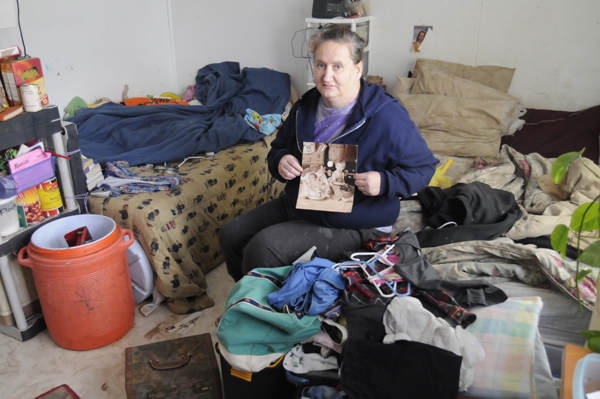
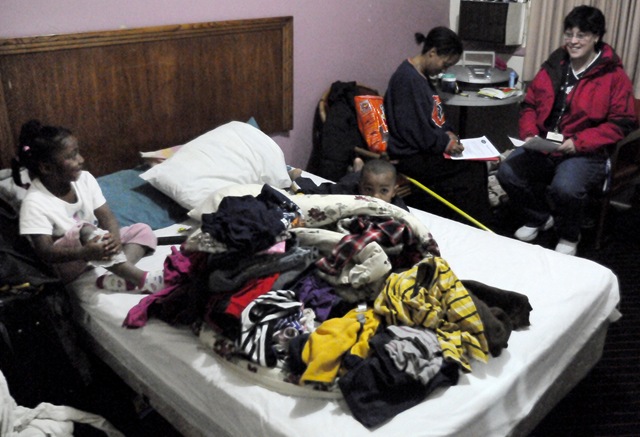
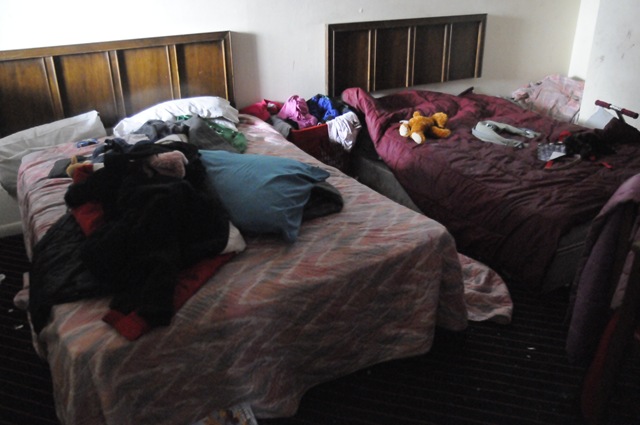
_DSC0233 While a lot of folks cast blame on others for being homeless, who in their right mind can fault a kid for being forced by circumstances – whatever the reason – for living in a roach-infested room, a broken down car or even a tree house out in the middle of the sticks. Not a lot of fun to sleep on a bedbug ridden mattress covered with piles of dirty clothes and food wrappers, especially if you’re sharing it with siblings while trying to do your homework. Good luck, kid. Wish you all the best in the world…that’s the attitude of a lot of folks who have a roof over their heads, three squares a day and some clean sheets.

However, at the SCB A.S.K. program, a couple of case workers are trying to make things right, sometimes in spite of  ‘the system’

Jamie Latimer has worked as a student support specialist for six years, and works with homeless students in four of the county’s eight school districts: Fallsburg, Liberty, Roscoe and Livingston Manor.

“Some of the kids have head lice, and there’s no money for medicine, so they stay home and miss school,” she said. “If they [the parents] don’t have money to do the laundry, they don’t send their kids to school.”

Just like a slice of bread, there are two sides to any story, and as a case in point while a lot of people decry the often deplorable conditions of some department of family services-funded temporary housing, in other instances it’s the tenants who trash the place and leave it a mess.

“We have some very destructive families, and when they leave [the rooms] need a complete overhaul, and that’s expensive…I’ve been in some rooms before they were redone, and it’s pretty scary,” said Latimer.

If you’re homeless and forced to live in temporary housing, don’t expect a palace, but you shouldn’t have to live in dump crawling with roaches. First impressions are lasting ones, and Latimer and Crumley have enough ‘first-hand looks’ to last a lifetime.

“The thing that stands out for me is everything they own is packed into the room,” said Latimer of the typical one-room temporary housing provided by the county’s Division of Health & Family Services (DHFS). “When you walk into the Lakeside and open the door to the hallway, the smell is awful…sometimes you see the clothes hanging over the sink because they don’t have money for the [coin-operated) washers and dryers.”

“Kids are bouncing on the bed because they are bored, and the playground is a parking lot,” she added.

According to Latimer, a lot of parents aren’t thinking about their kids’ homework because they are worried about putting food on the table and how to get enough gas for the car (if they have one) to get to a doctor’s appointment.

It’s proven by any number of academic studies that homeless kids traditionally post lower grades in school, due in large part to living in temporary housing.

“It’s constant,” said Latimer of the vicious cycle of poverty and homelessness, “[In some cases] They’re listening to mom and dad or mom and her boyfriend fight all night, they’re trying to sleep with two or three other kids in the bed, and a lot of time they’re getting bounced around from one pace to another…people get it together, and then it all falls apart again.”

Latimer said one thing that really stands out when she interviews students about their homeless situation is that [in most cases] they want the teachers to know what’s going on in their stress-filled lives. “If a kid’s having a bad day or didn’t get their homework done, there may be a very good reason, so instead of saying ‘You have detention!” or ‘You’re in trouble!, find out why.”

Crumley is a veteran in the local social services field, and for the last three years has worked with homeless students in four school districts (Monticello, Tri-Valley, Eldred and Sullivan West).
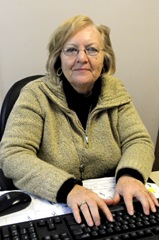
_DSC0072 She described most of the temporary housing provided to homeless families or single moms with kids through the county’s social services as “below adequate for anybody.”

“I don’t find fault with family services for any of this,” she added. “It’s what’s available out there, and it’s what they are allowed to use [but] it’s not living for normal people.”

First impressions at the Heritage Inn of Monticello …

“They use these motel rooms in back of the Heritage, and there are usually eight to ten rooms assigned [to homeless families with students] in back of the building,’ said Crumley.

“You knock on the door and go in and there’s two beds less than double size, sometimes they have a tiny table, sometimes they don’t. One or two chairs, and there’s always a TV that is probably 20 years old, something you can use to keep your mind off your troubles, and the bathrooms are about the smallest you can ever use.”

Crumley said some tenants try to make the best of what she called “just deplorable conditions to begin with” by cleaning the floors every night, but it’s a hard row to hoe if you’re homeless and living in one room with a bunch of kids.

Asked if taxpayers and the ‘system’ are getting a good deal for their money, she replied, “Absolutely not!”

In Sullivan County, the Department of Health and Family Services (DHFS) provides temporary housing for homeless students served by A.S.K. at eight locations in three towns: Monticello (Heritage Inn, Raceway Motel, Travel Inn, Delano Motel and Super 8), Liberty (Liberty Motel and Budget Inn) and Fallsburg (Lakeside Motel, formerly Hillsdale Dorms).

Is Past Really Prolog?

Meckle recalled going into a room at the Willowemoc Hotel (currently closed) a few years ago to offer assistance to a mother living in one cramped room with five kids and her elderly father.

“There was a playpen in the middle of the room, and the kids were beating on one another, there was nothing else for them to do but jump on the beds…it was a memorable experience,” she said. “A couple of these children were in school. Could these children think about doing homework when they came home?”

When she first started out in social services, Meckle encountered an 18-year old BOCES student who built a tree house in the Western part of the county because he had nowhere else to live.

“These are my circumstances, these are my options,” she said of his will to surmount some difficulties.

“A lot of these kids have a great spirit to survive, triumph and still maintain a sense of their dreams even in desperate circumstances.” Meckle added that Steve White, program administer of the Sullivan County Federation for the Homeless has long held that a shelter for the county’s homeless women and children is an idea that should be put on the front burner.

“It’s critical to give children a place they can call their own, [that they] know they can have three meals a day, a place to put their pictures on the wall, a place for them to do their homework, a place to give them a sense of stability,” she said. “It’s just looking at the tip of the iceberg,” she said of gazing at
homelessness in the land of plenty.

For additional information about Sullivan County A.S.K., call 845-794-4405 (Jamie Latimer @ ext. 303 or Patricia Crumley @ ext. 304), or visit them at the St. John Street Education Center, 22 St. John Street, Monticello, New York.

The mailing address: A.S.K. Program, Sullivan County BOCES, Educational Support Services, 6 Wierk Avenue, Liberty, New York 12754.

levine workshop 09

Writers from all over the country attended the 2009 Mike Levine Workshop. The Mike Levine column read-a-thon helps support the annual hands-on workshop. – Provided photo

NEWBURGH – The community is invited to the third annual Read-A-Thon of stories and columns by the late Mike Levine to support one of the best writing workshops in the journalism business.

Jim Moss, former publisher of the Times Herald-Record will host the 2010 Read-A-Thon at Christine’s on Broadway, his new Southern barbecue restaurant in the heart of Newburgh. The Read-A-Thon takes place from 2 p.m. to 6 p.m. on Sunday, January 17, 2010, at Christine’s, which is located at 167 Broadway (snow date is January 24). A special barbecue sampler will be served.

image The 2010 workshop celebrates the life and career of Mike Levine on the third anniversary of his death. The beloved Times Herald-Record columnist and former executive editor died suddenly in January 2007 at the age of 54.

The Read-A-Thon supports the Mike Levine Workshop, a hands-on writing workshop credited with re-igniting the passions of working journalists.

At the Read-A-Thon, anyone who wishes can read one of Mike’s 1,800 columns or simply listen. Donations to the Mike Levine Journalism Education Fund may be made at http://www.cfoc-ny.org.

Columns will be available at the Read-A-Thon, or, visit www.mikelevineworkshop.org . Column readers are also welcome to secure pledges and donations from their friends and neighbors. A pledge form may be found at http://www.mikelevineworkshop.org. For more information, contact Steve Israel at sisrael@hughes.net or call 845-583-7046.

The Mike Levine Journalism Education Fund is a component fund of the Community Foundation of Orange and Sullivan, a nonprofit organization. For more information about the Community Foundation, please visit www.cfoc-ny.org

Story by Ted Waddell

SULLIVAN COUNTY – If you’re homeless or living in temporary housing, your kids have a right to free and appropriate public education. No if’s, no buts, no ands about it…federal law as authorized by the McKinney-Vento Homeless Assistance Act of 1986 (Public Law 100-77) was the first significant federal legislative response to homelessness in the nation, and was passed and signed into law by President Ronald Reagan on July 22, 1987.

Since the original act was passed to provide federal funding for shelter programs, it has been amended several times, most notably in 2002, as reauthorized as Title X, Part C of the No Child Left Behind (NCLB) Act in January 2002, as the primary piece of federal legislation dealing with the education of homeless children and youth in America’s public school systems.

The conditional funding act stipulates that if states accept the federal grants, they are bound by the terms of the act, and in the case of children defined as “homeless,” are mandated to provide school-age children up to 21-years of age living in temporary housing with equal access to education in such areas as school selection, dispute resolution, enrollment, transportation, school liaisons and the prohibition of segregation.

A Closer Look at McKinney- Vento

When it was originally passed in 1987, the McKinney-Vento Act was designed with 15 programs to provide a broad range of services to the homeless in the land of plenty, and included the Continuum of Care Programs, the Supportive Housing Program, the Shelter Plus Care Program, and the Single Room Occupancy Program, in addition to the Emergency Shelter Grant Program.

It also established the Interagency Council on the Homeless, later known as the Interagency Council on Homelessness.

After receiving reports that up half of all homeless children were not attending school, Congress established the McKinney-Vento Homeless Assistance Act with the goal of ensuring the enrollment, attendance, and academic success of homeless children and youths.

As published in the United States Code (USC), Title 42, Chapter 119,
Subchapter I # 11301 (laws in effect as of 1-6-1999), Congress found that
“the nation faces an immediate and unprecedented crisis due to the lack of shelter for a growing number of individuals and families, including elderly persons, handicapped persons, families with children, Native Americans and veterans; the problem of homelessness has become more severe and, in the absence of more effective efforts, is expected to become dramatically worse, endangering the lives and safety of the homeless …,” going on to note “the causes of homelessness are many and complex …”

Under McKinney-Vento, children defined as “homeless” are entitled to numerous protections, as the act defines homeless children as “individuals who lack a fixed, regular, and adequate nighttime residence.”

According to the National Center for Homeless Education, the definition of homeless children and youth includes the following: * children and youths who are sharing the housing of other persons due to
loss of housing, economic hardship, or a similar reason; are living in
motels, hotels, trailer parks, or camping grounds due to the lack of
alternative adequate accommodations; are living in emergency or
transitional shelters; are abandoned in hospitals; or are awaiting foster
care placement

  • Children and youths who have a primary nighttime residence that is a public or private place not designated for or ordinarily used as a regular sleeping accommodation for human beings.
  • Children and youths who are living in cars, parks, public spaces, abandoned buildings, substandard housing, bus or train stations, or similar settings.
  • Migratory children (as such term is defined in section 1309 of the Elementary and Secondary Education Act of 1965) who qualify as homeless… and are staying in housing not fit for habitation.

According to A. Laudan and M. Burt in their book “America’s Homeless II: Populations and Services” published in 2000 by the Urban Institute, over 1.35 million children experience homelessness each year.

The National Center on Family Homelessness, in a report titled “America’s Youngest Outcasts”, reported that as of the 2005-2006 school year, they counted 1.5 million homeless kids in the nation, about 200,000 more than the figure it counted a decade before.

Requirements for Schools Under McKinney-Vento

The McKinney-Vento Act provides certain rights for homeless children, which include waiving some requirements such as proof of residency when students are enrolling, and allowing categorical eligibility for specified services, such as free textbooks.

The act states that homeless children may attend their school of origin or the school district in which they are temporarily living; must be provided a written statement of their rights when they enroll and at least twice annually; may enroll without school, medical and/or similar records; have a right to transportation to school; must be provided a statement explaining why they are denied any service or enrollment; must receive services, such as transportation, while disputes are settled….

Continuing…students are automatically eligible for Title I services; school districts must reserve a portion of Title IA funds to serve homeless students; school districts must review and revise policies that create barriers to homeless students; schools must post information in the community regarding the rights of homeless students, in schools and other places that homeless families frequent; school districts must indentify a McKinney-Vento liaison to assist students.

Sullivan County Central School District McKinney-Vento Liaisons

Regional & State McKinney-Vento Liaisons/Contacts

A Word to Homeless Youth in Search of an Education

According to the New York State Technical & Education Assistance Center for Homeless Students (NYS-TEACHS), you have specific rights under McKinney-Vento (the short list includes) –

  • Youth living in temporary housing and not with their parents or legal guardians (known as unaccompanied youth) can enroll themselves in school.
  • Students have several options when it comes to the school of choice: the school they attended when they had permanent housing (known as the school of origin), the last school they went to (also called the school of origin), or the school located in the attendance area where they are temporarily living (known as the local school).
  • A school cannot require a student in temporary housing to show proof of residence to register for school. If a student says they are homeless, they must be enrolled immediately even if they don’t have documentation normally associated with school registration, such a proof of residence, immunization records, a birth certificate, guardianship records, or school records.
  • Students can get free meals without filling out an application.
  • Students can participate in any school activity that is available to other students and get transportation to and from all before or after-school activities if it is provided to other students.
  • Students can get special education services if the student has a current Individualized Education Plan (IEP), even if the IEP itself is not available or it is from another district.
  • Students are entitled to free transportation to the school of origin even it is located in another district.
  • Students get free transportation to the local school if transportation is provided to other students.

DSC_0007

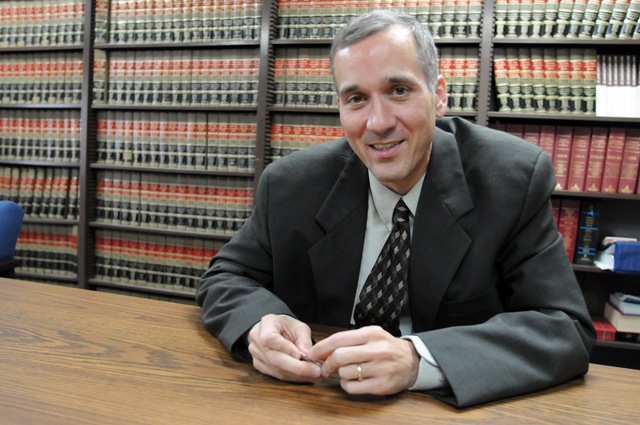
James R. Farrell holds forth on the meaning of the law in the DA’s Office library.

Story and photos by Ted Waddell

MONTICELLO – “Know your facts, know them all, leave nothing to chance and never be surprised,” said James R. Farrell, the newly elected Sullivan County District Attorney a couple of weeks before his swearing in ceremony.

Back 14-years ago when he came on board at the local DA’s office as one of the assistant district attorney’s (ADA) serving under Stephen F. Lungen, he said his former boss would “throw you out of the office if you didn’t know your facts.”

James R. Farrell, the county’s newly elected DA and Stephen Lungen, who retired as DA after 28 years in office.

“Steve is very much like my father in terms of work ethics, he’s always here…he’s had an enormous impact on me in the courtroom, I’ve learned quite a bit from him,” said Farrell.

“I’ve learned how to try cases and how to make sure the victims get justice.”

Farrell said that one of the tricks of the trade he picked up from Lungen was that in today’s visual world in which “people no longer get their information from newspapers, they get it from television and the internet,” prosecutors need to keep up with the times and present their cases visually.

“It’s the art of persuasion, you have to present [your case] in a way the jury can comprehend it [and] you have to make it interesting so they can follow it, [and] if you don’t you lose them.”

“When you go into the courtroom, you have to convince twelve people that this particular person committed the crime beyond a reasonable doubt,” he added.

Another thing Farrell and the other ADA’s learned from Lungen, was that after a crime occurs, start preparing your case by going to go to the scene, “learning the facts firsthand…when it’s fresh.”

As he moved up through the ranks to the post of Chief ADA, Farrell perfected the prosecutorial art for the people in the courtroom by trying several notable cases.

James Farrell with the two DA’s Office investigators: Paul R. Hans and Robert C. Rowan.

His first arson trial was the case against Robert Comfort who was charged with setting a blaze at a Callicoon apartment house on Christmas Eve 1999, and alleged involvement with previous fires in Cochecton and North Branch.

Comfort was convicted and sentenced to 25 years in prison. “I went to the fire scene with the fire investigators,” said Farrell, who shortly thereafter joined a local volunteer fire department as a firefighter.

“The volunteer fire departments really give a lot to the community, they’re on call 24/7.”

Farrell tried a couple of persistent felony offenders including the 1997 case against Kenneth Bingham who was indicted for possession of a stolen handgun and in 2001, the Earl Coleman drug sale case. Bingham allegedly fled from South Carolina after stealing an arsenal of weapons, and when stopped by the NYSP, had the handgun on him and was accompanied by a 15-year kid.

“He was a bad guy,” said Farrell, adding Bingham, who was sentenced to 15 to life, was previously convicted of drug possession, and escaping from a prison van after setting fire to the vehicle.

As a ‘three strikes and your’re out ‘ felon, Coleman was rounded up along with 40-50 other criminal defendants as part of the DA’s mobile enforcement team (MET) drug sting in Liberty.

With a history of drug sales and possession of weapons, Coleman was sentenced to life in an iron bar hotel.

According to Farrell his toughest case to date was against Howard “Sonny’ Greene, a retired corrections officer who was accused of sexually abusing and raping his eight-year old daughter.

“It was an extremely difficult case as the teenager had to go through it (the testimony) again [on retrial]…this was a girl who had been significantly damaged.”

“When you rape a child, you take away part of their soul, you kill that child,” added Farrell. “Greene got 65 ½ years in the retrial…he’ll die in prison where he rightfully belongs so he can’t harm another child, ever, ever again.”

James Farrell in his Chief ADA’s office with a campaign banner from the 2009 election.

As the county’s new DA, Farrell will follow in the footsteps of Lungen, taking on the most difficult cases, including murder.

During the county’s current budget crisis, county manager David P. Fanslau proposed cutting the chief ADA position and eliminating one of the investigator slots, in a move Farrell said would have put the DA’s Office back to 1997 staffing-wise.

“We can’t afford to roll back public safety…we want to go forward, not backwards,” he said.

In the wake of some last minute negotiations, the budget axe was lifted from the investigator’s neck, and while the Chief ADA slot was saved, it will be funded at a reduced pay level.

Farrell, who ran for DA under the banner “Courtroom Tested, DA Approved,” easily defeated challenger local attorney-at-law Glenn Kroll on November 3, 2009.

“One of the things I want to look at is public corruption, [and] gang activity,” he said.

Farrell graduated from Newburgh Free Academy (NFA) in 1986, and furthered his education at Dutchess County Community College and SUNY Binghamton (he earned a degree in economics), later graduating from Albany Law School in 1993, where he studied Constitutional law and criminal law procedure.

His father was a corrections office who moved up to deputy superintendent at Wallkill, until retiring after 39 ½ years working his way up through Sing Sing, Green Haven, Fishkill and Yonkers.

“He was my role model, a hard working man who went to work every day. He taught me a good work ethic,” said Farrell.

The county’s new DA started out with a private law firm in Vermont, and on October 2, 1995 accepted a position as an ADA in the Sullivan County’s DA’s Office.

Farrell’s take on the law?

“It regulates how we interact with each other,” he said. “Our criminal law comes from the Ten Commandments…’thou shall not murder, thou shall not steal’…it’s pretty basic.”

“It gets justice for victims of crimes…the DA’s office speaks for the people, and when the law has been violated it’s a transgression against everybody, not just a transgression against the person who has been violated but against society as a whole.”

To view more photos or to purchase prints from Farrell Takes Over Reins at DA’s Office visit the Chronicle on Zenfolio.

DSCN5805 Story and photos by Carol Montana

“I, James R. Farrell, do solemnly swear that I will support and defend the Constitution of the United States and the Constitution of the State of New York, and that I will faithfully discharge the duties of the office of District Attorney of the County of Sullivan, according to the best of my ability, so help me God.”

With those words an era ended. Actually, several eras ended on December 31, 2009. And over a hundred people witnessed the events as Jim Farrell was sworn in as Sullivan County’s newest district attorney. The date also marked the retirement of Steve Lungen, the county’s DA for the past 28 years, as well as the retirement of the man who administered Farrell’s oath of office, Judge Anthony Kane.

Surrounded by family, friends and well wishers, Farrell took the oath of office in Courtroom #1 of the Sullivan County Courthouse. He shook hands with Judge Kane. Then Farrell hugged his family, signed the oath in front of County Clerk Daniel Briggs, and held up a very large book, joking that he’d prepared some brief remarks.

“I’d like to thank everyone for coming out today,” said Farrell. “It’s truly an honor and privilege to have all this support, it means a lot to me on such an important day. … I’d also like to thank all those people who supported me during my campaign for DA … the voters of Sullivan County for overwhelmingly electing me as District Attorney … I’ll work to make them very proud.”

DSCN5841 Engaging in a little prognostication, Farrell went on to thank “Danny Briggs (photo right), who is our county clerk, who is here to put the oath into the official books. Danny has served in a variety of positions … he was initially our country treasurer, he was our county manager, now he is our county clerk, who knows, maybe someday he’ll be our county executive. …” Farrell was referring to a recent move by some county residents who are exploring the possibility of having an elected county executive.

Farrell then acknowledged Kane’s retirement. “After 25 years of dedicated, distinguished service to the citizens of our county, Judge Kane is retiring. And Sullivan County has a strong and proud tradition of the finest jurists in the state of New York, if you look around this room, Robert Williams, Chief Judge Cooke, Judge Sidney Foster, also Chief Judge Judith Kaye. Anthony Kane is no exception to that long line of fine, distinguished jurists.

DSCN5840 “Judge Kane, you are a fair, honest man of integrity, you’ve made us all very proud, and congratulations to you on your retirement. I am proud and honored to have had you swear me in as one of your last official acts. Thank you for that.”

Farrell conceded that the last few days had been bittersweet for him because his mentor and friend was also retiring after 28 years as Sullivan County DA. "Steve has been a constant for me in my career as a prosecutor," said Farrell, "He’s taught me how to be a prosecutor … to secure justice for victims of crimes. And for the last 28 years, the people have been able to sleep well, knowing that he’s been on the job. Crime victims have received justice, violent criminals have received justice, and innocent people have not been wrongfully convicted.”

Lungen had made these goals his life work, Farrell continued. "Under his tenure our office has achieved a reputation for regional and statewide excellence. He’s led the office with a high degree of professionalism, integrity and honesty. And I cannot underestimate, at this very moment, how important Steve Lungen has been to me both personally and professionally. To have his unqualified support during this election process has meant everything to me. … my boss, my mentor and my friend knew that I had the right stuff to be Sullivan County’s next district attorney."

Then, addressing Lungen personally, Farrell said, "You will be sorely missed, and you will go down in history as a legend in the law enforcement community in this county, there is no doubt."

Farrell also thanked his new staff, law enforcement personnel and his family.

DSCN5824 Referring to his wife Nicole, Farrell quipped, "While I thought that I ran the campaign, I know better. I know who really did, and who put all her energy and passion – thank God she’s a school teacher, she had the summer off – into my campaign. She’s my life partner, the love of my life, my wife Nicole. Nicole, I shall always be in debt for the sacrifices and unqualified support you gave me. Thank you for all you did … I love you very much.

“To my children who also sacrificed and gave me support and encouragement, I thank you both. Douglas, you began a new school year at the Sullivan West High School, and if that wasn’t stressful enough, we were also neck-deep in a county campaign. Douglas, you handled this time in your life very well. You campaigned with us. You went to dinners, pancake breakfasts, and I’m very proud of you and the beautiful young man you’ve become. You’re a credit to this family. I love you very much, buddy.”

Laughter filled the courtroom when Farrell took out an essay that his daughter Kelsey wrote about her dad’s campaign. “To my daughter Kelsey, you were also very helpful to your dad, campaigning in ShopRite, handing out cards, pens and pads to all the shoppers, even when you really didn’t want to. I’m just going to read an essay that she wrote a few days after Labor Day. ‘My problem is that my dad is running a campaign. It’s very hard because we need lots of money to get all the stuff we need, pens, signs, pads, car magnets and car stickers. My Mom, Dad, Doug and I are doing an election. Douglas is stressed out because he has homework, and is going to a different school. It is hard on my Mom because she has school, doctor’s appointments and much more. My Dad is running around like crazy because he’s delivering signs, pens and magnets. And we are never home because we are going place to place every day. It’s not much fun.’ ”

Farrell remarked that Kelsey’s teacher wrote back that November was coming and things would get better soon.DSCN5799

“Kelsey, I’ll always remember the sacrifices you made to help me in this endeavor. You, too, are a credit to our family and I love you very much,” said Farrell.

Well aware that challenges lay ahead, Farrell said that he had been very well prepared and that he cares about the people of the county. He promised: to continue his crackdown on gangs and violence, to work with schools to keep children safe and away from drugs, to prosecute drug dealers, domestic violence cases, and to continue to protect senior citizens from financial predators and scammers. “I will never lose sight of fundamental fairness, and will do the right thing no matter what. 

“As your DA, I’m going to make sure that children in this county are protected from abuse and exploitation. I will make sure that the Sullivan County Family Violence Response Team, born in the aftermath of the Christopher Gardner homicide, stays in place and continues to protect our children from physical and sexual abuse. This team has been highly effective in deterring, apprehending, detecting and prosecuting these offenders and child predators over the last decade. And it’s vital for our children’s safety,” said Farrell.

He thanked the Sullivan County Legislature for restoring and funding two positions that had been cut in the original county budget for 2010. “The restoration of these positions – an assistant DA and an investigator – are vital to the public safety needs of this county – and for the courage to reinstitute those two positions to the budget, I and the residents of the county publicly thank the legislature.”

And, once again acknowledging the two people who were retiring, Farrell finished his remarks with, “Judge Kane, Steve Lungen, I’m going to work very hard … to live up to the example that you have set and the legacy that you both have left.”

Then, joking about the fundraisers that his supporters had attended, Farrell invited the assembled crowd to a reception at the Monticello Firehouse. “Lunch is on me today – please join us.”

DSCN5969 The now-retired DA, Steve Lungen reflected on the end of an era, “I’m happy for Jim and I wish him all the best in the world. All good things do have to come to an end. I love my tenure, I love my job, and now I’m looking forward to the future. I thought the time was right [to retire]. I wanted to make sure that when I left it was on my terms. … I thought it was time to be a little selfish for myself and my family. I spent 40 years in public service; it’s time for me to step aside.”

Lungen’s future plans? “I’m going to probably open up a little law practice in a couple of months, do a little work on my own. In the meantime, I’m going to take some time for myself and enjoy myself for awhile. A trip is in the plans.”

Regarding the highlights of his 28 years as Sullivan County DA, Lungen said that citing the individual cases isn’t what matters. “I think that the most important thing for me is that, after all these years, my office is still deemed to be an office of high integrity and character. The District Attorney’s office did the best we could for the county, and I hope the people feel I did the best I could for the county.”

As a number of people filed into the courtroom across the hall, Judge Kane reminded them that “The day’s work is not done. It is my pleasure to administer the oaths to the next three people.”

DSCN5961 Kane was referring to the swearing in of Sullivan County Deputy Treasurer Nancy Buck, Treasurer Ira Cohen and Liberty Village Justice Harold Bauman,

As he swore in Bauman who suffered a slight slip of the tongue during his oath, Kane joked that he felt like Judge Roberts, referring, of course, to the mistake Chief Justice John Roberts made as he administered the oath of office to President Barack Obama in January 2009.

After he finished what was probably his last official duty – administering the oath of office to Cohen – Kane told the audience, “There is a certain symmetry to this that you should know – the first public job that I got in Sullivan County was as an assistant public defender, and Ira was the public defender. He was the one who hired me – we were good friends before that, we remained good friends while he was my boss, and we’ve been good friends since. So I think that for me, it’s special, that, as perhaps my last official act as a public employee, I get to swear Ira into his position as County Treasurer.”

To view more photos from Sullivan County Has a New District Attorney visit The Catskill Chronicle on Zenfolio.

DSC_0377

Story and photos by Ted Waddell

MONTICELLO – “I would like people to believe that we ran this office to the highest degree of integrity and fairness to ethical standards,” said Sullivan County District Attorney a few days before he retired as the county’s chief prosecutor; after 28 years at the helm.

Stephen F. Lungen in Judge Frank J. LaBuda’s courtroom, made his case to the jury in the 2003 Hal Karen murder trial.

“We may be tough, but I think we’ve been fair,” he added of the concept that if folks commit serious crimes such as murder, sexual assault and general mayhem, these crimes weaken the fabric of society, and those convicted should face the music.

Lungen was elected as the county’s lead prosecutor in November 1981, and took over as DA in 1982, following in the legal footsteps of a long line of distinguished public officials starting with Lemuel Jenkins who was appointed to the position in 1818, Charles H. Van Wyck, the county’s first elected DA, right up to his immediate predecessor Joseph Jaffe.

Lungen was born and raised in Mountaindale, where his family has been a presence for 100 years to parents who ran Lungen Motor Sales, a Ford dealership founded by his family in 1919 only to close in 1967 (the garage shut down two years later) “when the economy in Sullivan County started to go south.”

After graduating high school, he was accepted at Brooklyn Law School, was married on June 16, ’68 and upon returning from their honeymoon, found his draft notice waiting for him.

On December 1, Steve Lungen was the keynote speaker during a Sullivan County Drug Court graduation.

On January 13, 1969 Lungen entered into military service where he served with distinction as a combat infantry lieutenant in a helicopter assault unit during the Vietnam War.

He talks about his wartime experiences in an article titled “Reflections of a Vietnam War Vet” published exclusively online by The Catskill Chronicle.

During the conflict up by the DMZ, Lungen led his unit into battle and was awarded numerous citations including two Bronze Stars and a Purple Heart.

Upon arriving back home, he carried over a few hard earned lessons learned on the battlefield to the DA’s office: as a commander, you’re the first one in and the last one out; you always take care of the people in your command; you never ask anyone to do anything you wouldn’t do yourself; and you always lead by example.

According to Lungen, as a DA you can’t have a win at all costs attitude – unlike Vince Lombardi – because you have the obligation to comply with the law and code of ethics “to make sure that at the end of the day the right thing is done.”

James R. Farrell, the county’s newly elected DA, talks to retiring DA Steve Lungen.

“We need to be ethical, have integrity and do the right thing,” he explained, adding that on the opposite side of the courtroom, defense attorneys have the right to keep some things under wraps in the best interests of their clients.

“As a DA, I had a lot of power, let’s say it the way it is, and with that power I could do harm and I could do good to affect people’s lives…[but] if you don’t recognize how much power you have, that’s when you get into trouble. You have to do what you think is right.”

After graduating from Brooklyn Law School in 1973, Lungen worked for local attorneys-at-law Louis Scheinman and Marty Gilman, and then for a few years as a private attorney working for the DA’s office, including an assignment as an appointed special prosecutor for the kidnapping/homicide cases of Richard Lucas and Richard Graham after Scheinman was elected DA.

When Joseph Jaffe took over as DA, Lungen went back into private practice until he threw his hat into the ring and was duly elected.

Lungen with a framed article by The Times Herald Record’s departed Mike Levine.

On his watch, Lungen tackled some of the hardest cases, including almost 100 homicides: single murders, double homicides, heat of passion homicides, robber homicides, rape homicides, and double arson homicides.

“Trials involving little babies, cases were little babies were stuck in storage containers in Arizona, cases where the victims were dead for 25 years and there was hardly any DNA from the victims.”

Lungen said the “most notorious case of child abuse in the county” was the death of Christopher Gardner, in which the jury found his mother Diane Erwin and her boyfriend guilty of murder and sentenced both to life in prison without parole.

“There wasn’t a square inch on his little body, from front to back, that didn’t have a bruise or a mark…that case was brutal.”

Other memorable homicide cases include using DNA evidence to convict Anthony Burton “of brutally murdering an elderly Hasidic couple”, the killer of Barbara Vote in Eldred, and the murderer of Gary Keyes of Callicoon.

In 2003, Lungen tried two murder cases: Hal Karen, a former special forces soldier convicted of killing his wife, stuffing her into a garage can, and tossing her over a cliff, and Diane Odell, convicted of stuffing several of her infants into a suitcase and abandoning them in a storage container in Arizona.

In “The Garage Can Murder”, Karen was sentenced to 25-plus years to life, and in “The Babies in a Suitcase” trial, Odell was sentenced to 25 to life.

A caricature cartoon portraying Lungen as King Kong being strafed by Legal Aid attorneys Tim Havas and Stephan Schick.

“I was their only spokesperson, it was very heavy to tell the jury what she did to them,’ recalled Lungen of the Odell trial. “We had to get it right because she was a killer.”

From 1982 to 2009, the Sullivan County DA’s office filed three death penalty cases that went to murder one, life without parole. “I’m the last one standing, but at the end of the game, it’s a joint effort between me and the police agencies in every case,” said Lungen. “The murder cases allowed me to make it right for the families of the
victims.”

The retired DA leaves behind a legacy including the initiative of addressing alcohol and drug abuse cases through rehabilitation as an alternative to incarceration, forming a family violence response team with former Sullivan County Sheriff Dan Houge, creating a Stop DWI program “long before it became politically fashionable” as a forerunner
to the NYS Stop DWI program, and handling one of the first DNA cases in the nation.

His take on the meaning of ‘the law’? “It’s what we follow, it’s the bible of what we do.”

Since being elected in 1982, Lungen was consistently re-elected until he decided, “It was time for younger blood, somebody to move this office forward.”

His handpicked and publically elected successor is James R. Farrell, who served as an ADA for 14 years, most recently as Chief ADA. “I know the man’s ability, his integrity, and courtroom skills,” said Lungen. “I know his dedication and his passion…he reminds me of myself thirty years ago. He’s going to be great DA.”

Lungen in his office with a poster from one of his early election campaigns.

As Lungen started the task of packing up his files and taking some pictures and memorabilia off the walls in his office, he said reflectively, “I will not miss the public life, [because] you’re always under the microscope. But I will miss the trial work, I love going into court and trying cases.”

So what’s the outgoing district attorney going to do once the new year rolls in?

“I’m going to take some time off and recharge after working 24/7 for 28 years, mellow out and get myself together…and maybe in the Spring start a small private law practice,” replied Lungen. “I think over the last 28 years, I’ve served this office pretty well.”

To view more photos from Lungen Closes His Case after 28 Years as DA visit the Chronicle on Zenfolio.

_DSC0078

Gloria Sanabria is defined as ‘homeless’ because she is living in temporary housing. She is paying for her own room after being cut off from local social services for “not following the rules”.

Story and photos by Ted Waddell

SULLIVAN COUNTY – “The job market was pretty good until about six months ago,” said 48-year old Gloria Sanabria while sitting in her one-room temporary housing she shares with her 15-year old son at the Catskill Motel just outside Liberty, NY.

Sanabria was born and raised in Sullivan County, and in 1980 graduated from Fallsburg High School, attended East Stroudsburg University and then worked at Community General Hospital (now Catskill Regional Medical Center) for several years before moving to warmer weather in South Carolina after being injured in a car accident.

The graduate of the Sullivan County BOCES LPN program lost her job, and then her house due to foreclosure when the private medical company cut her loose, “they can fire you without any explanation,”  so Sanabria packed up their belongings and returned to the county.

Home is where the heart is, and Gloria Sanabria decorated the room she shares with her teenage son.

“I’ve been living in motels for about six months,” she said, adding that after she tried to get help from the county’s social services department, she and her son wound up in a small room at the Lakeside Motel (formerly Hillsdale Dorms).

After about three weeks, Sanabria called it quits at the Lakeside, due to living conditions she called less than adequate.

“It was terrible, the door wouldn’t close and cold air was seeping in, and there were cockroaches,” she said. “You had to provide everything for yourself living there…if you didn’t have a car, and thank God I do, you’re stranded, you’re stuck. It seems like social services expected you to stay there…it was like their main hotel.”

According to Sanabria, she told social services about the situation, “There a lot of people there [at the Lakeside] with felonies, they all talk about it, and nobody sleeps at night, there’s a lot of noise, a lot of ruckus and rambunctiousness going on…after midnight everything goes on there.”

“They try their best, but their clientele is sent here,” she added.

Sanabria said she couldn’t take it anymore at the social services-funded motel, so they moved first to her mother’s house and then to the Catskill Motel where she pays $273.00 per week out her own pocket.

“Social services told me at the time they were paying two hundred something dollars as week for me and my son,” she recalled of living at the Lakeside.

“After I decided to leave I got a letter from (from Sullivan County social services) saying that I was responsible for paying [the Lakeside] over a thousand dollars a month, because they felt I was entitled to unemployment in South Carolina.”

Then came another notice telling her she was cut off from any more assistance including food stamps just in time for the holidays, because Sanabria was allegedly in “noncompliance for not following their rules…and I abandoned my area of living” by not filling out job search forms.

“I’m coming to you begging for money while I find a job,” Sanabria said she told workers at the local social services department. “How can I job search with no money and no gas?”

Her take on the landlords at their new temporary living arrangements?

“They’re wonderful people, very humble and respectful and they take care of their place.”

To keep a roof over their heads, Sanabria worked as a substitute at Fallsburg, and just landed a job as an LPN at the Center for Discovery, where she said they will help her fulfill her dream of becoming an RN.

Her take on the county’s social services system?

Jamie Latimer, a student support specialist with Sullivan County BOCES A.S.K. (Academic Support for Kids), stops in to talk to Gloria Sanabria about how her 15-year old son is doing at Fallsburg High School.

“I think Sullivan County really needs to revamp their whole system,” replied Sanabria.

“They need to break it down and start over from scratch…figure out who’s at risk first, and help those who really need help…it’s like triage we use in hospitals….what is the quickest way to help people that are truly in need.”

“Sullivan County really needs to wake up, [and] provide the best help possible for people who want to do something with their lives,” she added.

Her take on the ‘rules’?

“For the most part, the job searches are realistic…but in this county there are no jobs…there’s a stigma about Sullivan County, and I’ve felt it,” said Sanabria, who added that she missed out on a job interview because she didn’t have any gas money.

Asked what it’s like to lose a job and your home, thus joining the ever growing ranks of the homeless in the land of plenty, Sanabria replied, “It’s scary, nerve wracking and stressful, you could really lose your mind.”

“But I have a piece of God’s grace in my life, I’m going to make it no matter what. I’ve worked all my life, and I’m always going to work.”

“I’m not ashamed that I’m asking for help,” said Sanabria.

To view more photos from Homeless in the Land of Plenty – Part III visit the Chronicle on Zenfolio.

LIVINGSTON MANOR – Tragically, in October of 2009 Livingston Manor resident and businessman Willie Taggart, a carpenter and general contractor, was severely injured when the ladder from which he was working fell causing him to drop from roof level onto his back. Willie has been hospitalized since the incident undergoing treatment and therapy for various injuries, illnesses, and complications related to the fall. Most severe is the damage to his spinal chord that will likely leave him paralyzed.

Willie is a devoted husband, father, brother and son. He is also a great friend to many who miss him dearly. In wishing Willie well and hoping for his long-awaited return, it is important to recognize him for his enjoyable smile, pleasant attitude, and dedication to his family, friends, and community.

When Willie returns he and his family will need assistance from many of his friends to improve his home and adjust his lifestyle to accommodate his injuries. While there is a growing network of volunteers to lend a helping hand, there is a larger need for financial assistance to fund the modification, purchase, and delivery of a vehicle to accommodate a wheelchair, loading, and unloading facilities.

On January 10, 2010 the family, friends, and community of Willie Taggart will host a fundraiser at the Rockland House in Roscoe, NY between 1:00 p.m. and 4:00 p.m. with buffet, entertainment, and a CASH bar. Raffles to be determined. Tickets are available $100 per couple.

Willie, his family, and his friends wish to offer special thanks to the Roseo Family at the Rockland House, Bill and Debbie Hendrickson for entertainment, and all other participants who helped organize the event and fundraisers.

For Tickets, Contact: Susan (845) 439-3919 or Jeanne (845) 439-4450

Story Ted Waddell – Photos provided by Steve Lungen

2

Lungen up by the DMZ with an M16 and a command radio at the ready. – From the wartime collection of Steve Lungen.

ROCK HILL – Sullivan County DA Stephen F. Lungen was never one to wrap himself in the proud colors of the American Flag when it came time to being elected as the county’s lead prosecutor starting in 1982 and right up until the time he decided to hang it up in 2009 after 28 years as DA.

But, in an exit interview with The Catskill Chronicle, followed in short order drill by a keynote speech to the graduates of the Sullivan County Drug Treatment Court on December 1, ’09, he talked about how his experiences during the heat of the Vietnam War shaped his character, focused a desire to complete law school and later helped him mold his assistant district attorneys (ADA’s) into razor-edged weapons for the prosecution in the courtroom…

You can read the full story – Reflections of a Vietnam War Vet – in the Chronicle’s Sullivan Faces section.

*All photos are from the wartime collection of Steve Lungen.

* Coming soon – further reflections on Steven F. Lungen’s career as DA

To view photos from Reflections of a Vietnam War Vet – Provided by Steve Lungen visit the Chronicle on Zenfolio.

Story and photos by Ted Waddell

_DSC0120

Sharon Dodd, a homeless mother of two with her 4-year old son Fredrick, who attends Project EXCEL.

SULIVAN COUNTY – “I don’t want to be living like this forever,” said Sharon Dodd, a 44-year old mother of two who lives in one small room with her kids at the Delano Hotel outside Monticello. “It’s very depressing living in one room with my two kids who drive me crazy all day.”

Sharon Dodd, in her family’s one-room $1,690 a month social-services rental at the Delano Hotel, holds a photo of her two young sons.

Dodd has resided in the local social services-funded rental for a little over a year now, and has been without, in the parlance of social workers, living in ‘fixed, regular and adequate’ housing since 2005 after encountering problems with her first pregnancy.

Before becoming homeless, she “had a good job and a new car” while working for an office warehouse outfit in Middletown. That was before she reportedly got tagged at work with “three occurrences” for missing work due to what Dodd said were medical problems.

No work, no pay. No car, no place to live. No place to call home for her kids.

At the Delano, the county social services department shells out $1,690.00 per month for one cramped room in the local hotel, a figure that was prominently displayed on government-issued paper work.

“I was living in Sleepy Hollow, and she (the landlord) didn’t want any new mommies,” recalled Dodd of being asked to leave the large subsidized housing complex along Route 42 by Monticello High School.

So as Christmas Eve 2009 draws close, Dodd and her two children Fredrick Cederlund, a four-year old enrolled in Project EXCEL, and Robert Cederlund , 6, who attends Cooke Elementary School try to find enough room to live in just one room.

Unlike a lot of other social services funded temporary housing in the county, the Dodd family can consider themselves blessed. Sort of.

Jamie Latimer, a student support specialist with Sullivan County BOCES A.S.K. looks over some paperwork from social services as Sharon Dodd looks on.

In addition to a couple of beds, they have a stove, a refrigerator and a dresser, even though the a few drawer fronts have fallen off. Have some food? Store it on any flat surface you can find. How about your clothes? Store them in black plastic garbage bags, pile your duds on the beds, or leave the dirty stuff on the floor. A tiny plastic Christmas tree and a photo of her two young sons taken at
Walmart, a while ago tries to lighten their spirits.

But, when Robert comes home from school, there’s no place to study. Except maybe a bed or the floor, and doing your homework over the blare of a television isn’t the best of circumstances when it comes time to get a start on your education.

“It’s hard because Robert brings his homework home and Fred wants to watch TV,” said Dodd. “It’s big distraction.”

“It’s a cramped life-style, she said. “There’s no space that they can go to…it’s a fairly good hotel, but there’s no space.”

Asked what she wants for their future, the single homeless mother of two replied, “I want to be out of here and in my own apartment, the kids especially where they can do their homework and stuff like that.”

“I want to get my GED, get and job, and get back to the life I want to lead,” added Dodd.

With an eye on bettering their situation, Dodd is studying for her GED at the local BOCES, while keeping an eye on some additional knee surgery. But the folks over at Sullivan County BOCES A.S.K. (Academic Support for Kids), a program for families in temporary housing, have a mantra – “Fixed, Regular & Adequate”, that spells out in three words what drives them to help students in the county who are living in temporary housing, let’s not mince words, and call it what is really is, and that’s homeless, to stay in school and complete their education.

If you don’t fit into these pigeonholes, then in the real sense of the word in an all too real world filled with living in emergency housing, beat up motels often run by slumlords, or kicked out of your home by eviction or foreclosure, they (ASK) strive to make people aware of federally mandated rights for students in these dire circumstances: the right to attend school. Students don’t need a permanent address to enroll in school, they have the right to stay in their home school if the parents choose, they cannot be denied school enrollment just because school records or other documentation is not immediately available, and they have the right to transportation services to and from the school of origin.

“We have a place to stay, we’re not outside in a cardboard box…the landlord is very nice; and that’s really cool,” said Dodd.

To view more photos from Homeless in the Land of Plenty: Part II visit the Chronicle on Zenfolio.

Story and photos by Ted Waddell

_DSC0066

Deanna Defreese is a single mother of six; of which five live with
her between two cramped rooms. She is pictured here with her 4-year old daughter
Trinity, a student at Head Start.

SULLIVAN COUNTY – If your idea of a homeless person is a raggedy-assed bum sleeping on a heating grate in a big city covered in yesterday’s newspapers, you’re sadly mistaken. Scores of single mothers are looking after their kids while living in deplorable conditions, living situations reportedly inspected and approved by local authorities.

It isn’t a pretty picture.

While some landlords of rental rooms paid for by social services make an effort to keep the places up, others seem to have never painted the walls in decades or even shelled out a few bucks to provide a stove, a fridge or a couple of dressers. A few beds, a broken down dresser missing some drawers. Peeling paint, holes in the wall. A chair or two. Maybe a table, maybe not. Sure, there’s probably an old television set on a box, but in a lot of cases, that’s it.

The Sullivan County BOCES Academic Support for Kids (ASK) program is designed for families in temporary housing, an administrative euphemism for “homeless,” is funded by the NYS Education Department (NYSED) as authorized by the McKinney-Vento Homeless Assistance Act, part of the No Child Left Behind (NCLB) Act of 2001.

_DSC0011adjusted As outlined in the federal legislation, all children in temporary housing have the right to attend school, and in the local BOCES ASK program, last year student support specialists Jamie Latimer and Patricia Crumley spent countless hours working with 146 homeless students in grades K-12, plus 27 kids age 3-5 not enrolled in kindergarten, for a total of 173 students in the county in dire need of help in staying in school despite often terrible living conditions.

Deanna Defreese, a 28-year mother of six kids lives in two rooms connected by a small doorway with five of her children in the Budget Inn of Liberty.

David is two, Trinity is four and attends Head Start, while seven-year old Yasmin, Jaquain, 9, and 11-year old Andre attend Fallsburg’s Benjamin Cosor Elementary School. Cedric, Defreese’s 8-year old son lives with an aunt in Pennsylvania.

“I came from Rockland County, that’s where I was raised and born,” she said. “We moved up here maybe nine years ago…my mom wanted to get away from the drama and trouble down there, so we moved up here.”

_DSC0037 Since relocating to Sullivan County, Defreese and her kids have bounced around in temporary housing from Monticello, Liberty, Woodbourne and Fallsburg, until five months ago they landed at the Budget Inn.

“My building in Fallsburg (located at 73 Laurel Avenue) was closed down, the building got condemned so all the tenants got pushed out…Steve, the landlord, wasn’t a good landlord, he was a slumlord,” recalled Defreese.

Allen Frishman, now in his 24th year as the Town of Fallsburg Code Enforcement Officer (CEO), said in essence the one-month evacuation/closure of the building was a combination of the condition of the building “the living conditions were really bad” along with “some of the tenants were living really rough.”

“In the month’s time that the building was closed, the landlord (identified as Steve Plotkin) made great gains in cleaning up the whole place…[and] at the same time there were tenants that had to come back and clean out their apartments because there were piles of I don’t know what it was, moldy clothes, God knows what laying around on the floors.”

“If you’re in your own house and want to live like a pig, that’s up to you. But if it affects other tenants in an apartment, you have responsibilities,” added Frishman.

According to the town’s CEO, once tenants were allowed back into the building as the renovations progressed, they were put on notice that their living quarters would be inspected periodically and, if warranted, violation notices would be issued if things weren’t maintained by the tenants in their own rental spaces.

“Piles of dirty dishes, and plies and piles of dirty clothes in all the rooms …that’s a great breeding ground for cockroaches,” said Frishman.

Defreese explained that it’s tough trying to find more permanent housing with five young children in tow. “It’s hard because there ain’t nothin’ available…they’re already rented or they ain’t sure in they want five kids.”

For a year and three months, the single mother of six worked at Rolling V
as a bus aid, but had to give it up because she couldn’t get any childcare.

“I was doing good, it was a good job,” she said.

On the plus side of things, her three elementary school kids attend an extended school day program at Benjamin Cosor Elementary School; time that allows then to get their homework done. But, Defreese said, her oldest boy “is having a difficult time” in school because “other kids pick on him, saying he’s homeless…he comes home real upset about it.”

“Kids were making fun of him…he’s a real good boy, don’t bother nobody,” she said.

Defreese said that as a 17-year old attending Spring Valley, she got pregnant with her first child and dropped out of school in the 9th grade. “I don’t have my GED, but I’m going to work on it as soon as I get settled and get a job,” she said.

_DSC0027 Asked what it was like for a mother and five young children to live in two small rooms with dim light filtering through the blinds and all their clothes and worldly possessions in plastic trash bags on the floor or on the beds, Defreese replied, “It’s not easy, it’s hard. It’s real stressed out being here, I’m real stressed out every day. We don’t have much, and [other] kids are hangin’ out in the hallway.”

“When the bus drops off my kids, they eat dinner, shower and go to bed, and maybe watch a little TV…but as long as they continue to go to school, it’s okay,” said Defreese.

To view more photos from Homeless in the Land of Plenty: Part 1 of a Series visit the Chronicle on Zenfolio.

IMG_3250

Seth Wegener, Catherine Peters, Drew Maier, Dylan Reno, and Sam Sedlack – Santa’s Elves and Assorted Characters.

JEFFERSONVILLE – Look, up in the sky. It’s a bird! It’s a plane! It’s the Starship Enterprise…

YRP X-MAS 2009 Readthrough Edit No, that’s just Santa Claus and his new experimental warp-drive sleigh. His Science Elves loaded it with futuristic technology, and now Santa is using it for the first time on Christmas Eve.

What could possibly go wrong?

Well, if it’s like any other holiday radio play by WJFF’s Youth Radio Project (YRP), everything could go wrong. Everything probably will go wrong. To hear the hilarious results, all you have to do is tune to WJFF – 90.5 FM at 9 p.m. on Wednesday, December 23 and listen to Radio Revolution, the region’s only weekly youth-produced radio show.

IMG_3271 This is the plotline for “Across the Santaverse,” the YRP’s seventh annual X-Mas X-Travaganza on WJFF. So, you know the teens, mentors, and YRP alumni behind the scenes have a lot of experience with this sort of thing.

It all began in 2003 with “A YRP Christmas Carol;” the play that started it all: an 11-minute romp through the oft-repeated Dickens Christmas Classic. It’s the same story, but everything is different.

Scrooge is greedy, but for presents, not money. The Ghost of Christmas Past goes too far into the past. The Ghost of Christmas Future doesn’t go far enough into the future. And for some reason, the Ghost of Christmas Present is a pirate.

The first full incarnation of the YRP is the cast here: Amanda Martins as Narrator, Dylan Grunn as Cratchit, Emily Gref as Flem, David Lundgren as Marley and "Arrrt," founding member Allison Coe as G.O.C. Future, Zack Rettoun as our first-ever Santa, and starring Alex Duke as Scrooge. Written by Alex Duke, Dylan Grunn, and the YRP. Edited and mixed by Jason Dole.

“We always write our own original play, and it’s always a comedy that satirizes the secular aspects of Christmas,” says YRP Adult Coordinator Jason Dole. “So, that usually means making fun of Santa. We basically torture him each year.”

imageJust look at the YRP’s most recent radio comedies.

In 2006’s “Judge Frosty,” the Youth Radio Project put Santa on a daytime courtroom television show, trying him for “breaking and entering” and “voyeurism.”

Poor Santa. In this play, the YRP takes him to trial on the popular daytime courtroom television program, Judge Frosty’s Courtroom Justice. Grandma says she got run over by Santa’s reindeer, the reindeer says Santa is cruel to animals, and there are many other accusations.

Is Santa "Naughty" as charged? Listen and find out in this 2006 original play conceived by the YRP, written by Johnny T, Eric D, and Jason Dole, starring Victoria Harman as Judge Frosty and Alex Duke as Santa.

imageOne of three separate plays produced for Christmas, 2006, X-Mas Royale aired while the hit James Bond movie Casino Royale was still in theatres.

Conceived and scripted by 007 fans Dylan Grunn and Jason Dole, this spy movie spoof sees James Bond hard at work saving Christmas from sabotage. Actually, he just drinks a lot while investigating the disappearance of Santa’s naughty list.

X-Mas Royale was mixed and produced by then YRP alumni David Lundgren and Jason Dole. It runs 26 minutes. Part One is presented here, while Part Two can be heard here.

In 2007, Santa was tricked into starring in a celebrity weight loss show while nefarious forces conspired to take over the North Pole.

OLYMPUS DIGITAL CAMERA         "Santa Vs. The Media" Part One and Part Two finds Mr. Claus under lots of scrutiny from reporters. Racked by scandal after scandal, Santa flees to LA to be on a reality TV weight loss show. In response, a lonely Mrs. Claus starts her own reality dating show.

Meanwhile, it seems like someone really is trying to sabotage Santa. Is it Marty, his handler? The simple-seeming Rudolph? The Love Doctor? Talking cookies?!?

"Santa Vs. The Media" Part One and Part Two starred R.J. Smith as Santa, Sommer Johansen as Mrs. Claus, Eric D as Marty and Rudolph, and John Taylor as Vinnie, The Love Doctor, and The Magician. Conceived by the YRP, written by Victoria Harman, Sommer Johansen, and Jason Dole, edited and mixed by Victoria Harman, John Taylor, and Jason Dole.

In last year’s “Santanomics,” the North Pole was out of money and Santa had to lay off all of his elves under an inept government bailout program.

jason and Santa The process of writing an all-original youth radio play is often as wild and crazy as the stories themselves. The group brainstorms the ideas together, then multiple writers begin work on different parts of the play. The students, adult mentors, and YRP alumni all collaborate on the writing, performance, recording, and editing of the final story.

This year (2009), faced with severe budget cuts in a bad financial year, the YRP entered play-writing season with only two regular members. However, like a made-for-TV Christmas miracle, by the time December rolled around the group was up to 10 members; representing five separate school districts in Sullivan County.

“We don’t do anything like this play all year long,” explains Dole, who says Radio Revolution usually consists of reviews, interviews and discussions.

“The play is a unique project that we all work on. It builds the group, brings us together, and in terms of the learning experience, it’s a quantum leap for the students.”

IMG_3263 Perhaps it’s no surprise then that the 1980s show “Quantum Leap” was a partial inspiration for “Across the Santaverse.” Faced with too many possible plotlines this year, the students put Santa on a headlong journey through the Multiverse. After a warp drive malfunction, Santa is stuck jumping from one alternate reality to another. There is a world where people are made of springs, and another where toys get children for Christmas.

In “Across the Santaverse,” Santa must face mobsters, misfits, fitness gurus, and even a hippy-dippy version of himself.

Will Santa get back to his own reality? Will he ever learn to use his inter-dimensional cell phone? Tune in to “Across the Santaverse” to find out.

“Across the Santaverse” debuts on community radio station WJFF – 90.5FM in Jeffersonville at 9 p.m. Wednesday, December 23. After that, it will be available on WJFF’s archives at wjffradio.org. You can also hear “Judge Frosty” and the YRP’s X-Mas X-Travaganzas for 2007 and 2008 on the archive. Just click and listen to the 12/9 and 12/16 editions of Radio Revolution.

WJFF’s Youth Radio Project’s “Across the Santaverse” also streams live online. Just go to http://www.wjffradio.org/wjff/ and click Listen Online to hear the show as it happens.

Provident Bank donates house to Shadowland Theatre_with caption 

MONTEBELLO, NY – Actors working for the Shadowland Theatre in Ellenville, N.Y., will have a much nicer place to live next year thanks to Provident Bank’s decision to donate a house to the non-profit regional equity theater company.

“We’ve used the building to provide housing for our actors for about 10 years thanks to the generosity of Provident Bank and, before that, Ellenville National Bank,” said William H. Collier III, president of Shadowland Theatre’s board of directors. “Our union contract requires us to provide housing for our actors, so the banks’ support has been essential to keeping our expenses low, which helps us keep tickets affordable. Now that we own the building we’ll be able to renovate it to accommodate more actors and staff. We wouldn’t be able to do that without Provident Bank’s support.”

George Strayton, President and Chief Executive Officer of Provident Bank, said he is pleased to help Shadowland Theatre, a critically acclaimed organization that presented five shows during its box office, record-breaking, 25th anniversary season in 2009.

“Provident Bank and Ellenville National Bank, which Provident acquired in 2004, have supported Shadowland Theatre since it was founded 25 years ago, and donating this house reflects our commitment to helping the theater thrive and attract tourists to Ellenville,” Strayton said. “Shadowland Theatre is an important part of Ellenville’s downtown economy and Provident will continue supporting Shadowland in the future. We expect to help finance the upcoming renovations and in the past gave Shadowland a mortgage to pay for improvements to its theatre. This is a vivid reflection of Provident Bank’s commitment to supporting the communities we serve, which is a core principle for Provident as a community bank.”

Time has taken a toll on the house at 7 Elting Court, and Collier said the growing need for repairs presented a dilemma. It did not make sense for Shadowland to pay to renovate a building it did not own, while Provident Bank had little incentive to rehabilitate the old house it was letting the theatre group occupy for free. The solution, Collier said, was for Shadowland to assume ownership of the building so it would be able to make the necessary investments.

“We approached Provident Bank earlier this year to see if they would consider donating the building because it needs renovations,” Collier said of the house a short walk from Shadowland’s theater. “They decided it made good sense to donate the house for use as housing for our actors and staff drawn from all over the United States. This is a step forward for us and we’re very thankful for Provident Bank’s support. This addition broadens Shadowland’s scope and Shadowland’s presence in the industry.”

The house, Provident said, is worth about $50,000 in its current condition. Collier said renovating the two-family home to provide six-to-eight bedrooms, bathrooms and a kitchen probably will cost about $50,000. Shadowland is planning a campaign to seek funds and donations of labor and materials.

“It will be a big project, but when it’s done we’ll have a much more comfortable place for our actors and staff to live,” Collier said. “It will let us offer performances year-round for the first time and also will provide a space for us to hold receptions and other meetings during the off-season. Provident Bank’s donation will have a tremendous positive impact on our operations.”

…The theater company is required to provide housing for Actors’ Equity cast members within walking distance of the theater, and Collier said the renovated housing will make it easer for Shadowland to attract professional, experienced actors who typically live and work in New York City.

Founded in 1984, Shadowland performs in a restored 1920’s Art Deco vaudeville/movie house converted to a 148-seat theatre. For more information visit http://www.shadowlandtheatre.org.

Story and photos by Ted Waddell

_DSC0150adjusted

SCHS board member Barbara Viele in the exhibit space.

HURLEYVILLE – As part of the Sullivan County Historical Society’s 23rd Annual Theme Tree Exhibit, the custodians of local history unveiled an exhibit titled “Victorian Era” in the main gallery.

The Victorian Era dress worn by Mrs. J.C. Young to Queen Victoria’s Golden Jubilee in 1887.

The centerpiece of the exhibit is a black dress once owned by Mrs. J.C. Young, who had the outfit made to wear to Queen Victoria’s Golden Jubilee in 1887.

Queen Victoria was born May 24, 1819 in Britain’s Kensington Palace, and ascended to the throne in 1837 upon the death of William IV. She passed away on January 22, 1901 and was buried alongside her husband Albert in the Windsor Frogmore Royal Mausoleum.

Emma Crary married James Chandler Young, a prominent banker who was later named president of the Sullivan County National Bank of Liberty in 1905.

The Young’s resided in a grand house in what is the now the town hall at 120 North Main Street, Liberty.

According to SCHS board members Sharon Thorpe and June Koester, organizers of the exhibit, the opulent house was constructed in 1844 and was considered one of the finest homes in the village.

A Victorian Era ballroom gown.

“We have an extensive collection of vintage clothing,” said Thorpe, noting that last year a dress nicknamed “Lizzie,” which dates from the 1770s-80s, was displayed at the county museum

“We have 170-some dresses going from “Lizzie” through the 1950s,” she added.

In addition to Young’s Golden Jubilee outfit, her elegant ballroom gown is also on exhibit, along with two other dresses from the Victorian Era.

Images of fancy women and beautiful girls were popular during the Victorian Era.

A vintage music box, donated to the SCHS by Dorothy Breen of Liberty, and various artifacts from the society’s Victorian Era collection complete the exhibit, which allows visitors a fascinating opportunity to step back in time.

The Sullivan County Historical Society is located in the Sullivan County Museum, located at 265 Main Street in Hurleyville. The museum is open Tuesday through Saturday from 10:00 a.m. to 4:30 p.m., and Sundays from 1:00 p.m. to 4:30 p.m. It is closed on Monday.

The special Victorian Era exhibit runs through the end of February,2010. For information, call 434-8044.

To view more photos or to purchase prints from SCHS Showcases Victorian Era visit the Chronicle on Zenfolio.

HPIM6187 Story and photos by Carol Montana

Four or five weeks ago, NY State Assemblymember Aileen Gunther and her staff decided to have a holiday open house. It would also be a great time, they realized, to collect items for Operation Support Our Troops, a nationwide effort to send boxes of goodies and personal items to military personnel stationed overseas.

Lots of invitations were sent out and lots of people pitched in to help including Barbara Strong, a teacher from Benjamin Cosor Elementary School in South Fallsburg. “Sandy Vanderzell and I talked about sending out a letter that asked in lieu of gifts for us that the children participate [in this effort],” said Strong, “and one of my aides did the same thing, asking us not to give her gifts, but donate instead to this cause.” Several other teachers and teacher’s aides hopped on board, and Strong said that several of the correctional officers from/ Woodbourne Correctional Facility participated as well. 

At the actual open house on December 14, piles and piles of items were on display in the lobby of Gunther’s office in Monticello.
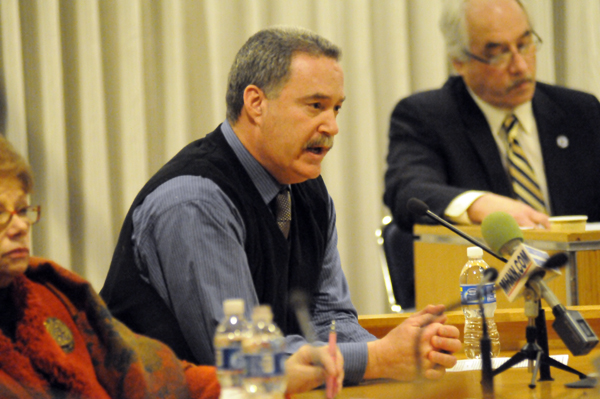
HPIM6190 As guests arrived, they contributed boxes and bags to the collection and then hob-knobbed with neighbors and friends, enjoying food and drink, and even some entertainment courtesy of Stacey Cohen and her guitar.

Items collected included personal items like: toothpaste, tissues, deodorant, shaving items, lip balm, and entertainment and food items including: books, CDs, DVDs, envelopes, pens and notepaper, magazines, instant noodles, pudding, energy bars, plastic zip-lock bags (to keep the sand out), lemonade mix, beef jerky, batteries and candy, and so much more.

Gunther also mentioned that her office is collecting names of military troops serving overseas, “if anyone in the assembly district I serve has a child serving oversees, we’d love to send them a special package. Please let us know if they have special likes or dislikes, or allergies. In Sullivan County and surrounding areas, contact her at 794-5807or click here to contact Gunther through her Web site.

HPIM6205Once collected, the items have to be sorted, packed and shipped. And that’s where Stephanie Johnson comes in. Representing Operation Support Our Troops, Johnson (pictured with Gunther in photo at left) has been a military mom since 2002, when her son Erik became a member of the first West Point class following 9/11. “I’ve been packing boxes for the troops for quite a few years,” said Johnson. “We’ve sent over 20 tons of care packages.” She and her helpers send packages all year long to “to local kids, friends of local kids, family members … it’s a way to build up their morale, especially at the holiday times when their morale takes a little dip because they’re really missing being home with their family.” Johnson’s son, a captain in the army just returned from deployment in Iraq. He’s now stationed in Missouri, as is his sister Jennifer Johnson, who is a doctor.

The items get boxed up, and taken to the post office. “Each box is sent to an individual soldier,” says Johnson, “but each soldier shares their box with other soldiers, so we put several of the same item in each package.”

Johnson explains that each box is handled four or five times, “so it’s an intense labor of love. Each box weighs 20-35 pounds, so Johnson is asking for donations to help defray the cost of postage. Contact Gunther’s office for additional information on donating.

HPIM6223 Of all the items collected, there is one thing that the soldiers want more than anything else, and it’s also the most difficult to collect. “The hardest thing for us to get is for people to put pen to paper and write a note,” says Johnson. “ ‘Dear Soldier, we appreciate your sacrifice and thank you for all that you’re doing.’ ” Johnson says that it’s hard for people to express their feelings. “I challenge each and every one of your readers to do that – write a letter, send it to Aileen’s office and we’ll forward them on – every month of every year, we have been sending packages. As long as there are troops overseas, we’ll send packages. This is a heartfelt thank you – write what you think a soldier would want to hear.”

You can send your Dear Soldier letter care of Assemblymember Aileen Gunther, District Office, 18 Anawana Lake Road, Monticello, NY 12701.

To view more photos or to purchase prints from Open House for the Troops visit The Catskill Chronicle on Zenfolio.