Review by J. A. Di Bello
HURLEYVILLE, NY (August 20, 2013) – Not only is “Holy, Holy, Holy” the title of William Duncan’s riveting new drama, but it is also, interestingly, the title of the well-known Christian hymn written specifically to celebrate The 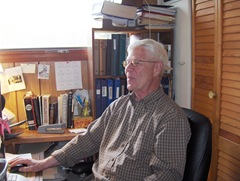 Trinity, one of Christianity’s greatest mysteries. It remains an important component of the Roman Catholic liturgy.
In the view of this writer, the connection is obvious and as such intentional. An award winning playwright, William Duncan (photo left), of Woodbourne, NY appears to be significantly acquainted with liturgy and religious practices of traditional and contemporary Catholicism. He spins a compelling narrative of three good, but quite ordinary men. As a playwright, he too celebrates a trinity: A trinity with a lower case t.
Presented on Saturday afternoon, August 17, as a reading at the Sullivan County Museum in Hurleyville, it follows the paths of three Catholic priests who have lost their way. Each searches and struggles with bouts of introspection, guilt and frequently piercing memories, providing an attentive audience with ringside seats.
It’s about time, space and change. It’s about men, their children and the women who loved them. As a play in two acts, the dialogue is quick, intelligent and frequently witty, while legitimately and respectfully questioning the basic dogma and doctrines of the Catholic Church, from celibacy to euthanasia and to a significant extent the Church’s developing role as a social activist. It should be pointed out; these men are not evil, only fallen. They are only men, mere mortals, who chose a profession that demanded more than they were willing or able to provide.
Change in the Roman Catholic Church combined with the development or growth of human behavior remain the actions surrounding and pushing this drama forward. It is here that setting, time and place, with only a tiny stretch, becomes Dramatis Personæ. Consider the ramifications of Vatican II (1962) and the New Mass (1964) had on the Catholic Church and subsequently these men. As boys they were raised to know the Church as “eternal, timeless and unmoved by history.” Clearly, their world changed! How did they adjust or stumble? Act I, scenes 1 and 2 clearly demonstrate the case. The setting for each respectively is Brooklyn 1966 and Brooklyn 1955. This play is not a show about three individuals. It’s an eloquent delivery of conflicting personal growth in an era of life-altering social and systemic change!
Holy, Holy, Holy! Lord God Almighty!
Early in the morning our song shall rise to Thee;
Holy, Holy, Holy! Merciful and Mighty!
God in Three Persons, blessed Trinity!
The difficulties offered by this play as a reading are far too numerous to detail and far beyond the modest intentions and scope of this review. For proof: “…the play is the thing…”








 The Catskill Chronicle
Leave a comment