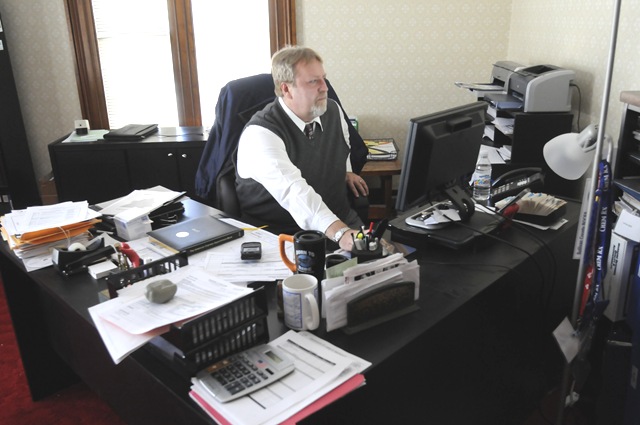
Story and photos by Ted Waddell
SULLIVAN COUNTY – While there may not be a pot of gold at the end of the rainbow, a lot of folks in the county are hoping that for the homeless in the area, there’s going to be a light at the end of the tunnel.
Sullivan County has a housing task force within what is known as the Continuum of Care, which consists of a broad range of members representing various groups concerned with the issue of homelessness.
The group meets on a monthly basis, alternating between the full continuum and work group, and is co-chaired by representatives from Rural Sullivan Housing and the Recovery Center.
Spearheading the continuum (as identified in the Sullivan County Federation for the Homeless’ Grant proposal to create a local homeless women’s and children) are the following members/groups: Rural Sullivan Housing Authority, Recovery Center, USDA, American Red Cross, Sullivan County Division of Health and Family Services (DHFS), Sullivan County legislators, CACHE, Monticello Housing Authority, Sullivan County Teen Pregnancy Support Network, Sullivan County Federation for the Homeless (SCFH), Senior Legislative Action, and NYS Assemblywoman Aileen Gunther.
Also listed as continuum of care member organizations: NYS Office of Alcoholism and Substance Abuse, Sullivan County Department of Children and Families, Sullivan County Department of Planning and Development, Monticello Code Enforcement, Sullivan County Veteran’s Agency, Sullivan County Department of Community Services, Liberty Housing Authority, Woodbridge Housing Authority, Sullivan County BOCES, Sullivan County Community College (SCCC), Fallsburg Police Department, Monticello Police Department, Liberty Police Department, Woodbridge Police Department, Sullivan County Center for Workforce Development, Council on Alcoholism and Drug Abuse Services of Sullivan County, Rehabilitation Support Services, Inc., Rural Opportunities, Inc., AIDS Related Community Services, Sullivan County Office for the Aging, along with individual members Debra Issman and Desmond McNamara.
A Member of the Housing Task Force Talks About Homelessness
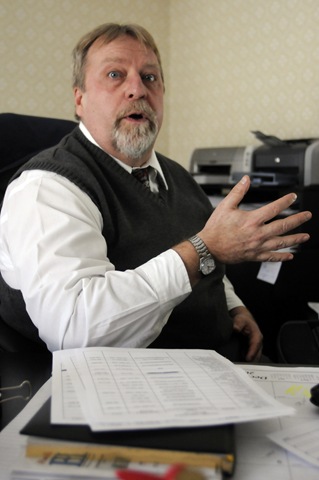 David P. Kreuter, chief administrative officer (CAO) for the Recovery Center is a member of the Sullivan County Housing Task Force within the Continuum of Care.
“Sullivan County is framed a little differently than most counties which call their housing task force a continuum of care, [but] here we have a housing task force with several sub-set committees, and one of them is a continuum of care,” he said, noting that in essence while the names may vary, the functions are in essence the same.
As required by the U.S. Department of Housing and Urban Development (HUD), agencies that receive grant funding to serve the homeless, counties must conduct a point-in-time (PIT) count of their ‘homeless’ at least every two years, preferably annually.
“It’s a snapshot of what the homeless population looks like,” said Kreuter, noting that sheltered homeless as individuals and families are counted, and in addition an attempt is made to include those folks living in unsheltered situations such as abandoned building, broken down bungalow colonies or as the British would say “sleeping rough” out in the woods or in derelict cars.
Last year, the total number of people who presented themselves as homeless in Sullivan County (PIT dated 1-28-2009) was 245 and another three people living in unsheltered situations.
Administrative records documented several subpopulations: veterans (7), mentally ill (10), substance abuse (20), domestic violence (3), and youth under the age of 18 (100).
Virtually everybody ‘in the know’ says the real number of homeless are probably three-times the reported number, and some contend that conducting a homeless count during the winter fails document a transient population that frequently heads to warmer climates or vets who seek seclusion in a county that is far and wide geographically.
“I think most counties would say they are under-reporting, you just can’t count everyone who is homeless at any particular time,” said Kreuter.
“Around here I’ve heard stories about people living behind Walmart at different times, or in abandoned bungalows somewhere behind the road up to Walmart.”
His take on whether the homeless population is on the rise?
“It’s increasing, especially the type of people that you don’t stereotype as homeless, people who are suddenly unemployed…there’s the saying that some people are two paychecks away from poverty,” replied Kreuter.
The Housing Task Force Looks at Creating a Homeless Shelter in the County
The SCFH recently submitted a proposal for a $1.5 million grant to convert their existing facility into a shelter for homeless single women and women with children, a proposal that is backed by numerous local agencies including the Recovery Center.
Several years ago, Kreuter worked at a homeless shelter he said was turned into a modified shelter from “just a shelter”, as a model for providing a broad range of services at a central location.
“In the long run, central locations are more cost effective than scattered sites and moving people around,” he said.
“The county is bound by law and statute to help people,” said Kreuter, adding that “Homelessness is not just a physical state of being…people often need follow through.”
“You lose a job or your house, and all of a sudden your kids are in a place you’d never want them to be, and for some people that psychological impact just paralyses them…they need supportive case management and follow up to break the cycle [of homelessness].”
He said the largest homeless population in need of housing and other services are single males, but they are often the hardest to locate “because they come with the scariest parts of homelessness, what scares people are crime and violence.”
“If you’ve ever visited a homeless shelter at its worst, they can be scary places…[but] the new model of homeless services really speaks to centralized services, both for cost effectiveness and positive outcomes.”
Kreuter said that in 2008, the Recovery Center provided services to approximately 1,100 people, and he estimates that of that number 10%-15% would be indentified as homeless by the federal government’s definition of ‘homeless’.
“When you define homelessness, it’s a syntactical challenge.”









 The Catskill Chronicle
Thank you for your great article. I also must say that your layout is a pleasure to view. Keep up the good work.
Hi~ many years ago my mom and her friend along with 9 kids fled a domestic violence situation in New York. We drove forever to this very green place with lots of woman & children. They took turns cooking, cleaning, ect.. We slept in a large room sometimes or in a bungalow situation at others. We took very little with us.
Men were allowed to visit on Sundays. That was 40 years ago. I was wondering if this is around or about the same location. It was the catskills and there was lots of space.
I remember not being scared there.
My mother did stop and pick apples off a tree on the way up and a guy with a gun stopped her. I’ll never forget that.
And she bought a paddle to smack us with everytime someone said they wanted something.~ one of the mom’s whould say I ‘ll give you something.! We called it our commune experience we stayed about 4 months.
I was wondering if this was the same place or if you know of where I speak. Thanks!
Holidaymermaid
Thank you so much for sharing your story with The Chronicle and our readers. I do not know the place you speak of, but perhaps one of readers does.
Dear readers,
If anyone knows the place that Holidaymermaid speaks of, please feel free to write a comment below.
[…] the original here: Homeless in the Land of Plenty – Part IX « The Catskill Chronicle Share and […]