Story and photos by Carol Montana
MONTICELLO, NY (January 24, 2013) – As Jeremy Gorelick talked about his travels to Sub-Saharan Africa, the students in the Monticello Academy of Finance (AOF) class listened in rapt attention.
 The AOF is a nationwide program established in 1982 by the National Academy Foundation. According to the Foundation’s website, the AOF connects “high school students with the world of financial services, offering a curriculum that covers entrepreneurship, banking and credit, financial planning, international finance, securities, insurance, accounting, and economics, among other topics. … Today, there are over 300 Academies of Finance in 119 school districts across 32 states and D.C. They serve more than 20,000 students annually …”
Gorelick was invited to address the students by Wendy Levinson, Director of the Monticello High School Academy of Finance and Head Teacher in the Business and Family & Consumer Science Departments.
In addition to his extensive background as an entrepreneur and real estate developer, Gorelick is also past chair of the Sullivan County Chamber of Commerce, works with Sullivan County’s Habitat for Humanity, is involved in local politics and teaches classes at Johns Hopkins University.
In introducing Gorelick, Levinson told the students that it is “important to understand the goal of business in reaching out to other countries for many reasons; it’s advantageous for business in terms of revenues but also in improving the quality of life in other countries.”
Gorelick has traveled in the past six months to half a dozen countries in sub-Saharan Africa, and spent the month of September 2012 in Ouagadougou, which is in the country of Burkina Faso.
But the major reason for his trip, he told the students, was because he was hired by the city of Dakar, the capital of Senegal, through funds that came from the Bill and Melinda Gates Foundation, which gives grants for health, education, special initiatives. The Special Initiatives division funds the work that Gorelick is doing, giving him $5.5 million as lead technical advisor for a project to work with the City of Dakar in launching a municipal bond.

Considered one of the world’s leading experts on municipal finance in emerging markets, Gorelick said the Foundation wanted someone who wouldn’t mind living in Sub-Saharan Africa, and someone who could speak French, the primary language in Dakar.
He explained what municipal bonds are, the differences between a concessionary loan and a regular loan, what a prospectus is, what market rates are and other financial terms and products.
Weaving his educational talk with anecdotes, Gorelick mentioned that prior to January of 2012, there was not a single traffic light in the entire country of Senegal. Traffic lights were installed through a two-year loan from the Islamic Bank of Senegal, for which Gorelick helped with loan documentation. But because the citizens had never seen them before, every intersection that has a traffic light, also has a traffic cop to make sure the drivers know what the different colors mean.
Gorelick explained that the strings attached to the Gates Grant state that the money needs to be used to improve quality of life, and investors want to see the project as revenue-generating to use money to pay back debt associated with the municipal bond. He asked the students to come up with ideas for the project, and mentioned, after they suggested ideas for education, water, sewer, factories and others, that the students gave him better ideas than the city did.
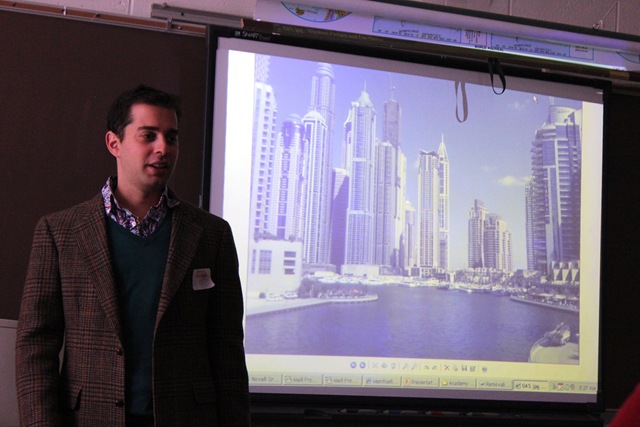 Realizing through questioning that the city did not have a long-term plan, Gorelick has spent the last year helping the city of Dakar develop a long-term comprehensive, strategic plan.
“The project chosen was a the construction of a consolidated market place,” said Gorelick. “The vendors wanted to be in one place, and the purchasers wanted to be able to go to one place. That was somewhere people would rent specific stalls and be able to pay [rent] to go back into the general fund to pay back the bond that was issued. The Gates Foundation loves it.”
The next steps are writing the prospectus, and proving the city’s credit worthiness to satisfy investors. Gorelick will be working with banks that will help to launch the bond, helping to find purchasers for the bond, and eventually launching the bond at the end of this year. “The goal is by January 2014 we will be building the marketplace and begin paying back the bond by December of 2014,” Gorelick told the students. “I love what I do, I think it’s extremely interesting.”
He then fielded questions about how he gets contacted, told of the customs and cultural differences of countries he’s visited and shared more anecdotes about some strange foods he’s eaten.
Levinson asked the students what characteristics they saw in Gorelick that enable him to do this kind of work. Their answers? Flexibility, knowing another language, initiative, adaptability and communication skills.
Gorelick ended the presentation by telling the students that networking is critical. “Learning how to network is one of the most critical skills you can have. Being able to do a good “elevator” pitch – talking to someone for 20 seconds telling them: this is who I am, this is my idea, this is why this is valuable and being able to get that point across so that they will listen and think ‘this is important, I need to have a longer conversation with this person.’”
The Monticello Academy of Finance has, in the past, offered an Income Tax Assistance program and will do so again this year.










 The Catskill Chronicle
I knew I was missing Jeremy on a local level because he has been so involved in our area in the past. Great to know the details of where and why he has been traveling.
Wonderful report. Best of luck my friend, Jeremy.
My son-in-law just returned from some far off country, and on Sunday, after church as we met for coffee, I asked him if he missed getting his coffee while over there. He laughed and said, “no, Dunkin Doughnuts was right on the corner.”