Review by J. A. Di Bello, photos courtesy of Met Opera Press Department
LOCH SHELDRAKE, NY (December 17, 2012) – While shrouded in the darkness of a crisp December morning, the kitchen radio began its day. “The Conflict in Egypt grows.” It boldly proclaims an ominous message to a not yet fully  awake audience. NPR’s “Morning Edition” reminds listeners that the place of Giuseppe Verdi’s setting for the dramatic spectacle “Aida” is, was and will continue to be an unforgiving battlefield. From the days of the Carthaginians, Phoenicians and Ethiopians to the Allies and Axis Powers, the unquenchable sands of North Africa remain to this day, ready to absorb without shame the blood and spirit of unsuspecting combatants.
It is in the land and time of the Pharaohs that the Metropolitan Opera’s HD production (seen recently at SUNY Sullivan) of Verdi’s tale of love, honor, betrayal and the suffocation of entombed lovers begins. To the careful observer, the production by Sonja Frisell, with a stunning set designed by Gianni Quaranta avoids the pitfall of presentations that rely heavily on the visual elements of drama. The vast stage and mechanics of the Metropolitan Opera House are perfect for spectacular offerings that approach the Circus Maximus category. It is without dispute an attraction that lures many paying members of the audience. It is also fun but should not, please note, detract, overshadow or upstage the artists, i.e. vocalists (actors) and musicians (members of the orchestra). In “Aida” the concept is tested as the exaggeration of spectacle is expected. The principals of Frisell’s production will not be upstaged by horses, donkeys and flying monuments dedicated to the gods of ancient Egypt. Their individual artistic talents and collective impact are a sign or artistic strength, training and a thorough understanding of Giuseppe Verdi’s intentions. If there is any upstaging to be done it’s to be found in what one might call “A Duel in the Desert ” the contest between  Liudmyla Monastyrska in the title role and mezzo soprano, Olga Borodina, as her rival Amneris. The emotional and lusty strength of Sonja Frisell’s production is found in the firm fortitude of its women!
Liudmyla Monastyrska (photo right), as Aida is a thoroughly mature and pure vocalist. One needs to look no further than her emotional rendition of “O Patria Mia” in the third act. She’s an exact and sensitive soprano able to generate and hold a vocal discipline while displaying the overpowering passion of her character. This potency is further evident in the tone and purity displayed in the delivery of “In Questa Tomba.” It will convince even the staunchest skeptic of her vocal prowess.
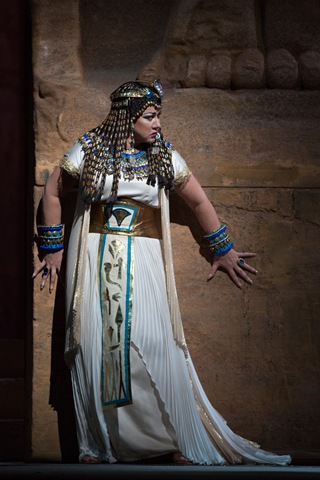 Following closely as contender for attention on the immense stage of the Metropolitan Opera is Amneris, as presented by a distinguished and commanding lyric mezzo soprano, Olga Borodina (photo left). Olga’s ability to deliver the succinct dramatics of Verdi’s opera, results in a credible display of the spoiled, bullying princess with stunning regality! She holds the stage tightly in her grips as she portrays the character as sneering and sarcastic. Truly, she’s a woman scorned! It is here in the third act that Ms. Borodina attempted thievery approaches success. To steal the show from the multi-talented Liudmyla Monastyrska is an accomplishment for which laurels are awarded. But the victor of on-stage competition is irrelevant. It is the combined and complementary vocal talent of an unbridled, passionate Ethiopian slave coupled with the sensuous cravings of an “unspoiled” princess that cause Sonja Frisell’s production to be memorable!
The hypotenuse of this love triangle supports Pythagoras and his theorem. For if Amernis is three  and Aida four, Radames must be five. He binds the fabric of drama into a woven whole. Without him, sine qua non, there’s nothing. As a successful, intelligent and gregarious military officer he is actively pursued my socially conscious women. Radames is competently portrayed by the well-known and respected French tenor Roberto Alagna (photo right), winner of the Pavarotti Competition in Philadelphia in 1988. But poor Radames is no match for either of these lusty women; he remains for them mere male amusement.
  This writer suspects that if Radames were legally tethered to Aida or Amneris, he would re-up and seek immediate deployment.
Outstanding and gifted is Italian conductor, Fabio Luisi, the relatively new Principal Conductor of the Metropolitan Opera in New York City. His accomplishments as a pianist and conductor are numerous and are graciously reflected in the Met’s current production of Aida.
The remaining cast members are effectively placed and complete the necessary elements of drama that create narrative unity. Amonasro, the strapping and callous father of Aida and King of Ethiopia is forcefully brought to the stage by George Gagnidze. The King and Ramfis are appropriately represented by Miklos Sebestyen and Stefan Kocan (photo left) respectively.
The next Live in HD opera is “Les Troyens” by Berlioz on Saturday, January 5, 2013 at 12:00 p.m. Prices are adults: $20.00, children (13 and under): $10.00 and students: $10.00. There is still time to purchase the OPERAtunity Package and get the last six operas of the season for the price of $96.00. For ticket orders, or for more information, contact the SUNY Sullivan Box Office at 845-434-5750, ext. 4472.








 The Catskill Chronicle
Love this review, it made me feel that I was there. Great sentence: “Olga’s ability to deliver the succinct dramatics of Verdi’s opera, results in a credible display of the spoiled, bullying princess with stunning regality! ” Keep ’em coming!
Thank you for a so-very-intelligent and beautifully written review. Yes, it is sooooo powerful when directors adhere to the original time-place of a libretto so that you can revel in whatever the music has to offer.without the need to think about some far fetched concept.
Barry Plaxen