Review by Barry Plaxen, Photos by Ken Howard/Metropolitan Opera
LOCH SHELDRAKE, NY (February 15, 2012) – When an opera libretto does not fully engage you, you start to rely totally on the music. On February 11, 2012 at Sullivan County Community College  (SCCC) in Loch Sheldrake, because of its convoluted narrative, that was the case with the six -hour Live from the Met in HD “livecast” of Richard Wagner’s “music-drama” (Wagner’s term), “Gotterdammerung” (“Twilight of the Gods”), the last in his “ring” cycle of four operas.
“Convoluted” not because it is difficult to follow (with the wonderful supertitles all is clear and understandable), but convoluted because it confuses the emotions and jars you as it see-saws between so many forms: realism, fantasy, legend and analogy (between what is happening and how it relates to the Gods who, in this opera, you do not see). It was also easy to follow because the SCCC pre-performance guest speaker, international music critic Donald Mehus, gave out a wonderful reference family-tree-like chart of the characters of the four opera cycle.
You are also not involved emotionally as you listen again and again to the recapping of what happened in the first three operas of the cycle. You get involved in the dramatic sections, uninvolved again with more recap, your concentration moving from head to heart and back to head … 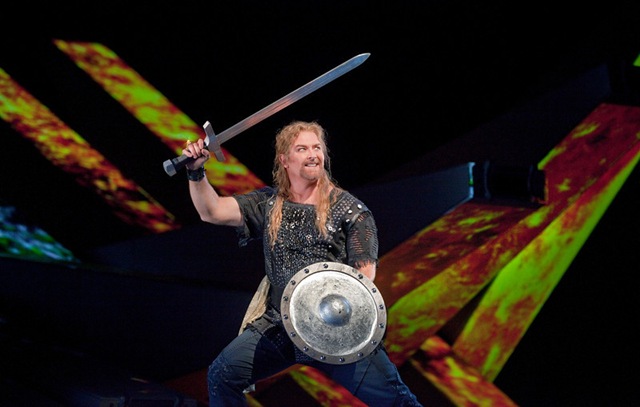 and then, after five hours, as you are finally about to experience what promises to be an emotional and cathartic climax, it distilled by having characters (the Rhinemaidens) tell you what is going to happen in the last three scenes, weakening any dramatic and emotional effects. All the immediacy of an expected emotional conclusion and powerful ending is destroyed.
So, much of the first part of the six-hour presentation – including two intermissions – and sections of the second part are given to those lengthy recaps of what transpired in the first three operas. Not terribly riveting, to be sure, and not at all in-sync with the powerful music. One wonders why Wagner chose certain plot machinations, even though they may have come from the original Icelandic (or Germanic) sagas – those magic potions etc., as they detract from the believability of the drama and make the story a bit too much like a fairy tale, which it truly is not.
Therefore, your attention falls to the music and the singing aspect of the actors, and it is then that you are so fully aware that you are in the presence of greatness … and for six hours!… a handful of the  greatest singers in the world today and, arguably, the greatest opera orchestra (conducted by Fabio Luisi) and opera chorus in the world today. Adding to the awareness of that greatness, is the great fact that you are watching this extreme level of mastery here in your own backyard, so to speak. I, for one, am so grateful for that great gift.
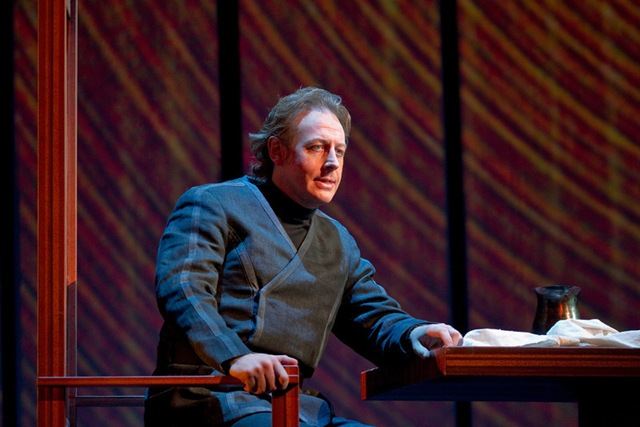
Thank goodness that the actors (in this case, singers?) are superb as they maintain some semblance of drama with their total involvement in their portrayals. Deborah Voigt (Brunhilde) and Jay Hunter Morris (Siegfried) (photo left above) as the “star-crossed” lovers, Hans Peter Konig (Hagen) and Wendy Bryn Harmer (Gutrune) (photo right), and Iain Paterson (Gunther) (photo below left), as the plot-drivers, and in a brief appearance, the magnificent Eric Owens (Alberich) (photo below right with Hagen).
 As mentioned, most of Act I is recap and the use of fantasy detracts from there being any drama in this part of the opera – except for the observing of Hagen’s manipulation of Gunther and Gutrune to get what he wants (the golden ring). But then in the last scene of Act One, another kind of magic happens, theatrical magic, when the great legendary mezzo-soprano Waltraud Meier in the role of Waltraute, one of the Valkyries and sister to Brunhilde, enters and tries to convince Brunhilde to throw the ring into the Rhine because Wotan and all the Gods are miserably unhappy, all because of the ring.
The two sisters have a wonderful exchange of dialogue that is at once human, sisterly, theatrically and skillfully crafted. Voigt is excellent in the scene, but it is Meier (photo below) who magically conveys a myriad of expressions, creating mystery and suspense, and expressing fear, anger, love and wisdom, to name just a few of the uncountable aspects she conveyed as she describes the misery of the Gods and turns to her sister for deliverance and rescue.

This scene was the highlight of the afternoon for me as it was total drama, no melodrama and no plot machinations here, but a skillfully crafted section of a true “music-drama” where all elements of the work are equal, with the powerful music and the powerful drama complementing each other and the powerful performances. And only in this scene does the drama begun in “Die Walkyrie” come across – the conflicting emotions of Wotan and ergo the motivation for the third and fourth operas in the cycle and the final destruction of the Gods, albeit given to us second-hand via Waltraute and Brunhilde.
 For this production, director Robert LePage teamed up with set designer Carl Fillion who conceived a 45-ton machine that consists of a palisade of two dozen fiberglass-covered aluminum planks that tilt to form various stage configurations. They were very obtrusive in the first three operas, but for some reason, they worked in this opera, as did the lighting projections by Etienne Boucher which were highly distracting in the first three operas. Sadly, the projected flames at the end of the opera were inadequate, not at all pyrotechnical either visually or emotionally.
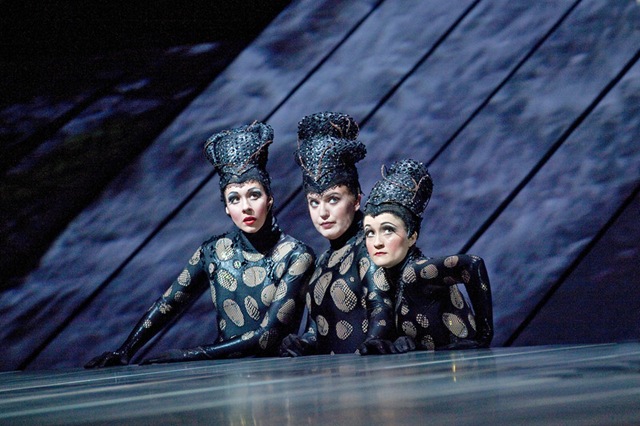 What was designed with great imagination and craft were all the wigs and makeup (no credit given in the program) and most of the costumes by Francois St-Aubin, especially those of the three Rhinemaidens, Erin Morley (Woglinde), Jennifer Johnson Cano (Wellgunde) and Tamara Mumford (Flosshilde) (photo above). Though their re-capping dialogue was not of interest, their singing and their music was highly expressive and very entertaining. This time around they were not hooked up to wires as they were in the first opera, so there was more of an immediacy to their presences without the faked mermaid-like swimming in “Das Rheingold,” so you are comfortable as you watch them cavort in the river and on the protruding rocks.
 The dramatic finale is also diluted because the actual destruction of Valhalla and the Gods is not a scene that takes place on stage with those characters, but is depicted with flames projected on the set and no visible beings or view of the Valhalla that was built for Wotan and the Gods. After seeing the Gods in the earlier operas of the cycle, you do not see them being destroyed “in person.” A major failure in Wagner’s conception.
The program notes state: “In the distance, Valhalla and the gods are seen, surrounded by flames.” NOT!
Unlike the first three operas in the Ring, the melodramatic “Das Rheingold,” the character-driven and highly dramatic “Die Walkyrie,” and the somewhat (to me) ineffective “Siegfried,” “Gotterdamerung” is an emotionally distracting combination of too many dramatic forms. But because of the greatness of the music and performances it did deliver enough to keep in my seat for six hours with no awareness of the lengthy time.
Next up in the Live in HD Series at SUNY Sullivan is Verdi’s "Ernani" on February 25 at 1:00 p.m. For tickets, phone: 845-434-5750, ext. 4472.







 The Catskill Chronicle
Thanks for this, Barry! Spot-on critique of the piece and the production. You’ve gone where few critics dare to tread: candid, cogent, and justified criticism of Wagner’s unwieldy dramaturgy.
All best,
Cori Ellison, NYC Opera Dramaturg
Thank you again, Peggy.
I admit to being somehwat chauvanisitic as I was not capable of seeing what you saw in regard to Brunhilde’s fate. What a great thing to be aware of. And I will try to see that aspect as I view future offierings.
I do always notice it in Puccini operas – but perhaps that is because those libretti are much more realistic and “more better” dramatically.
Barry
Kudos as usual to Barry for an original, cogent review of Gotterdam. Although I found the whole “music-drama” engaging, if taken at all literally the plot is a mess — I have always been turned off with Wagner’s super-mensch gods and heroes, and it is annoying that, as usual, the soprano gets it in the end when she destroys herself on Siegfried’s funeral pyre. Brunnhilde is such a strong female character, too bad Wagner makes her fate dependent on the male characters who manage to destroy their world. But as Barry says, the music is great, and thanks to SCCC for bringing the HD broadcast to us, we were able to appreciate a first-rate theatrical and musical experience.