Review by Barry Plaxen, Photos by Marty Sohl/Metropolitan Opera
LOCH SHELDRAKE, NY (April 19, 2012) – The Live from the Med in HD presentation at Sullivan County Community College in Loch Sheldrake on April 14, 2012 was a surreal production of Giuseppe Verdi’s “La Traviata”.
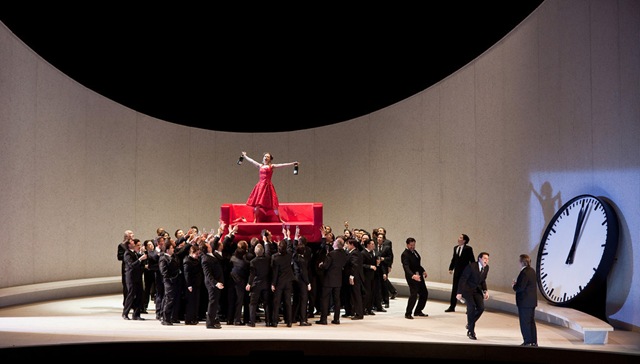 It began with a surreal staging of the celebrated Overture during which you tried so hard to imagine, comprehend or decipher what was going on onstage that the music, celebrated for its purposeful and brilliant setting of a particular mood, had no effect. Deadly Sin # 1.
As the opera itself began with its large chorus on stage, both genders were “surrealy” dressed as men. At the end of their scene, they announced, “Let’s all go dance,” and you then pictured all those men dancing together. Or was it to be men dancing with women in drag? Or perhaps a surreal free-for-all? Anyway, it certainly was not what the dialogue expressed. Deadly Sin # 2.
Conducted by Fabio Luisi – you paid no attention to the orchestra half of the time because you were so busy thinking about the surreal staging, costumes  and props. The simple and direct effects on the emotions that Verdi, a genius, wrote to Francesco Maria Piave’s excellent libretto, based on a play by Alxandre Dumas, were sabotaged. Deadly Sin # 3.
La Traviata was to be the very first modern dress opera of all time, but the opera authorities did not permit it, so it was set in the 18th century. The surreal setting was left with the 18th century dialogue intact so they played against each other. Deadly Sin # 4.
Then the sublime. The two protagonists left alone on the stage to be true to Piave’s realistic libretto without any overbearing surreal conception to interfere and “disagree” with the dialogue. Perfect Music-Drama! Ergo: Emotional Comprehension. What a concept!
Because the surreal setting eradicated Piave’s intended period’s societal ramifications of lover-courtesan-family-etc., the plot and character-behavior had no raisons d’etre. Only the love story worked, thanks to Natalie Dessay as the heroine, Violetta, and Matthew Polenzani as Alfredo, the object of her affections.
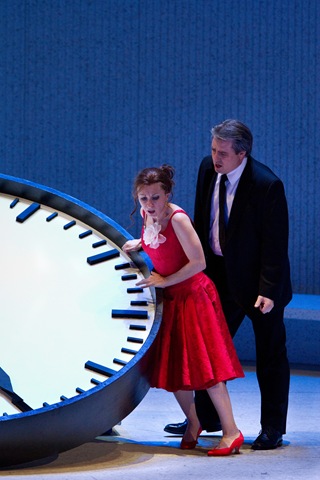 Polezani, a somewhat “wooden” actor in the early acts, but able to convey lots of anger in the final acts, sang beautifully throughout the afternoon with a number of sensitive piano and pianissimo passages.
Dessay was an acting marvel. Though she apologized at an intermission for missing “her high note”, her coloratura runs and scales were clear and easy, but one could hear a bit of stress in the voice at times . Her acting was heartfelt and she worked hard to make the surrealist staging believable. Very hard.
(I meant she worked very hard to make it believable – but then I thought, one could also say it was very hard for it to be believable.)
Alfredo’s father was portrayed by the great Dmitri Hvorostovsky who, demeanored with the slight air of a villain at first, was also hampered by the situation’s surreal non-placement in time, and hence lacked justification for his narrow, moralistic beliefs. He sang gloriously except for some slightly “off” notes at his deepest emotional moments
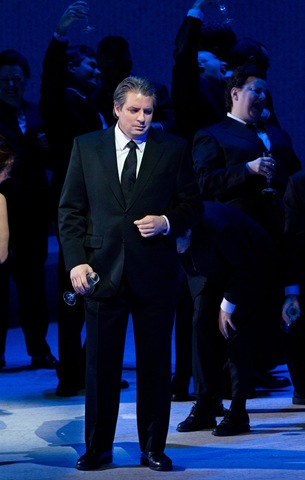 The production was a tour de force for Dessay, affording her every chance of showing off her acting prowess. However, you were not totally comfortable watching her, since she had to work so hard to conjure up some emotion for the surreal staging as it basically either had no meaning or had blaringly obvious meaning. Deadly Sin # 5.
Going back and forth from the ridiculous mass scenes to the sublime performances of the left-alone-on-stage-to-address-the-libretto leading characters was disturbing, to say the least. Deadly Sin # 6.
Reactions to an opera presentation, like everything else, is “horse-racing”, as the saying goes. But I feel it necessary to remark here that, for the first time in my attending this series, audience members expressed their great disappointment in the despoiling of what the opera’s creators intended. Deadly Sin # 7.
BUT – go know! Violetta’s death scene was surrealy staged and, for me, it worked! I am ashamedly still trying to figure out why. Was I getting used to the surrealism? Was it because the scene was without surreal props and costumes? Was it because generally Violetta dying in bed of consumption singing loud and at the top of her vocal range is not believable – and Dessay’s surreal roaming around the stage just prior to her death makes Verdi and Piave’s intent believable? Whatever, I guess it matters not.
The excitement of the Live from the Met in HD Series 2012-2013 has been announced and there will be twelve presentations after a few summer “re-livecasts”. Thanks to SUNY Sullivan for the opportunity to view the great (and non-great) performances in a perfect-sight-line auditorium so close to home.







 The Catskill Chronicle
Ms. Ziavras–
I don’t think the end worked for me for the reason you state above. I think the emotions expressed were truly and deeply felt and ergo overrode the surrealism.
However, I will be mailing you half my paycheck. You covered in your response all the things I did not mention but wanted to.
And you pointed out that not only did the staging not adhere “truthfully” to the words in the libretto – but it did not adhere “truthfully” to the basic elements of “proper” staging based on feelings and emotions.
Please do not contact the editor and offer your expertise. She might fire me..
Barry
Mr. Plaxen – However could I fire you? You are so diligent, so thorough, so intelligent, so reasonable, so … dare I say … easy on the budget. I think I’ll keep you.
Diligent! Thorough! Intelligent! Reasonable! WOW! Thank you Madame Editor. And I thought I was just another pretty face.
Barry
Good move!
Barry does it again! Thoughtful, well-written review of a production that was, I agree, partly sublime, partly a mess.
I loved reading your review. I agree with you on all counts. The staging is what ruined everything for me. The director had Dessay running around in act one, climbing on the couch during Sempre Libera. It made her coughing in that scene (which is in the score) all the more implausible. More importantly, he had all of the characters so far away from each other it was hard to imagine there was any emotional bond between Violetta and Germont. She had to literally run across the entire stage for the intimate moment when she asks him to “embrace me like a daughter” and quickly ran away again. And the hide and seek scene with Alfredo was simply ridiculous.
Do they even read the librettos? How dare they have Dessay needlessly traipsing around the stage while doing vocal acrobatics knowing that it will compromise her voice. Especially since she has had her share of vocal surgeries in recent years. Yes, she can sing while laying upside down, but is it good for her to tax her instrument unduly? Or is she competing with the Delilah who climbed a 30-foot ladder and did a split while singing her aria. I watched with binoculars with horror as Dessay ran around the shards of the broken glass barefoot (even if it was plastic, really!)! Has it come to this?
By the end, I was so hellbent on enjoying the last scene that I made it a point to not let the stage design or the staging ruin it for me. Perhaps that’s what happened to you, too.
We opera singers spend our whole career learning to do the roles to be true to the composers’ intentions, phrasing and stage movement, and making the words in their librettos count. I find it insulting that we have to endure this narcissism in which stage directors and designers jeopardize the singers well-being to be noticed by the critics.