Review by Barry Plaxen, Photos by Ken Howard/Metropolitan Opera
LOCH SHELDRAKE, NY (February 20, 2013) – On February 16, 2013, one of Verdi’s early musical masterworks, “Rigoletto,” was shown at Sullivan County Community College, Live from the Met in HD. With a libretto by Francesco Maria Piave, this 1851 opera, based on the play “Le Roi s’amuse” by 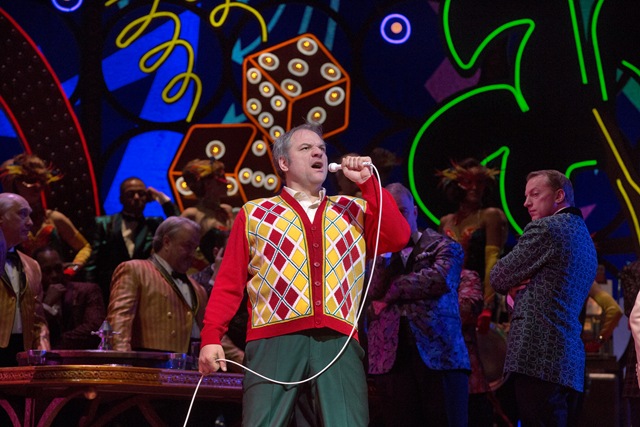 Victor Hugo was originally titled “La Maledizione” (“The Curse”), but Verdi changed it prior to its premiere.
Hugo’s story of “absolute power corrupts absolutely” is told via the unveiling of the destruction of innocence along with the message that those who support corrupt power can also be destroyed by that very same power, as you watch a man whose support of a corrupt and powerful degenerate leads to the destruction of that man’s one valued possession, his daughter.
Director Michael Myer’s relocation of the opera from 16th Century Mantua to 1960s Las Vegas does afford some glitz, spectacular and clever costumes by Susan Hilferty and vividly extreme sets by Christine Jones, both enhanced by Kevin Adams’ sparkling lighting designs. But, though the updating “works” part of the time (and only peripherally), it does absolutely nothing to enhance the opera.
Though the libretto was slightly emended to fit the updating, I was still jarred out of complete identification and emotional involvement when “La Maledizione” was referred to. Curses in 1960s USA would have made most “cursees” laugh, not panic.
Extreme shame over what came across as an of-age young woman losing her virginity in 1960s USA is not cause for murder – or even extreme shame. 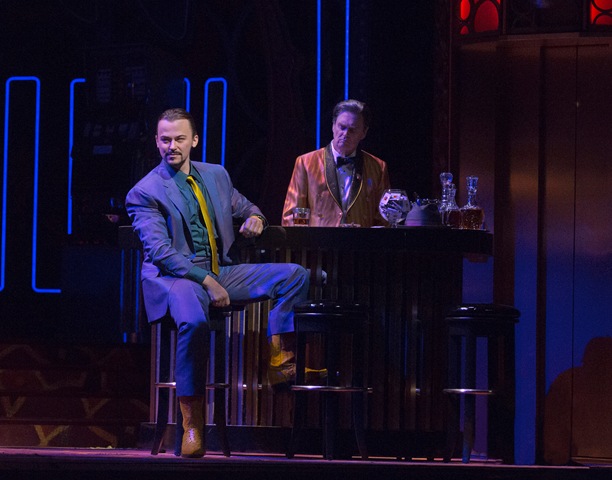 Don’t want to accept it? Perhaps disowning her, or having her leave home – but not the murder and revenge that belongs in the 16th Century.
Musically speaking, Verdi introduced some innovations – such as the opera’s famous quartet in which the four singers sing different melodies, rather than the usual sharing of the same melody – but it is his genius of dramatic musical composition that stands out over everything else, as explained so well in the pre-opera talk by Marge Feuerstein: his creation of the “parlante” style of composition and his dramatically theatrical orchestral scoring.
And musically speaking, the afternoon was 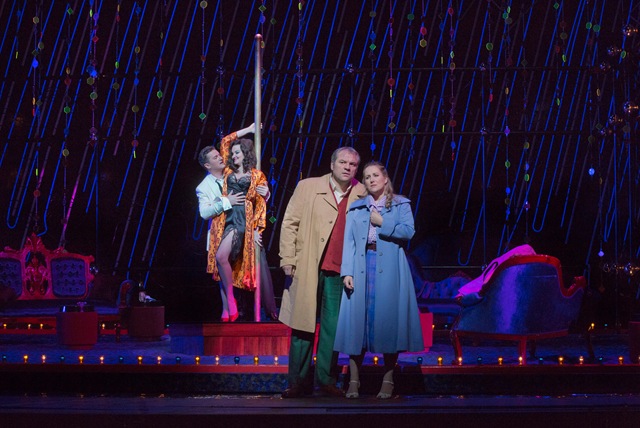 exquisite. Once again, the program does not list the comprimario singers who were all excellent: Monterone – who institutes the curse; Count and Countess Ceprano (yes, Count and Countess in 1960s Las Vegas) whose inclusions in the story later aid in the abduction of Rigoletto’s daughter, Gilda; Gilda’s duenna Giovanna (yes a duenna in 1960s Las Vegas); and various baritone, tenor and bass cohorts of the 1960s Las Vegas Duke.
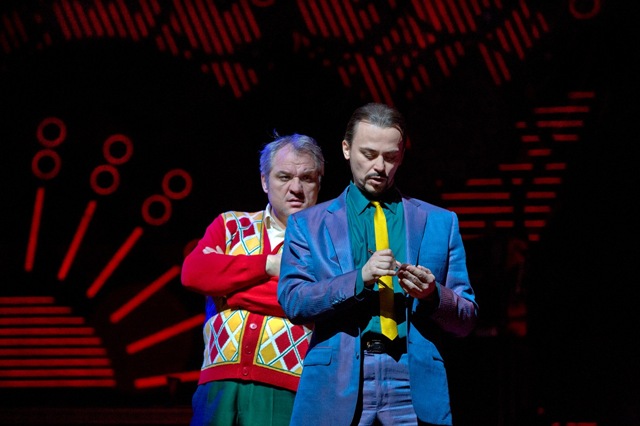
Stealing the show as the assassin Sparafucile, charismatic Štefan Kocan (at left in photo above) did a masterful job of singing and acting. He was aided by an excellent Maddalena (his sister), Oksana Volkova (in orange in photo left).
As the Duke, Piotr Beczala (photo below) happily was quite comfortable with the updating of his characterization and staging. A superb tenor, his voice was thrilling and he performed with all the confidence and excitement necessary for the role and for a star tenor.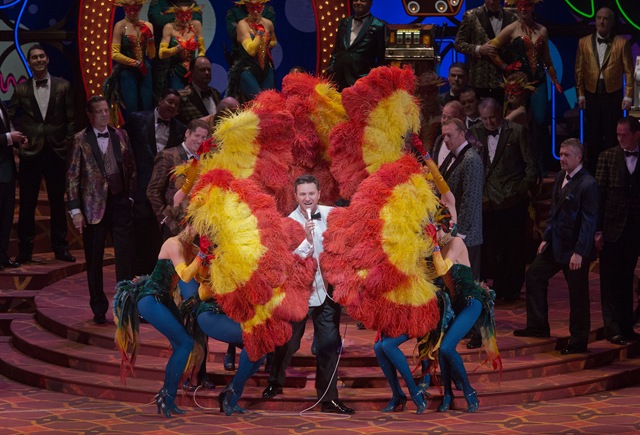
In the title role, Željko Lucic (at left in photo below) tried his best to make the 16th century mores work, but, for me, could not. His singing was superb – though he does not offer a depth in his acting as one would hope for – and what was best, was that he never tired and his most exciting singing was in the last two acts of the opera when his clear and sure voice was most dramatic.
Though Verdi titled the opera “The Curse” and later changed it to “Rigoletto”, from what I saw, a better title would be “Rigoletto and Gilda.” The role of Gilda is not small and
the effects of the curse and the entire plot revolve around both of them. And the entire “message” is given by Gilda who keeps the opera from being an oft-called “tragedy”, in that she dramatically chooses to die for the man she loves, motivated libretto-wise by her expressed desire to know her family and especially her deceased mother.
Yes, Gilda. What can I say? How to convey the magic of Diana Damrau (photo below)? How to explain that is was Damrau who held the opera together, making the overhyped production take a back seat to the emotions and human foibles Verdi and Piave intended to express? 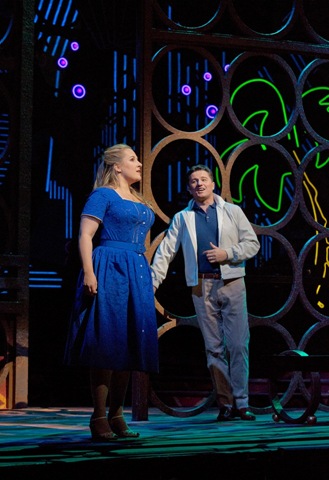 In no way could the updating take away from her magnificent performance. Her acting gave us the best of all possible Gildas, with every action completely motivated whether by her attention to the libretto or the sensing of what was inside her. And “the music.” All through the performance she communicated every possible musical nuance, giving all her runs, her legatos and her coloratura fireworks dramatic value and importance. Never have I witnessed a better “Caro Nome” (the famous aria) in every respect. Her exquisite phrasing was so wonderfully aided and abetted by conductor Michele Mariotti and the superb Met orchestra, that I shall never forget it.
As explained to me, “From what I remember, the 1960s Mafia that controlled Las Vegas would not like a guy like the Duke running around making public chaos, so he would have disappeared like Jimmy Hoffa. If by chance the mob hadn’t got him already, they would not have gone for the kidnapping a nice young daughter of an underling (as opposed to bringing in boatloads of sex slaves from Eastern Europe and the Third World), so they would have hung him very publicly on meat hooks.”
And, unlike the very enthusiastic audience, most of whom did appreciate the relocation of the story to 1960s Las Vegas, for me to align and / or equate the production – the rape, the murders, the corruption – to some of the great entertainers of the period simply because they were sexually promiscuous, is an insult to their memory and to the joy they brought, and still bring, to millions. That is not how I remember them.
Next up in the series is Wagner’s “Parfisal” on March 2 at Noon. For tickets: 845-434-5750. ext. 4472, weekdays 9:00am-4:00pm.







 The Catskill Chronicle
Maladetta.
Foiled again.
F Piave.
Dear Senior Piave,
Now that you invoke the name of my dear friend and Comrade, Constantine Stanislavski (ah those endless white nights in Moscow in the Green Room), I understand better the characters’ motivation. Thank you. But perhaps Rig. didn’t have a hump after all? Recently we have learned that the good king Richard III was unjustly maligned by a hack playwright in the pay of the Tudors. May I ask you who paid your commission? Sincerely, Mme. Friedman
Madama Friedman. My name is Franceso Maria Piave. My paisano Joe Green and I ALWAYS make sure that we include full motivation for people’s behavior in our operas. Even before the days of Freud and Stanislavski. Gilda is figuratively and literally DYING to know her mother – ergo she allows herself to die for her lover. Her papa IS a complete Quasimodo hunchback, which motivates his hate of other people. Without that large hump (or other deformity that is referred to in the libretto), any Las Vegas baritone has no motivation for his loathsome behavior.
Oh Barry, what difference what is in the original libretto? We don’t have those deformitives these days, esp. in Las Vegas. I suppose you would like to go back to the moldy fig story of the Duke ruling an actual kingdom……. with no mics.
Thank you Barry for such an insightful review. Family matters made me miss it. Such beautiful music, but why the transposition? Should we move “Downton Abbey” to 1990s Park Ave? I want the Duke, not a lounge singer.
Forgot to mention the fact that I did not see Rigoletto’s deformity (hump) until the second act – it was so tiny and almost negligible, certainly not enough to motivate his hate of humankind. In the original libretto, he has a large Quasimodo-sized hump, big enough for him to carry a neurotic grudge against others.