Review by Barry Plaxen; Photos: Ken Howard/Metropolitan Opera
 LOCH SHELDRAKE, NY (November 11, 2011) – In 1848 Richard Wagner began writing a libretto entitled “Siegfried’s Death” which dealt with the death of Siegfried, the central heroic figure of the “Nibelungenlied,” a 12th Century poem.
After completing a musical sketch for the proposed opera, he felt that he needed a preliminary opera about the young Siegfried to explain the events in “Siegfried’s Death.” Wagner then decided he needed an opera to tell the story of Siegfried’s conception. And then he subsequently decided he needed a “prelude” that told the story of the original theft of the gold in the Rhine River, which is a ramification in the story of Siegfried’s death.
So he conceived his four opera Ring Cycle “backwards,” but composed it forwards.
The first opera, “Das Rheingold,” is full of action with multiple Gods, multiple unattractive Dwarfs, multiple Slaves and Giants and multiple Mermaids (that comedienne Anna Russell calls “Avian Andrews Sisters”), all involved in an exciting melodrama of greed and power. The second opera, “Die Walkure,” is totally different. It is a powerfully 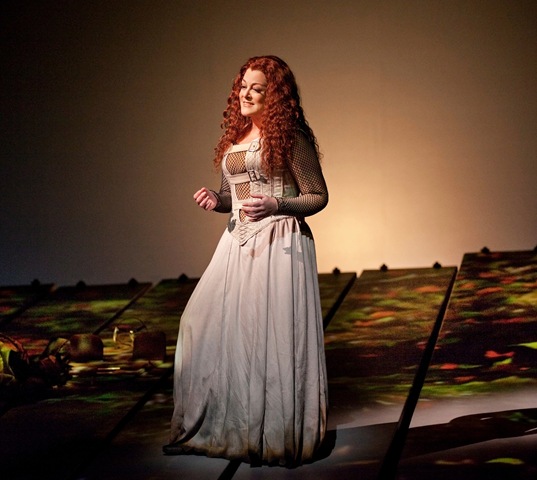 moving, deeply intense drama of control, betrayal, love and sisterhood, with undertones of confusing and contradictory Judeo-Christian concepts and beliefs. The libretto is especially dramatic and “well-written.” Watching these two operas in this particular Metropolitan Opera 2010-2012 series was a wonderful theatrical experience for me, with the opera genre being a perfect mesh of music and drama.
Sadly, that was not so with the third in the series, “Siegfried,” shown as part of the Live from the Met in HD Series at Sullivan County Community College on November 5. Dramatically it lacked much, if not everything, inherent for “good” drama, whatever that might be. Choosing what famed comedienne Anna Russell calls a “regular L’il Abner type” to be the main character does not leave much room for dramatic exposition and depth. His thoughts and expressions are too simple and unimaginative to be of sustained interest. And more-so, with Wagner’s libretto, they are too repetitive and not capable of holding your interest for five hours, which also included verbose explanations of the first two operas that added to the lack of any dramatic movement.
The libretto has none of the melodrama and excitement of “Das Rheingold” and none of the dramatic conflicts that permeate the profound “Die Walkure” libretto. Ergo, “Siegfried” is not, in my mind and to use Wagner’s term, a “music-drama.” It is an opera in which music is the be-all-and-end-all. Regrettably, it is not Wagner at his best musically, but it is Wagner nonetheless, and if you like Wagnerian music, you’ll like “Siegfried.”
 As a musical piece, it was, as expected, performed by some of the world’s greatest singers, three of whom – Bryn Tefel (photo left standing) as The Wanderer (Head God Wotan in disguise), Eric Owens (photo bottom left) as the dwarf Alberich and his dwarf brother Gerhard Siegel (photo left on floor) as Mime, who raised Siegfried from childhood to teenhood – could not be as exciting as they were in the previous operas without subtle dramatic conflicts. Their operatic singing craft was highly evident as was Deborah Voigt’s as Siegfried’s love interest Brunnhilde (second photo on page), Patricia Bardon’s earth goddess Erda and Hans-Peter Konig as the slain dragon, Fafner. Superb singers all. With Wagner’s not-at-his-best music, if you concentrated on their abilities and musicality, you were able to remain in your seat throughout as some viewers did, and enjoy the music very much.
 The tenor originally scheduled to perform the title role became ill. I did not watch the all of the intermission interviews during which all that was explained, so I surmised that it happened during rehearsals. The story of his replacement, Jay Hunter Morris (photo right), could be your typical “rags to riches” or “overnight-sensation” story. “Young American tenor gets big break on Met Stage in leading role as last minute replacement.” The above listed experienced Met singers have nothing on Morris. Not only did he hold his
 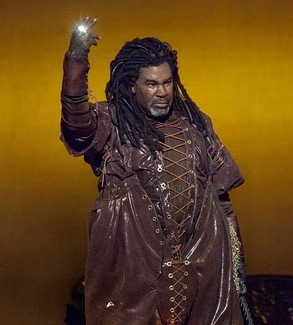 own with them all, so to speak, but he performed with great skill and charisma (though with a bit of obvious watching of conductor, Fabio Lurial.) As Siegfried is often called the most difficult tenor role, and he was outstanding as Siegfried, Morris, will – or has – obviously become a major world-class singer in great demand. His rise to stardom was the most exciting aspect of the afternoon for me.
The Met production was very imaginative – staged by Robert Lepage, costumed by Francois St-Aubin and designed by Carl Fillion. The lighting by Etienne Boucher and video-imaging by Pedro Pires were a bit busy for my taste.
Once again, the Met stupidly and insultingly does not supply the names of singers in comprimario roles, so I cannot give deserved credit to the soprano who sang the role of “the bird” whose song guides Siegfried to his fate.
The next opera in the series is Philip Glass’ “Satyagraha” on November 19 at noon. Call 845-434-5750, ext. 4472 for information.







 The Catskill Chronicle
A great review Barry. I must add that your introductory discussion of the opera was a bright note to the afternoon – thoughtful and provocative. Thanks for the presentation.
Greatly appreciated, Barry. Like Peggy, we’re no longer so sorry we couldn’t make it to the theater. As for the next opera, “Satyagraha,” we saw it at the Met when it was first staged (we’re Glass fanatics) and urge you to bring along some potent pick-me-up coffee beans to chew during the last twenty minutes or so. Great singing…beautiful Glass music…but, wow, what a slooooooow endless ending. Lookin’ forward to your thoughts.
Thanks for the heads-up.
I was not able to write a review of “Nixon in China” as I had no idea what was going on onstage and did not care about the inner thoughts of the protagonists. But I liked the music very much.
So let’s hope if I tune out of the “story” at the end, I can at least bathe in the music.
Thanks Barry. Very interesting review. Now I don’t feel so sorry to have missed it. Peggy