Review by J.A. Di Bello
FORESTBURGH, NY (July 25, 2012) – Revisiting “West Side Story” is an anxious experience for this writer, one to be savored and replayed, comparing it to those that have gone before. The process overflows with memories and is spiked with intoxicating nostalgia. For whatever else this musical represents it 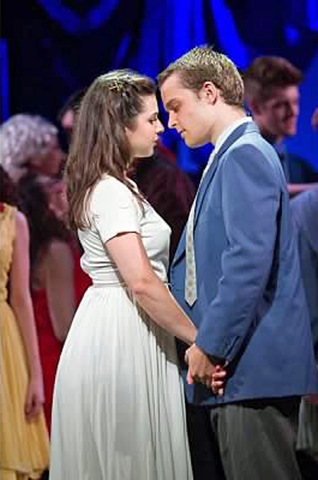 remains a period piece. One that exposes New York City’s West Side kids to the rest the world. It’s the mid-fifties of the last century. The kids are foul, tarnished and trapped, unable to control or even understand the events that magnetically draw them to a fated destiny.
Any anxiety pertaining to the quality of the production that opened at the Forestburgh playhouse on Tuesday evening is gently put to rest. A seductive set is open and in full view. It stands naked, there to be digested by an opening-night, full-house. Ron Nash’s creation is unpretentious, revealing little more than a black silhouette of the city’s skyscape. The contrast is appropriately spattered with the warm pastels of life as it ever so gently foreshadows the events to unfold. Enter the Jets and Sharks. The Jets wearing the bland, ill-fitting, hand-me-downs of the mid-fifties and the Sharks adorned with tarnished splashes of passionate color, reflecting a not-so-hidden Latino sensuality. Costumes, designed by Ashleigh Poteat accurately reflect the neighborhood, the time and a cancerous ethnic divide, soon to fester and explode.
Tony, sensitively portrayed by Michael Schauble, consumes less than thirty seconds of stage time to audibly inform the audience of his vocal warmth, range and superb competencies. He far exceeds any Tonys of recent revivals and can legitimately be placed on a level reminiscent of Larry Kert in the original 1957 “West Side Story.” Tony’s Act I delivery of “Something’s Coming” is literally a foreshadowing that places a yearning audience on notice: What’s about to happen in this diminutive theatre in the forest is perhaps the most vivid, passionate revival of  “West Side Story” to be experienced by this writer!
There are numerous elements actively involved in the presentation of “West Side Story.” It’s the dance that binds the production into a dramatic whole. Without it, there is nothing. Jerome Robbins was the original director and choreographer and his work has been creatively and artistically adjusted by chorographer Maggie Anderson to fit the intimacy of the Playhouse stage. A perfect example is the technically demanding scene “Cool,” Act II. It is exact, challenging and a fine vehicle to demonstrate Andersons skill and artistic management, as the production retains the exciting spirit of Jerome Robbins.
Two complementing actors in this theatrical masterpiece are Michael Starr as Riff and Michael Graceffa as Bernardo. In addition to mastering the essentials of dance, and the physical requirements of the respective roles, each actor is vocally able as he brings to the stage the pertinent, credible character traits of the respective roles, Bernardo with his bluster and swagger and Riff the cocky, territorial agitator.
Of course two other geniuses of the theatre world were at work in the mid-50’s, Leonard Bernstein and lyricist Stephen 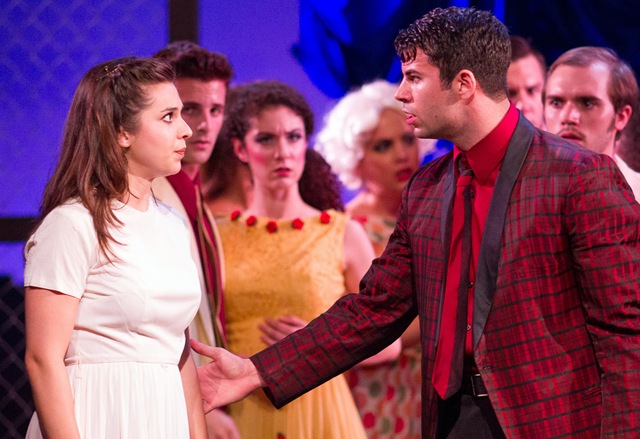 Sondheim. Bernstein’s harsh, shrill and often truculent score is filled with the sensual percussion instruments that dominate the “Dance at the Gym” scene. That musical composition is magically delivered in this production through what must be a miracle of major proportions. Music conductor Ryan Touhey is able to create, with four instrumentalists in the pit, a fluid, dynamic sound that approaches the majestic richness of a full Broadway orchestra, a size that has varied over the years but approximates sixteen to twenty-four instrumentalists. And it is through the artful direction of Touhey that the most beautiful lyrics of the Broadway stage are delivered. Sondheim, a protégé of Oscar Hammerstein became a dominant force in musical theatre and it all began at the Winter Garden with “West Side Story.” Stephen Sondheim then a 27-year-old lyricist who wasn’t even mentioned in the New York Times’ review of “West Side Story.”
There are four grownups on the stage at Forestburgh: Harold Tighe, as Officer Krupke; Norman Duttweiler as Glad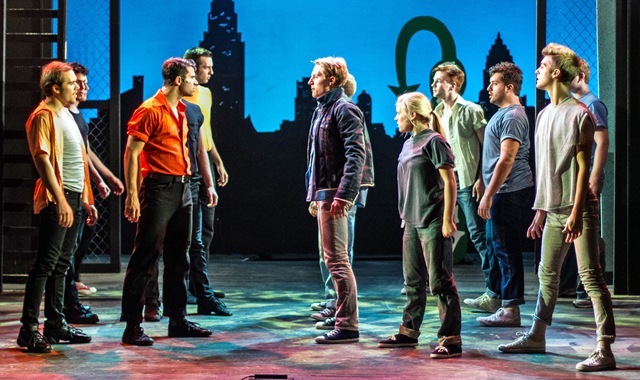 Hand; Steve Davis as Doc; and Kevin Confoy as Shank. These characters have always been stock characters and for the accomplished actors portraying these roles the temptation to expand to something with more depth must be tempting. But the show is about the youth and the explosive adrenalin that lies just below the surface. To develop these characters into anything more than what they are would damage the drama’s cohesion.
This stellar production of “West Side Story” is filled with moments to savor, but one that stands out is the vocal solo by the wanna-be gang member and tom-boy Anybody’s. A rough and tumble character brought to life by a most competent Lauren Chapman. Amidst the turmoil and confusion of “The Street” scene she quietly moves to the warmest spot on stage and sings what seemed like an a cappella version of the heart wrenching, passionate lament “Somewhere.”
A dominant force in a play where the action appears to be controlled by males are the two females, Anita and Maria. The passionate Anita, brilliantly portrayed by Gabriella Perez is in a class all her own. Her ability as an actor and vocalist brings to the stage the anger  as well as the compassion of a hormone fueled Anita, ready to erupt at any moment. Her delivery of the sardonic hymn “America” is priceless and deserves a place in the recorded history of the Forestburgh Playhouse. Maria, the virginal Latina is enthusiastically portrayed by Emily Brown. Her voice is mellow and smooth, filled with a projected passion that longs for satisfaction. Her rendition of “Tonight” in the romantic balcony duet with Tony will remain with the audience for an extended period. Further “I feel Pretty” in the dress shop is even more engaging. She is visibly attractive with an exceptional acting ability to enrich the role she plays. Her expressions on learning of the tragedies appear to border on hysteria, adding needed depth to the character and a tragic reality to the stage. In the final scene under the highway, her anguish is authentic, her pain genuine. Eyes in the audience swelled as sniffles became audible!
As may be gleaned from comments above, this writer was privileged to experience the original production of “West Side Story” at the Winter Garden Theatre, only two weeks after it opened in September of 1957, with Larry Kert and Carol Lawrence. Yes, it was a different time, and the play broke the rules of Broadway, but the passions and anguish of dreams and the loss of loved one will continue to bedevil the emotions. At final curtain the full-house, opening-night audience at Forestburgh awarded the cast with a well-earned, standing ovation. One final confession: Emily Brown has replaced Carol Lawrence as my just-to-dream-about Maria. And about that Place Somewhere: “Hold my hand and I’ll take you there…” – to The Forestburgh Playhouse. The production will continue through August 5. Call the box office 845-794-1194 or visit the Forestburgh Playhouse website by clicking here.








 The Catskill Chronicle
Magnificent review! I second the guy below me – I gotta go and order my tickets!
Somebody needs to get some NYC papes to come see this show!
What a beautful review. it might be the best written review I’ve ever read.
Sharing:
One thing I noted one day back in autmun 1957 (I was at a matinee in the Winter Garden Thatre), was that after each of the three brilliant ballets, you could not applaud to release the emotional impact of the choreography because the dialogue began – so you never expended the tension the dances created and carried your deep involvement into the scene that followed. That was very innovative at the time.
Gotta go. Gotta pick up the phone and order my tickets.
Barry Plaxen